Based on a full review of the channel’s positioning, stated intent, content structure, and disclosures, Mr. Thinker225 is aligned with YouTube’s Edutainment and Content Quality Guidelines and does not fall under mass-produced or “Al slop” content. The channel demonstrates clear human intent, research effort, and educational purpose, which are key factors YouTube considers when assessing content authenticity and monetization eligibility.
Overall Status: Policy-Safe (Edutainment-Focused)
2. Al Usage & YouTube Guidelines Assessment
The channel openly discloses limited Al assistance and provides valid context for its usage, including accessibility needs. Al is used as a supportive tool rather than a replacement for human research or creative intent. Content is topic-driven, research-based, and explanatory, avoiding mass-produced formats or repetitive automation. This approach aligns with YouTube’s requirement for significant human contribution.
Risk Level: Low
3. Content Classification: Al Slop vs Edutainment
The channel’s content qualifies as Edutainment, combining educational explanations with theological, philosophical, and scientific discussion. Videos provide interpretive and contextua value rather than raw or automated output. There is no indication of reused content, automated bulk uploads, or low-effort production.
Verdict: Edutainment (Safe Under Current YouTube Guidelines)
4. Trust, Transparency & Human Presence
A major strength of the channel is transparency. The creator clearly discloses Al usage, emphasizes human research and originality, and demonstrates intent to comply with YouTube guidelines. These trust signals reduce policy risk and improve credibility during manual or monetization reviews.
5. Branding & Positioning Review
The rebranding to “Mr. Thinker225” unifies the creator’s online identity and reinforces the channel’s intellectual, discussion-based positioning. This branding supports authority, credibility, and long-term audience trust, while clearly distancing the channel from Al-driven content farms.
6. Final Professional Verdict
Mr. Thinker225 is a policy-safe, human-led edutainment channel. The channel does not exhibit characteristics of Al slop or low-effort reused content and aligns with YouTube’s quality and authenticity standards.
Hello everyone. I am Brian, I have been studying Theology, religion, mythology, Historical linguistics, Palaeography and philology, (which is The study of ancient languages and their historical texts). This will be me explaining in great details why this concept is a false doctrine!
The image presents a diagram illustrating a non-traditional theological concept or interpretation, suggesting that Cain was the child of Satan and Eve, while Abel and Sethwere children of Adam and Eve.
This view, often referred to as the Serpent Seed Doctrine, is considered an idolatrous or controversial concept by many mainstream Christian denominations. Standard biblical interpretation holds that all three sons—Cain, Abel, and Seth—were the biological children of both Adam and Eve.
What the theory teaches:
The serpent’s seed doctrine is a fringe theological belief that interprets the biblical Fall of Man as a sexual act rather than simple disobedience. It teaches that the “fruit” eaten in the Garden of Eden was actually sexual intercourse between Eve and the serpent (often identified as Satan), resulting in a literal, physical bloodline of evil on Earth.
Core Tenets:
The Sin of Eden: Adherents believe the serpent sexually seduced Eve. This act produced a child, Cain, making him the literal biological son of the devil.
Two Seedlines: The doctrine posits two distinct genetic lineages: the “seed of the serpent” (descendants of Cain) and the “seed of the woman” (descendants of Seth, the son of Adam and Eve).
Predestination: In many versions, these seedlines are spiritually predestined. The serpent’s descendants are considered inherently wicked and irredeemable, while Adam’s descendants are the righteous “elect”.
The Serpent’s Form: Some teachers, like William Branham, taught that the serpent was originally an upright, human-like creature—the “missing link” between apes and humans—before being cursed to crawl on its belly.
Modern Proponents and Variations:
William Branham: A 20th-century Pentecostal minister who popularized the doctrine, viewing it as a “divine revelation”.
Arnold Murray (Shepherd’s Chapel):Taught that Cain’s descendants are a group called “Kenites” who have infiltrated religious and political systems.
Christian Identity Movement: Radical white supremacist groups have used this doctrine to claim that certain races or groups (often Jews or non-white people) are the literal biological offspring of Satan.
Unification Church (Moonies): Teaches a spiritual and physical contamination of the human bloodline through Eve’s “fall” with the archangel Lucifer.
So is this theory true or false?
The serpent seed doctrine is a belief based on poor biblical interpretation and superstition. It is a primary doctrinal resource for those who want to use Scriptures to justify racial prejudice. The serpent seed doctrine is also closely related to other erroneous beliefs such as the Christian Identity Movement and the Kenite doctrine. Like many false beliefs, it has a built-in defense mechanism; that is, anyone who disagrees with it is accused of being a son of the serpent. One of the most unfortunate problems with the serpent seed doctrine is that it so heavily relies on prejudice and warped biblical interpretation that it can be very difficult to discuss rationally.
Simply stated, the serpent seed doctrine teaches that the sin of Eve was not simple disobedience, but sexual contact with the serpent, and that Cain was the son of Eve and the devil. Cain’s descendants are, according to this idea, the sons of Satan, and this includes most any race or group that the serpent-seed believer chooses to dislike. This idea is rooted in superstitious beliefs and is particularly popular with white supremacists and anti-Semites; the Unification Church also supports this idea. Noted false prophets and false teachers such as Arnold Murray of Shepherd’s Chapel and William Branham espoused the idea. Although an idea should not be criticized when it is wrongly applied, it is appropriate to condemn an idea when it logically leads to sin. A philosophy that teaches that some races or people are universally satanic, like the serpent seed doctrine, is one such philosophy.
Those who support serpent-seed ideas cite many passages in the Bible as proof that their idea is correct. Almost without exception, these “proofs” require an interpretation that is totally inappropriate to the context of the passage. For example, Genesis 3:13 is often cited, with the claim that the word translated “beguiled” in the King James Version really meant “seduced.” Context and scholarship would disagree. Proverbs 30:20metaphorically compares eating and sexual immorality; this is greatly overstated by the serpent-seed believer as proof that the Fall was sexual. Another passage is the parable of the tares in Matthew chapter 13. Those who believe in the serpent seed doctrine teach that Jesus’ description of the “children of the devil” in this parable is true in a biological sense. Again, only one who is trying to force this belief into the Bible will see it this way; it is not naturally read out of Scripture.
There are literally dozens of places in the Bible where this false idea has been wedged in, yet every single one requires a person to believe in the serpent-seed idea beforehand. Only by reading a passage and saying, “If you assume that the serpent seed doctrine is true, then this means…” can a person support this false philosophy. For this reason, arguing against the serpent seed doctrine can be difficult. Those who believe it interpret Scripture through a sort of “serpent-seed lens,” and are not likely to accept other interpretations, no matter how well supported by context and scholarship.
There are some basic questions and contradictions inherent to the serpent seed doctrine that can be used to demonstrate its lack of truth. For example, Galatians 3:28 clearly states that race and gender have no impact on our standing with God.
2 Peter 3:9 says that God wants everyone to be saved, not “everyone but the children of Cain.” Nowhere in Scripture is anyone condemned based on being from Cain’s lineage. Never are we warned about such people by the New Testament writers. Also, there is the question of how or why such persons survived the flood. The doctrine supposes that original sin was sexual, but cannot explain why the whole remainder of the Bible lays out a worldview where the original sin was disobedience, not sexuality.
This philosophy is most unfortunate in that it leads directly and logically to two main problems. Racism is by far the worst; believing that certain races are irredeemable and has no positive application. The only possible outcome of such a worldview is prejudice and bigotry. There is also a tendency to dismiss critics of the serpent seed doctrine as being the very “Kenites” the philosophy believes in. Arnold Murray is particularly guilty of this abuse. Fortunately for believers, God has given us a resource in Scripture that can show us the truth. We need only read it with unbiased and open eyes to find true wisdom.
Reasons why this theory is false:
Mainstream biblical scholarship and historical Christian orthodoxy reject the “serpent’s seed” doctrine, which claims Cain was the biological offspring of Eve and the serpent. The following verses are commonly cited to debunk this doctrine:
Genesis 4:1: This verse explicitly states that Adam was the father of Cain: “And Adam knew Eve his wife; and she conceived, and bare Cain, and said, I have gotten a man from the LORD”.
1 John 3:10-12: While proponents use this to claim Cain was “of that wicked one,” traditional interpretation argues this refers to spiritual allegiance and behavior rather than biological lineage.
Acts 17:26: States that God “hath made of one blood all nations of men,” refuting the idea of a separate “serpent seed” race.
Luke 3:38: Traces the lineage of man back to Adam, who is called “the son of God,” with no mention of a dual-lineage origin for humanity.
The Nature of Sin and Salvation:
Romans 5:12-19: Clearly identifies Adam as the one through whom sin entered the world, not through a biological sexual act between Eve and the serpent.
Galatians 3:28: Asserts that “there is neither Jew nor Greek… for ye are all one in Christ Jesus,” which contradicts the doctrine’s claim of a racially or genetically inferior class of people.
2 Peter 3:9: Declares that God is “not willing that any should perish,” opposing the idea that certain individuals are biologically excluded from salvation.
Contextual and Metaphorical Rebuttals that demonstrate why the serpent’s seed doctrine is false!
John 8:44: Jesus tells the Pharisees they are “of your father the devil.” Scholars point out this is a spiritual metaphor for those who follow the devil’s desires, just as those who follow God are called “children of God” (1 John 3:1-2) regardless of their physical ancestry.
Genesis 3:20: Adam calls Eve “the mother of all living,” indicating a unified human origin rather than a split lineage.
1 Timothy 2:14: Explains that “Adam was not deceived, but the woman being deceived was in the transgression,” focusing on the nature of the deception rather than a sexual
The contradictions the Doctrine fails to address:
The serpent’s seed doctrine, which interprets the “fruit” as a metaphor for a sexual act between Eve and the serpent, presents several critical biblical and logical contradictions.
Paternity of Cain (Genesis 4:1): The Bible explicitly names Adam as Cain’s father: “Adam had relations with his wife Eve, and she conceived and gave birth to Cain”. Proponents of the doctrine must argue that the Bible is “hiding a mystery” or that the text is literal only when it suits them.
Unity of the Human Race (Acts 17:26): Scripture states that God “hath made of one blood all nations of men,” directly contradicting the claim that there is a separate “satanic” bloodline among humans.
Origin of Sin (Romans 5:12): The New Testament repeatedly attributes the entry of sin into the world to Adam, not Eve’s alleged sexual encounter. If the sin were sexual, it would be Eve’s sin, yet the Bible identifies Adam as the legal and spiritual head through whom death passed to all.
Why the serpent’s seed Cannot Explain Adam’s Punishment!
The doctrine fails to provide a coherent reason for God’s punishment of Adam for several reasons:
The “Homosexual Act” Absurdity: Since both Eve and Adam ate the same fruit(Genesis 3:6), the sexual interpretation requires that Adam also had sexual intercourse with the serpent (a male/beast). If the fruit meant sex with the serpent for Eve, it must mean the same for Adam.
Disobedience vs. Biology: Mainstream theology holds that the “Tree of Knowledge” was a test of obedience. God punished Adam because he chose to listen to his wiferather than God (Genesis 3:17), which is a moral failure of leadership and trust, not a biological or sexual act.
The Nature of the Fruit: The Bible describes the fruit as “good for food” (Genesis 3:6). If the fruit was a sexual act, this description is nonsensical. Furthermore, Adam and Eve were already commanded to “be fruitful and multiply” (Genesis 1:28); they were already designed for sexual intercourse, so sex itself could not be the sin.
Punishment of the Ground: God punished Adam by cursing the ground (Genesis 3:17-18) so that he would have to toil for food. This fits the crime of eating forbidden food (the fruit) but has no logical connection to a sexual sin.
Theological Failures this Doctrine fails to address:
Redemption for All: The doctrine often implies that certain “seeds” are inherently irredeemable. This contradicts 2 Peter 3:9, which says God is “not willing that any should perish,” and Galatians 3:28, which removes all biological or racial barriers to standing with God.
Misunderstanding Sin: It changes sin from a spiritual condition (rebellion against God) into a genetic inheritance. Biblical conversion is about a spiritual change in allegiance, not a change in physical bloodlines.
So, as you can clearly see, the serpent’s Seed Doctrine is nothing but a false doctrine and shouldn’t be taken seriously in any way, shape or form!
If any further questions, then feel free to let me know!
Image is provided by Picryl, which is a site that includes public domain images
DOCUMENT REQUEST:
Dedicated research on Heinrich Range (1751–1776), a Hessian soldier under Colonel Johann Rall in the Revolutionary War. More specifically this is a hunt to locate any historical documents pertaining to him, or any additional information regarding family and relatives.
INTRODUCTION:
According to accounts, Range was wounded on October 28, 1776 at the Battle of White Plains and died in a skirmish on November 1, 1776, reportedly by a cannonball from Alexander Hamilton’s battery. His death is supposedly mentioned in General William Heath’s Memoirs and later tied by the Author Christopher Rondina to Washington Irving’s Legend of the Headless Horseman legend in the town of Sleepy Hollow.
OUR GOALS OF THE PROJECT:
To verify Range’s existence, service, and death in primary sources.
To track any genealogical links (parents, siblings, etc.).
To explore mentions in secondary works like Peter Lubrecht’s New Jersey Hessians and Christopher Rondina’s Legends of Sleepy Hollow.
To broaden the search in any other sources or societies like JSHA and archival digitized collections.
Ultimately, the main goal is to confirm Heinrich Range’s historical identity, expand genealogical details, and publish findings since almost nothing is available on mainstream genealogy platforms.
Image of the American Revolutionary War is by Picryl.
DOCUMENT CONTEXT:
The American Revolutionary War (1775–1783) was the conflict between Great Britain and its thirteen American colonies, which sought independence after years of disputes over taxation, representation, and self-rule. Fighting began in April 1775 at Lexington and Concord in Massachusetts, and on July 4, 1776, the colonies formally declared independence through the Declaration of Independence.
The war unfolded in several phases: an initial New England campaign with battles such as Bunker Hill and the siege of Boston, a mid-war struggle for the middle colonies where New York and New Jersey became central battlegrounds, and later a southern campaign supported by foreign allies, especially France and Spain.
The conflict reached its climax in 1781 when British General Cornwallis surrendered at Yorktown, leading to the Treaty of Paris in 1783, which officially recognized the independence of the United States.
THE BATTLE OF WHITE PLAINS:
The Battle of White Plains, fought on October 28, 1776, occurred during the middle phase of the war. After suffering defeats at Long Island and the loss of New York City, General George Washington withdrew his army northward to White Plains, New York, in an effort to preserve his forces. British General William Howe advanced against him with columns of British regulars and Hessian auxiliaries.
The main clash took place on Chatterton’s Hill, where American militia and Continental soldiers resisted repeated Hessian assaults. Although the Americans repulsed several attacks, they were eventually outflanked and forced to retreat. The British secured the hill, but Washington’s main army withdrew in good order and remained intact.
While technically a British victory, the battle strengthened American morale. As General William Heath later documented in his memoirs, the Continental Army had faced some of the best British and Hessian troops in open battle and had not been broken, which proved an important step in building confidence for the long war.
“HESSIAN” TROOPS?
Yes, the Hessians were German auxiliary troops hired by Great Britain to fight in the American Revolutionary War. Britain had difficulty recruiting enough soldiers at home, so it made treaties with several German princes (especially the Landgrave of Hesse-Cassel) to supply disciplined troops. These soldiers were paid for by the British government and fought alongside British regulars, but they remained under their own officers.
Colonel Johann Rall was a Hessian officer who commanded a brigade (about 1,200 men) of Hessian troops in 1776. He is most famous for leading the Hessian garrison at Trenton, New Jersey, where on December 26, 1776, George Washington crossed the Delaware River and surprised his troops. Rall was mortally wounded in that battle.
The book is a facsimile of the original. A facsimile (from the Latin fac simile, meaning “make alike”) is a copy of an original document or item that aims to be as accurate as possible, replicating its scale, color, condition, and other material qualities. Facsimiles are created to preserve and make accessible historical items like manuscripts or rare books that would be damaged by handling or are otherwise inaccessible to scholars. They differ from other reproductions by their high degree of faithfulness to the.original.
The book has around 400 printed pages with Major Heath’s memoirs. Being the period of the Battle of White Plains described at:
Printed pages: 59 to 95
PDF pages: 79 to 115
Time reference: Oct 1st,1776 to Dec 31st, 17766
1. Prelude to White Plains (Early October):
Heath describes fortification work near Williams’s Bridge and defensive measures at Frog’s Neck, including ordering Col. Hand’s riflemen to guard the causeway and be ready to burn the tide-mill if needed. The British navy moved up the Hudson and East Rivers; American galleys and Bushnell’s submarine “Turtle” were involved, but unsuccessfully. Washington’s divisions constantly reconnoitered ground to prepare for battle. Misidentification led to American artillery accidentally firing on Washington’s own pleasure-boat, killing three men.
2. British Landing at Frog’s Neck (Oct 12–16):
On Oct 12, 80–90 British boats landed troops at Frog’s Neck. Hand’s riflemen removed bridge planks and resisted effectively, aided by Prescott’s and Graham’s regiments. British encamped on Frog’s Neck; a prolonged skirmishing followed across marshes. By Oct 18, the British shifted position to Pell’s Neck, where a sharp clash ensued with Shepard’s, Read’s, Baldwin’s, and Glover’s regiments.
Americans lost ~30–40 men; Col. Shepard was badly wounded. This maneuver forced Washington to abandon the Kingsbridge position and move the army towards White Plains.
3. March to White Plains (Oct 21–22):
Heath’s division marched overnight, arriving at Chatterton’s Hill early Oct 22. Lord Stirling’s troops attacked Maj. Robert Rogers’s Loyalist corps at Mamaroneck, capturing 36 prisoners. The American army formed a defensive line near the White Plains courthouse; Heath’s division was on the left, securing key high ground.
4. The Battle of White Plains (Oct 28):
British advanced in two columns, supported by artillery. Main attack fell on Chatterton’s Hill, defended by American militia and Continentals. Despite stubborn resistance, the Americans were eventually outflanked and forced to withdraw in good order. The British took the hill but made no immediate pursuit Heath stresses that American losses were “inconsiderable,” while British casualties were thought to be higher. The British gained an advantageous position, overlooking part of Washington’s line.
5. Aftermath at White Plains (Oct 29–Nov 1):
At printed page 73 you find our passage of interest.
“A shot from the American cannon at this place took off the head of a Hessian artillery-man. They also left one of the artillery horses dead on the field”.
How does this connect to the Headless Horseman and Sleepy Hollow? Well, according to Christopher Rondina, the Hessian soldier who lost his life that day was Heinrich Range. As I could not find the book online, I ended up finding a video of the author presenting the book to an audience. Which I found very interesting. Highly recommend to watch! (historical facts start at ~18:00):
The Author Christopher Rondina Talking at the Library: The Legends of Sleepy Hollow:
Photo is provided from Archeon (which includes several documents from HStAM)!
He first appears in records in 1775, the year many Hessian troops were called into service for America. His name is documented in muster rolls/rank lists i.e. administrative lists of soldiers. We can also clearly see that He belonged to Regiment Rall, part of the Grenadier Battalion vonRall, the very unit present at White Plains. His rank also indicates that Heinrich was an ordinary soldier and not an officer.
Here is more information (by clicking the archival call number “signature”):
HETRINA stands for Hessische Truppen im Amerikanischen Unabhängigkeitskrieg, (“Hessian Troops in the American War of Independence”), a multi-volume printed register of Hessian soldiers compiled from the original archives at Marburg. Each soldier has a unique entry number (here, 11380) and a page number (228) in Volume III. “Proof of printing” simply means: this archival database entry is backed by a scholarly published record in HETRINA, which is widely used by historians as the definitive catalog of Hessian soldiers.
HETRINA was published in print (not fully digitized in open access). Some university libraries in Germany, the U.S., and the U.K. might hold it. The Hessisches Staatsarchiv Marburg hosts an online database version that mirrors the printed HETRINA volumes.
The second record states he was killed in action, November 1776, which align with the White Plains battle in America.
The third record is a duplicate record confirming his death in November 1776, likely from a different archival source or classification (sometimes “killed in action” is logged separately from “died” entries).
This third document confirms his Heinrich’s death, which did indeed occur in November of 1776. Here, the database has him under a general “death” category, without specifying “killed in action.” → This isn’t a contradiction: it’s simply the way this particular list was compiled, it grouped all deceased soldiers, regardless of cause.
In this documented list we get our first reference to Heinrich’s mother. This was unfortunately typical in the Hessian Nachlassakten. The bureaucrats at the time weren’t compiling a genealogical record as they were only settling military pay and distributing estates. In most lists, heirs are described generically: “dessen Mutter” (his mother), “dessen Frau” (his wife), “dessen Schwester” (his sister), etc. Names of heirs only appear in certain receipts (Quittungen) when the heirs or guardians came to collect the money.
Recap on our report so far:
Identity & Service: Heinrich Range was a Hessian grenadier from Melsungen (Hesse-Kassel), listed in the HETRINA Database. Archival references confirmed he was conscripted in 1775 and served in Grenadier Regiment Rall.
Death: He died in November 1776, aligning with the aftermath of the Battle of White Plains. Archival notes classify him as “killed in action.”
Heath’s Memoirs: William Heath records on Nov 01, 1776 that an American cannonball decapitated a Hessian artilleryman — a detail later associated by author Christopher Rondina with Range and the Sleepy Hollow legend
Nachlassakten (estate records) indicated his mother in Melsungen was his heir, though her name was not recorded in summary tables. These were financial documents, not genealogical ones.
The Kirchenbuch Registry:
A Kirchenbuch (literally “church book”) is a parish register maintained by a pastor, containing records of: Taufen (baptisms), Trauungen (marriages), Beerdigungen (burials) and also Konfirmationen (confirmations). They are the core genealogical sources in German research before civil registration (which began in 1874 in Prussia, 1876 in all of Germany). Kirchenbücher often survive back to the 1600s, sometimes even earlier.
They were kept by the Evangelical Lutheran parish pastors after the Reformation. They follow the local population closely, since nearly everyone was baptized, married, and buried in the parish church.
The Kirchenkreis:
A Kirchenkreis is a church district (like a deanery), grouping several Kirchspiele (parishes). Each parish had its own Kirchenbuch. The Kirchenkreis Melsungen covered Melsungen town plus dozens of surrounding villages.
The list provided here in this report are the individual Kirchspiele (village parishes) or affiliated communities within the Melsungen district. Military records often used the district/administrative name, not always the exact village. So when the Hessian soldier (Heinrich’s document) said “born in Melsungen” or “Dessen Mutter in Milsungen”, that can mean two things:
Born in the town of Melsungen itself (Melsungen I or II)
Born in one of the surrounding villages that belonged to the Kirchenkreis – Melsungen, where Melsungen was the administrative and church hub.
In short: Kirchenkreis Melsungen = the umbrella church district, covering Melsungen town and more than 50 villages. To save time, my proposal is to narrow down the scope from more than 50 to 24 communities, based on a “cutoff date” (1753). Communities that have no records prior to 1753 are not shown in the table. Still, the 24 communities left means hundreds of books in the database, because one community has multiple books in the catalog. As the soldier’s record said “Melsungen,” this is the most likely place.
Agriculture in Melsungen:
This Next part will be very beneficial in our research in determining a more historical connection to Heinrich range.
General view, Cassel (i.e, Kassel), Hesse-Nassau, Germany (1890’s)
Although this photograph of Kassel was taken in the 1890s, its timber-framed houses and clustered rooftops evoke the appearance of Hessian towns like Melsungen and Kassel in the mid-18th century, when Heinrich Range grew up and was later mustered for service. Melsungen itself lay on the Fulda River, surrounded by fertile valleys and heavily forested hills.
By the 1750s, Melsungen was a small market town (Marktflecken) of only a few thousand inhabitants, but it was the administrative center of the Amt Melsungen, governing dozens of surrounding villages.
Agriculture: Most families in Melsungen and its villages lived as Kleinbauern (smallholders) or Tagelöhner (day laborers), cultivating rye, oats, barley, and some wheat. Livestock (pigs, goats, cattle) provided manure and food, with pigs fattened in forest pannage. Flax and hemp were key cash crops, used for linen and rope, with women and children processing flax in winter.
Vineyards along the Fulda had mostly declined by the 18th century, while orchards (apples, cherries, plums) grew in importance.
Forestry & Wood Economy:
The surrounding forests were vital. Timber floated down the Fulda to Kassel, feeding construction and charcoal industries. Many peasants supplemented farming with woodcutting, charcoal burning, resin tapping, or hauling timber. The Landgrave of Hesse strictly controlled forest rights: peasants could gather firewood, graze swine (mastrecht), or cut small wood, while large timber sales enriched the state. Forests also supported beekeeping, often in hollowed trees.
Crafts & Secondary Work: Melsungen sustained a modest guild economy: butchers, millers, bakers, tailors, shoemakers, blacksmiths. Mills on the Fulda ground grain for local use and export. Families often mixed farming with craft work or seasonal labor.
Some insights here are: For Heinrich Range, born 1751/52 in Melsungen, this was most likely his world: a mixed farming-forestry economy. As a boy he likely helped in fields and woods—cutting wood, tending animals, spinning flax, carrying produce to market. Military service offered an escape from this narrow rural life, especially for smallholders’ sons with little hope of inheriting land.
In this section, we see that Johann, Catharina, and Anna were children of Morten, and Maria as his widow, lines up exactly with the info from the table/records (The abbreviation “Wwe” means Widow and “hinterl. To” means “hinterlassene Tochter”, “surviving daughter of a deceased father”). As it seem, Morten Range died between 1624 and 1626.
Maria, his widow, married again with another man in 1626. Those (similar to the others) are possible distant connections before Heinrich’s generation. About the 18th century records, Adolph Runge is our best candidate up to know for being Heinrich’s father. Due to the fact of the Melsungen baptism entry in 1751 (lines up with our target year). The name Anna Catharina appears twice and we can see Jacob as well as the possible child’s godparents.
Literal transcription:
“[…] Adolph Runge, B. und […], und Anna Catharina uxor eju, […] Anna Catharina, Jacob Roden […] von Casfell […]”
Explained transcription:
“Around May 1751 (can be seen comparing to the chronological previous entries) Adolph Runge, B. und ??? (Bürger=citizen and labor???), and Anna Catharina uxor eju (his wife, uxor ejus is the latin expression for “his wife”) [geboren??] Anna Catharina, Jacob Roden […] von […].”
So, this proves a connection between Adolph and Anna Catharina as a couple but I have to be fair here. From my understanding, if the word “geboren” is indeed geboren and not another similar abbreviation, the name of the child might be Anna Catharina. On the other hand, from the structure of previous Kirchenbuch we saw usually the father and pate where listed (godparents).
So there are two possible outcomes!
Outcome 1: the name of the child was not listed (it could happen sometimes, I saw similar cases), that would make the 2nd Anna Catharina and Jacob Roden godparents.
Outcome 2: the name of the child is Anna Catharina. Only Jacob Roden would be the godparent.
Recap since our previous report:
Kirchenbücher: focus on church books from Melsungen and surrounding parishes within the Kirchenkreis Melsungen led to 50+ possible communities, 24 were targeted (those with records pre-1753). Priority: Melsungen I and II.
Early 1600s: Several Range/Runge entries (children of Morten Range, widow Maria remarrying, etc.). These are distant, not directly tied to Heinrich.
1751 Melsungen record: Key baptism record mentioning Adolph Runge and wife Anna Catharina. This could be Heinrich’s parents, but interpretation is ambiguous: Either their child was named Anna Catharina, with Jacob Rhode/Roden as godparent. Or the child’s name was missing, with Anna Catharina and Jacob as godparents.
So which interpretation is the correct one? Further investigation is required. (The answer will genuinely surprise you).
Fehmer Genealogy’s transcription:
“Jun(ius) (or Johann) (?) Adolph Runge, citizen and …..?…. spinner (or spanner ?) and Anna Catharina, uxor (wife), cjg (conjuges = married). Godparents: Anna Catharina, Jacob Roden (or Koden), ….?….. von Castell, n. idem (presumably n(atus) idem/ born on the same day (?)).”
Explanation:
In order to get a second opinion from a native german researcher I contacted Herbert & Till Fehmer, they are a father-and-son business specialized in German ancestors.
Their transcription quite much aligns with the previous one and adds some new elements: “Spinner” is indeed an occupation that is best translated as weaver. It is plausible as it fits the textile economy of mid-18th-century Melsungen (linen and wool manufacture). The term “n. idem” means “born the same [day]”, confirming that this line belongs to a baptismal entry.
About the word they read as “Castell”, here is my take:
Hypothesis A – Place name: There is a “Castell” in Franconia (today in Bavaria, near Kitzingen, Lower Franconia), which was a small Grafschaft Castell (County of Castell), ruled by the Counts of Castell. However, Melsungen lies in Hesse-Kassel, quite a distance northwest. While migration wasn’t impossible, von Castell as a place indicator would usually refer to noble or titled people (“von Castell” = “of Castell”), not ordinary godparents.
Hypothesis B – Surname: “Castell” could also simply be a family name. There are known Castell or Kastell families in various parts of Germany, including Hesse. Local variations such as Kastell, Kastel, Casthel, Castelius appear in 17th–18th c. Protestant regions. In that case, the phrase “… Jacob Roden, [someone] von Castell” may read as “Jacob Roden [and] [someone] von Castell”. Two distinct godparents, with the latter having “von Castell” as a surname, not necessarily noble, but perhaps a locative family origin passed down.
Hypothesis C – The spelling issue: Castell vs. Cassel vs. Casfell: In the mid-1700s, Kassel (the capital of Hesse-Kassel) was still commonly spelled in Latin or German as: Cassel (the most common). Casel, Casell, Casfell, Cassell —all variants in local handwriting, depending on the s/ſ (long s) and f confusion.
Sometimes even Cassl. as an abbreviation in cramped parish hands. That confusion happens because: In 18th-century Kurrent handwriting, the long “ſ” (s) and “f” look nearly identical. So “Casfell” could very easily be a paleographic misreading of “Cassel”. Therefore, if the word in the record reads something like Casfell or Casel, it almost certainly refers to the city of Kassel, not Castell.
A second source revelation:
Under the same book, Melsungen II Kirchenbuch 1717-1761, in the Taufen section, I decided to scan neighboring pages (before and after our first entry) to collect more evidence. It turns out I found a second entry for Adolph and Anna Catharina 6 pages later.
In this entry, the full name “Johann Adolph Runge” is clearly visible. It is a Taufen (baptism) record dated two years later, in 1753. Anna Catharina once again appears as his wife, and another name, possibly “Johanna Christina”, can also be discerned. This may represent a sibling of the previously recorded child, further confirming the presence of the Runge family in Melsungen during the 1750s.
However, what remains particularly troubling is the absence of any reference to Heinrich, who was originally the main character of the research. (I’ll explain the reason for this momentarily)!
Note that in the transcriptions, in between the expression “uxor eju/uxor cjg” and the subsequent name “Anna Catharina” (1751 record) or “Johanna Christina” (1753 record) it appears a standard word, part of a formula. As this research lead to, this word seems to be Gevatern.
The German term Gevattern (or it’s archaic or dialectal spelling Gevatern) is an old word meaning godparent or sponsor at a baptism. So this could confirm Anna Catharina’s role together with Jacob Roden as sponsors/godparents of the baptism.
And this could also mean that the name of the child (possibly Heinrich) was not actually listed in the record. In fact this could be common in mid-18th-century Hessian (and wider German) baptismal records written in paragraph form rather than tabular format. Here’s why this happens: Older narrative (“paragraph”) Taufen entries often prioritized the sacramental act and social context rather than the individual identity of the infant.
The focus was on the parents (especially the father’s name, status, and residence) and on the Gevatern (godparents), since they were adults with legal and religious standing in the parish community.
Also note that in this section, A man named Johann Adam Runge and his wife Anna Catharina uxor ejus […] Casfell had a child in 1749. Johann Adam could be a sibling of Johann Adolph Runge. The word Casfell Also appears.
Conclusion Of these records:
The records examined directly from Archion confirm that a man named Johann Adolph Runge and his wife Anna Catharina lived in the Melsungen parish during the early 1750s. Two baptism entries (1751 and 1753) show their continued presence and family activity in the area, with spelling variations such as Runge, Range, and the reference to Casfell (Kassel) according to the local writing style of the time.
A second Runge couple (Johann Adam Runge and Anna Catharina) and a Rhode family appear in the same records, suggesting that these families likely belonged to the same Protestant network in Melsungen and nearby Gensungen.
The available sources I proposed initially have now been fully explored, and this report represents the most reliable reconstruction possible from the surviving evidence which I have been in contact with.
The next step: Heinrich’s background:
In our second report we discussed the agricultural aspect of Heinrich’s life. There was also a brief mention about his religious background. After this recent one, I determined that Heinrich’s parents were most likely of French origins.
After the devastation of the Thirty Years’ War (1618–1648), new farmers and villagers came to Melsungen, Germany, and the surrounding region of Hesse-Kassel from three primary sources: Local refugees who had fled the war, Huguenot refugees from France and. Other nearby German territories. So given that Heinrich’s mother was living in melsungen, and the timing of the baptism records, it’s likely that they had immigrated from a nearby region.
What is interesting in my report are the French Huguenots. A significant number of Protestant French Huguenots fled to Germany to escape religious persecution after the revocation of the Edict of Nantes in 1685. Approximately 4,000 of them settled in Hesse-Kassel, which was an accepting Protestant state. So here’s is probable that Heinrich’s taking could have migrated from France. And if true, this could Broaden the search to even more promising clues. We discussed earlier that Heinrich’s taking was likely into farming.
what’s interesting is that fact that farming didn’t really go into effect until the 1700’s. While some Huguenots were urban craftsmen, many also settled in the countryside and founded new farming villages, helping to repopulate agricultural lands.
What’s also interesting is the circumference of the far away recruitments. The search for available farmland was a constant in the post-war German states, where many areas were left depopulated. Princes often recruited tenant farmers and other settlers who had migrated from France to melsungen; and even as far away as Flanders or Southern Germany. Some German groups, like the Lutherans who were often in conflict with the Calvinist ruling house of Hesse-Kassel during the 17th century, may have emigrated from the region as well as immigrated.
Based on all of the evidence, it’s very plausibly that Heinrich’s family were indeed french protestant Hugoenots who migrated from France to Melsungen, Germany.
A second Revelation:
Going back to the Verzeichnib List, we can clearly see the word “Stadt”. “Stadt Milsungen” literally means “town of Milsungen,” referring to Melsungen, a small Hessian town (Schwalm-Eder-Kreis, Hesse, Germany). Melsungen was part of Landgraf Ludwig IX’s Hessian territories. Soldiers from Melsungen served in the Hessian regiments sent to America during the American Revolutionary War (1776–1783). This register lists men (among them Henrich Range) who died in America while serving, noting property or pay remaining to their heirs.
When the military record was written (around the 1780s–1790s), “Stadt Milsungen” likely means the walled market town (city proper) of Melsungen, as distinct from its surrounding Landgemeinden (rural parishes) and villages under the same Amt or jurisdiction. Melsungen was then a small urban center along the Fulda River in the Landgraviate of Hesse-Cassel (Landgrafschaft Hessen-Kassel). Thus, “Stadt Milsungen” probably referred to the core municipal area.
At that time, Melsungen belonged to the Landgraviate of Hesse-Cassel, a Protestant (Lutheran-Reformed) principality. The ruling family of Hesse-Cassel was strongly Calvinist (Reformed). The majority of the population, however, was Lutheran, especially in smaller towns like Melsungen. A small Catholic minority existed, as well as a Jewish community (hence the single synagogue noted later in Meyers). So when the record says “Stadt Milsungen,” it’s safe to assume the deceased soldiers from there were Protestant, most likely Lutheran, though the territory itself was under a Reformed ruler.
So already this proves my earlier hypothesis that the range was indeed of protestant origins. This is very important because In towns with two Protestant parishes, one was usually the Hauptkirche (main or mother parish) and the other a Filial- or Nebenkirche (subsidiary or chapel). Melsungen I clearly functioned as that Hauptkirche: It has the Pfarrerliste (minister/pastor list) from 1525, meaning the principal clergy were seated there.
It contains confirmations, church discipline (Kirchenbußen), and proclamations of banns — all signs of the central administrative church. Melsungen II, by contrast, behaves in its record set like a dependent preaching station or chapel congregation (e.g., for military or outlying residents). It kept vital records but not the full range of parish duties.
Confirmation was a formal act of instruction and admission to Communion, normally performed by the chief pastor (Pfarrer primarius) of the main town parish. Even if children were baptized in Melsungen II, they would likely attend catechism at the main church and be confirmed in Melsungen I. That’s the most reasonably theory on why we see Baptisms in both I and II (each local pastor could baptize), but Confirmations only in I (centralized rite under one clergy).
Identify possible deaths in Melsungen II. The goal here was to determine if death records might have listed an individual’s age, which would give us an estimated birth year for family individuals. To perform this research, I noticed the book (1762-1774) hadn’t yet been analysed as we had previously focused on the period (1717-1761). So I decided to scan it as a whole.
“Sepulti Milsungen 1768
Joh. Herman, Johann Adam Roden Söhnlein, begraben alt 6 jahr”
Which means…
“Johann Herman, little son of Johann Adam Roden, buried, aged 6 years
Although it’s not a direct match for Jacob Roden, my conclusion is that yes: Beerdigungen (burials) can also be helpful to map individuals! specially their estimated birth year. Here we see Johann Herman, born about (1768-6=1762). This section specifically has an index at the end which seems to list 3 Rode deaths.
While scanning through the Melsungen II Kirchenbuch (1762-1774), this record caught, once again, my attention.
It’s a baptism entry for the year 1772, it reads as following:
“Johann Heinrich, Georg Henrich (R*g*)(Range/Runge?), Musquetier bey dem löbl. V Mirbach Regiment, und Anna Libilla, einer Schrin, Eheleuten alhier Söhnlein ist gebohren d. 12. d. Juny. des Morgens um 10. Uhr, getaufft, d. 18.d.Juny. Gevater solte seyn Joh. Henrich Thomas aus Cassel, in dessen Nahmen der Grenadier Koerner(?) das Kind zur Tauffe hielte”
Which means:
Johann Heinrich, son of Georg Henrich (R*g*)(Range/Runge?), musketeer in the honorable von Mirbach Regiment, and Anna Libilla, his wife, was born on the 12th of June at 10 o’clock in the morning, and baptized on the 18th of the same month. Godfather was to be Johann Henrich Thomas of Kassel, in whose stead the grenadier Koerner(?) held the child at the holy baptism. Could this be… that “Georg” Henrich is our hessian soldier later found in America, and this record is listing a birth of his son in 1772 Melsungen?
In the 18th century, Hessian regiments were named after their commanding colonel, not by a fixed numerical designation (as later armies did). When the colonel changed, the regiment’s name changed too, even though the men, colors, and organization remained the same. Therefore, a possible theory for our case is:
Georg Henrich, son of Johann Adolph, father of Johann Henrich, was originally a Musquetier under von Mirbach, selected into the elite Grenadier Battalion von Rall when the Hessians organized for the American campaign, which later on was renamed to Regiment von d’Angelelli.
So according to this theory, this would be his continuous trajectory:
Melsungen-born soldier → von Mirbach regiment (local garrison) → reassigned to von Rall Grenadiers for American service → death abroad → estate listed in postwar register.
If you note, the 1772 baptism entry mentions Johann Henrich Thomas of Cassel as godfather. Once again, the places seem to be interconnected.
Despite the significant gaps in Kassel’s parish records from 1736 to 1830, the growing body of evidence for the family in Melsungen eventually will allow us to find any possible matches for this family on the earlier branches.
A Third Revelation:
By using both three St Nikomedes Parish Registry and and Range-Familienstammbaum profile from Ancestry. Com, I have successfully tranced the family tree of Heinrich Range to his living descendants.
In this photo from Ancestry you can see the full family tree of Heinrich Range!
Heinrich’s fate:
Here is where the legend begins. According to the Canadian archives there is a registry called [US and Canadia, passenger and immigration index list (1500’s-1900’s)] that lists Heinrich as a crew member that arrived in yew York in 1776 with the colonel Johann Rall. This is a vital piece of information as it not only compliments the memoirs of Major German William Heath, but it also confirms that Heinrich Range arrived with the main British and Hessian forces during the New York Campaign of 1776, who landed on Staten Island in July and then moved to Long Island, landing at Gravesend Bay in August.
Washington Irving’s story is certainly riddled with characters who are inspired by real figures local to Tarrytown. Catriena Ecker Van Tassel’s grave can be found, giving her namesake to Katrina, though Catriena herself was not a fit for the coquettish Katrina. This instead goes to Eleanor Van Tassel, her younger niece. (I’ll come back to this momentarily)!
The Hessian soldier named Heinrich Range was a grenadier who was decapitated by an American cannonball during a skirmish near White Plains on November 1, 1776. This event was even noted in the journal of American General William Heath, who wrote, “A shot from the American cannon at this place took off the head of a Hessian artillery-man”.
The aftermath:
The year after the Battle of White plains Cornelius and Peter Van Tassel were arrested by British and Hessian soldiers, and their farm burned.With their home set ablaze and he husband arrested, Cornelius’ wife Elizabeth Van Tassel was left stranded with their daughter Leah. Seeing this one of the Hessian Jäger’s bravely ran into the burning house to bring a mattress and blankets to keep them from freezing to death in the harsh winter night.
Another of those real people within Irving’s ‘The Legend of Sleepy Hollow’ are the inspirations behind Abraham “Brom Bones” Van Brunt. Brom has not just one, but three historical analogues. The first was Abraham Martling, born around 1742. Abraham was the town blacksmith, and was known himself to ride a large black horse, like Irving’s Brom (Brom is a a common nickname for Abraham or Abram). Abraham also had a son, also named Abraham. Born around 1763, he would also contribute to Brom Bones.
In 1777 around the age of 14 or 15, the younger Abraham Martling helped rally numerous other men to avenge the burning of the Van Tassel’s farms. Abraham and the others commandeered numerous small boats under the cover of darkness, rowed down the Hudson until they reached New York City, and upon encountering little resistance, looted the Tory General Oliver Delancey’s house and then set it ablaze.
The real story behind Washington Irving legend:
They made their way back after their late-night raid, with Martling being noted as carrying a massive pair of fireplace andirons on his back, a testament to the young teens strength, no doubt from helping his father at his occupation. Abraham went on to serve under Colonel Armand during the Revolution, and was at the famous battle of York-town when Lord Cornwallis surrendered.
He later bought a small plot of land from the Van Tassels eventually requesting a pension for his military service, as he was impoverished and stated in his appeal that he was:
“extremely poor; his debts amounted to five pounds; his cash in hand was fifty cents; that his real estate consisted of a few acres of mossy rock; that his dwelling was a hole in the ground ‘With a roof over it”
Abraham died in 1841 around the age of 78. The third inspiration comes from Brom Van Alstyne, who pranking his friend Jesse Merwin cemented himself as part of the legend. Jesse Merwin was a schoolteacher from Kinderhook, New York, and once penned a letter as “Jesse Merwin, the original of Ichabod Crane”, so he at least considered himself part of the inspiration. Merwin was not a physical match for Ichabod, the honor of which supposedly goes to a man Irving called Lockie Longlegs, a Scottish teacher Irving mentioned in a letter to fellow author Sir Walter Scott. Merwin also does not share Ichabod’s name, which was drawn from a Colonel in the U.S. army, who bears little resemblance to the superstitious schoolteacher.
So this leaves us with why Jesse felt he was ‘the original of Ichabod Crane”. In Irving’s story it is heavily implied that the Headless Horseman’s appearance to Ichabod was in fact a prank played by Brom Bones. Merwin was similarly pranked, which become part of the local Kinderhook lore. Merwin had been courting a girl named Jane Van Dyke for years, and would not commit to marriage. His friends finally took matters into their own hands and Brom Van Alstyne donned ghostly attire to scare his friend. Shortly after leaving Van Dyke’s home one night Brom accosted his friend Jesse as a ghostly specter wrapped in dark robes, chasing him with terrifying and booming laughter.Merwin seems to have taken the hint, and married Jane, and subsequently had 11 children. In the end, a blacksmith, a veteran, and a prankster all helped contribute to the character of Abraham ‘Brom Bones’ Van Brunt, just as two schoolteachers and a Colonel helped build Ichabod Crane.
Conclusion:
welt, this concludes the end of our journey on the Identity of the real life soldier who inspired the legend of the headless horseman. I truly hope everyone had as much fun reading this as I did researching it.
Hello everyone. I am Mr. Thinker225 and this is my Disney Theory! For several years I have pondered on how to create an official universe for the Disney animated films; yet no matter how I looked at it, it seemed almost impossible but then I discovered a Theory about Disney called the Disney Matrix!
This is what helped me develop the world’s most accurate Disney Cinematic Universe Family Tree.
In this blog, I will cover virtual every aspect, every idea and every piece of media and film every produced. So please sit back and enjoy the ride!
The Disney Matrix:
Here is a photo for reference
To summarize, essentially every Disney animated movie exists in the same world, but on different planes. There is the “real world” that includes movies like Meet the Robinsonsor Big hero 6 that largely resemble regular reality. In the real world, these varied animated films have Easter eggs that connect them to their own Film World. The “Film World” is comprised of films that the people in the “Real World” will see.
The Film World is connected by the Disney Matrix that essentially operates like kingdom hearts, with the goal being to make the ideal fairy tale. Going a step further, there’s the “Inner-Film World” that include movies that the fictional characters of the “Film World” would see.
Determining which timeline to use:
Ok, so with this in mind let’s discuss the backstory of this theory first and then will move onto some connections.
The Disney Animated Canon (sometimes known as the Disney animated features canon) is the name given to the series of Disney theatrical animated feature films produced by Walt Disney Animation Studios since 1937.
It’s one of Disney’s four main branches, and one of the four main Disney shared universes, the other three being Pixar (which takes place in the Pixar Universe, a universe often called the Pixar Theory), the Marvel Cinematic Universe and Star Wars (which takes place in an universe called “The Galaxy Far, Far Away” or just “The Galaxy”).
For advertising purposes, the Walt Disney Company began to affix numbers to each of the films in the late 1980s. Through this method, they could proclaim the film to be “Disney’s X full-length animated film”.
When the numbering system was introduced, the group of films included became collectively known as the “Disney Animation Canon.” Many film historians and animation fans refer to them as Disney “classics” or Disney “features”. The numbering system remains today, as recent press releases for such products as the 20th anniversary edition of Oliver & Company, as well as the opening and closing logos and marketing materials for Tangled, and still refer to the film’s number. Some foreign numbering systems of Disney Animated Classics exclude Dinosaurs and The Wild.
However, The Wild was neither produced by Walt Disney Animation Studios nor Disney in that matter, let alone owning the films’ distribution rights. In some countries, Winnie the Pooh does not count as a classic, leaving Wreck-lt Ralph in 51st place. Now a few other things that I think should be worth noting before I start the timeline of the Disney theory is the fact that “the Disney Channel Animated Universe” is apparently something that also exists.
The Disney Channel Animated Universe is the universe that most of the earliest animated Disney Channel Original series resides in, as well as certain shows from One Saturday Morning and ABC Kids. Six series were established through various Crossovers (mostly episodes of Lilo & Stitch: The Series where characters from another show visit Kauai) to exist in the same universe. This shared universe includes crossovers with characters from “Fillmore”, Kim possible, jake long the American dragon, the proud family, and even the kids from recess.
See also the Disney Channel Live-Action Universe for the live-action shows’ equivalent and to Not be confused with the DC Comics Animated Universe. The Disney Channel Live-Action Universe, The block featured animated series, shorts such as Marvel Mash-Up, as well as behind-the-scenes looks at the Marvel Cinematic Universe. The block’s shows exist within their own self-contained universe/canon continuity (which may or may not be part of the Disney Channel Live-Action Universe, since Ultimate Spider-Man crossed over with Jessie in one episode, and not to mention that “Spiderman into the spider-Verse” is also a thing in the Marvel cinematic universe.
I think it is entirely possible that this grand theory was created through the thoughts of imagination. This is best explained by the mascot of the “Imagination!” pavilion at the Epcot theme park at Walt Disney World Resort; also known as Figment, whom is a small purple dragon. (but that might be just over thinking it)! Now the reason I being up the figment the purple dragon is because of a lesser known theory called the Tommy Westphall Universe hypothesis.
The Tommy Westphall Universe begins with three major pillars of crossover-prone television, each crafted by either Tom Fontana or Dick Wolf, TV producers and close friends. Their long-running series St. Elsewhere, Homicide: Life on the Streets, and the Law & Order franchise regularly featured character cameos from each other in more than a dozen appearances from 1995 onward.
But why is it called the “Tommy Westphall Hypothesis” and not, say “The St. Elsewhere Hypothesis?” TWU became internet fodder because it has the sort of absurd punchline that is irresistible to nerds.
In the final scene of St. Elsewhere, it is implied that the entirety of the show never happened. The events of the six-year medical drama were merely an elaborate fantasy played out in the mind of minor character Tommy Westphall, inspired by a snow globe with a model of the title hospital inside it.
And if everything on St. Elsewhere happened inside Tommy Westphall’s head, you could suggest that, by logical extension, every show that crossed over with St.
Elsewhere is also inside Tommy’s head; And every show that crossed over with those shows.
So hear is the big question, is the Marvel Cinematic Universe apart of the TWU? And if you thought the introduction was a headache then just wait until I start taking about the actual Disney cinematic timeline, because it gets even deeper.
Also apparently the wold newton universe is a thing? Very similar to the once upon a time TV show.
Disney universe D23:
After much deliberation I have determine that our main timeline will be called Universe D23. This idea came to me after watching Disney’s Fantasia and Fantasia 2,000! So chronologically, Fantasia would be the very first thing to occur in this Grand universe.
So what exactly makes the Disneyverser different from ours? Well, magic. No seriously! It’s magic. Weather this is with talking animals, ghosts or just straight up wizards; but where exactly did this magic come from? It came from stars; weather it’s a wishing star, shooting star or magic from the sun; for whatever reason stars are inherently magical in the Disney universe.
This magic can be demonstrated in various Disney films, such as in the Cornelius song in Disney’s Wish. After the big bang sequence, we have our first chronological series of events which happens through the the ride of spring symphony in Disney’s Fantasia which shows us the formation of the earth and the development of life leading up to the age of dinosaurs.
The Rite of Spring:
Now, in order to explain who created these forms shown in the Pastoral symphony it’s indicated that Gods were at play. In this universe, they are the ones who manifested something out of nothing in their kingdom above the universe and they continue to play a part in the lives of the living.
We see this through Zeus bringing down a storm of thunder bolts on the party on earth. As they create life throughout the universe through the rite of spring organisms came out of the termoil and transformed into giant beasts who ruled the planet and ecosystems and life began to flourish. This brings us to the next Disney film, Dinosaurs.
Disney’s Dinosaurs:
Disney’s Dinosaurs is a story follows an Iguanadon named Aladar after a deadly meteor strikes the earth. This is a story that happens about 65 million years ago.
In this film, Aladar is raised by a family of lemurs. Their world is then turned upside-down however, when meteors strike, turning their green world into a desert wasteland. Not much can really be said for this film.
The Nutcracker Suite:
The reign of the dinosaurs was not endless though. They continued to thrive until storms and natural disasters wiped the planets life almost all away; Leaving a world to be reborn. This is when magic truly begins to take a stance in the Disney universe.
With almost no life remaining in the nutcracker suite, we see pixies and magical dancing flowers begining to take control of the lands. Life then reinstates itself with magic integrated into it’s existence lending all creatures to be more intelligent than the dinosaurs.
The Pastoral Symphony:
As life begins to reinstate itself, and with magic following through out the world, we start to see that mythological creatures like centaurs and unicorns roam the world. What we would consider as fairy tale beings would have been prevalent in this reality; and then some of these creatures transformed or evolved into more recognizable animal forms of our world such as alligators, hippos and ostriches.
These animals are all happy and dancing around in the “Dance of hour” symphony. Because of the column buildings, this leads me to believe that the magical world transformed into the animals we are more familiar with.
In this world, animal become self aware and able to understand speech.
Fantasia 2000:
After the earth is reinstated with life once again, the magic takes it’s course in the form of the northern lights and spread magic all over the earth.
At some point in time, around Circa 120,000 BC, This magic effected most of life, even the aquatic life on earth. This was such a bizarre occurrence that humpback whales ended up migrating to the pine population of the northern hemisphere; but also before the ice age had set in.
The segment Pines of Rome begins with the creation of the icebergs by starlight and Papa Whale is first seen coming out of the surface with a big splash. Then appears Mama Whale and Baby Whale who is the smallest in this segment. As the star flashes, all these whales begin to fly in the air.
Disney’s Atlantis 2 – Milo’s Return:
By around 13,000 year ago, the original Atlantan civilization flourished. This was where every nation on earth originated. Thenashoni, myayan, Aztec, Olmec etc. They all originated with this singular temple.
The ruler of this Grand empire was King Ufanifa Nedekh. He was one of the sons of Urchin, the grandson of Atlas, the Great grandson of Iapetus and the great great grandson of Gaia, (one of the creators of the D23 universe). Ufanifa was also the grandfather of Princess kids, As seen in Disney’s Atlantis: The Lost Empire.
A section of my Disney chart which shows the Atlantan Connection
Note: in 11,000 BC the genie was trapped insider his land and imprisoned for the next 10,000 years.
People at this point in time started to harness some of this magic for themselves. When they did this, they used magic bottles and lamps which helped give rise to even more magical creatures. Some genie for example were created out of the smokeless void, which other beings such as angels and demons arose from.
Unfortunately, genies in this universe was hunted to near extinction for unknown reasons.
Disney’s Brother bear franchise:
Just like we saw in the segment Pines of Rome with the humpback whales from Fantasia 2000, here we have the events of the ice age as presented in Disney’s brother Bear 1 and 2. This takes place sometime around 9,500 BC, give or take!
Brother bear is unique because, just like in Fantasia 2000, the Aurora Borealis also demonstrates it’s usage of magic as it transforms a Neanderthal named Kenai into a bear. These events take place in Prehistoric Alaska where the spirits of the deceased can interact with Humans and animals alike.
This film follows a young man named Kenai as the “spirits” show him “the way of life” on his journey to the great mountain as he learns to grow compassion and forgives after the death of his brother Sita.
Note: another instance of magic in this timeline is with Innoko in brother bear 2 when she showed Nita a flashback vision through her magic campfire. One of the earlier recorded instances of curses as well to be honest!
In part 2, Nita has to travel to Hokani Falls to burn a magical amulet to free her bonds with Kenai; however, they ultimately ended up together regardless.
For reasons I will explain later, I show on my Disney chart how the Indians from Neverland and Pocahontas would also be descendants from this expansion.
Disney’s Atlantis – The Lost Empire:
By the year 7,000 BC, Atlantis sinks due to a cataclysmic event known as the Great Flood, which was initiated by an attempt to harness the power of the Heart of Atlantis as a weapon of war. This accidental discharge caused a massive tidal wave that threatened to destroy the entire island, forcing the Atlanteans to evacuate. Although the city ultimately sank, its inhabitants, with the exception of the king’s brother, were successfully evacuated to underground shelters just in time to escape the rising waters.
Ironically, this is the time frame when the Noah’s ark sequence takes place in Disney Fantasia 2000.
We see Noah and his family and a bunch of animals on the only piece of land that isn’t submerged yet, but does the rest of humanity come back from the whole earth getting flooded event?
(King midas)
Well it my belief that parts of the world did survive. Take Disney’s “A strange world” where a group of people survive on the back of a giant turtle.
In Aladdin 3 we actually see something similar to this with Turtle island. This specific turtle is where King Midas built his city after the great flood.
Here on my chart you can see the relationship between Gaia and King midas
These giant turtles were most likely created by the very same magic that created everything else prior to this!
Another Cool connection between Disney Atlantis and “A strange world” is that a book appears in the film with the Atlantan symbols. This is further proof that “A strange world” is infact apart of the D23 universe. Just like we in Atlantis 2 with that city I mentioned earlier, the surviving humans studied the ancient language as they repopulated the earth.
The age of the Gods:
The family tree of Maui as shown on my Disney chart
After the giant turtles died off, the “Gods” then interviewed and reshaped the world and fix the mess that was left behind by Atlantis.
The first to step up was Te Fiti (AKA, Gaia/mother earth). She raised the land from the ocean and unflooded the planet. The world was still filled with bizarre monsterous creatures, such as Tomatoa who brought chaos to the world. He caused earthquakes and volcanoes that never slept.
Within other pantheons, such as the Greek pantheon, Zeus imprisoned the Titans and other monsterous beasts beneath tartarus to help humanity after their war with the God’s these prisons became small worlds onto themselves like Lalotai in moana and even possibly wonderland in Disney’s Alice and wonderland. Some beings were even trapped in cauldrons, like the Horned King from Disney’s black cauldron film.
Only Gods and creatures that could feasibly coexist were allowed to hang around humans. For example, dragons and mermaids were left off the hook.
Note: according to Polynesian mythological Maui was the 4th Great grandson of Rangi, a Demi God who married Te Fiti.
To make it even more interesting, Moana’s ancestors, and by extension, Moana herself, are descendants of a demigod who was granted status by Te Fiti As well. This connection might explain why the ocean chose her.
A darker theory states that Moana died during her first attempt to sail past the reef and was resurrected as a demigod by the ocean. This would account for her ability to complete the mission and explain the resemblance between her and the fully restored Te Fiti. If true, then in Moana 2 after she dies, her resurrection would make her a full God of the Polynesian Pantheon. How cool is that!
The Great Kings of the past:
The next series of events in the D23 timeline is the Lion king. By the way here’s the list of each film:
Mufasa
The lion king
The lion king 1/2
(Possibly the 6 new adventures)?
The lion king: Timon and puma
The lion Gaurd: Return of the roar
The lion Gaurd tv show
The lion king II: Simba’s Pride
Anyways, as indicated by the dates in Disney’s Hercules, I have placed the lion king around 1,000 BC.
Here on my family tee chart, you can see that I have the family of Mufasa as being the creations of the “Great Spirit” as being represented by the Egyptian God Sekhmet.
It is my belief that this lion headed God created an “Eden” like paradise “known as the pridelands” thousands of years ago.
In the lion king lore, this ray of sunshine represents God to the lions of the pridelands. What’s interesting is that the Aurora also does it’s magic once again in the lion king.
So clearly there is some sort of Heavenly afterlife in this universe. Furthermore, according to lion king lore, the very first “lion king” of the pridelands was created and placed in a garden by the “Geat Spirit”.
What’s intriguing is that there exists an African myth of lions being created in a garden exists among the Shona people of Zimbabwe. The story recounts how lions and other predators came to be after the first woman defied a divine command in a garden-like setting. It’s this is where I grew my inspiration for the religion shown in the lion king films.
The Nemean Lion:
In this next part of the timeline we have Disney’s Hercules, (this also includes Hercules: The Animated Series).
The theory is that scar didn’t actually did from the hyaena attack at the end of the first lion king film. According to Andreas Deja, the lead animator on The Lion King and Hercules, this was the case. He confirms that Hercules did indeed lol scar as the Nemean Lion. You can also clearly see that Hercules is posing with Scar’s pelt, and in Ancient Greek mythology, it was customary to wear the skin of a monster or animal.
Canonically, according to Deja, The Lion King takes place a year before Hercules (although there is actually about three years separating the movies) so if Hercules is wearing the pelt, he’s the one who took down Scar.
So after the Hyaena attack, scar took off, badly wounded until he landed in Greece before making a deal with Hades, the Lord of the dead; thus he was then transformed into the mythological Nemean Lion before meeting his fate with Hercules during the 12 labors.
Note: In Lion King, Zazu exclaims that Scar “would make a very handsome throw rug”. This is later fulfilled in Disney’s Hercules movie.
So apparently according to this credit card from Disney’s Hercules we can therefore determine that the events of Hercules in the year 1,000 BC. (Along with the lion king)!
Appearantly capitalism had jump started in this timeline, Lol! Even in the year 1,000 BC the God’s are still running the show.
The Kingdom of Kumandra:
The Family Tree of Hercules
At some point in time, something happened that drove away the God’s. I have come to believe that this thing was none other than the Druun from Disney’s Raya and the last Dragon.
In the year 800 BC, Dark entities known as Druuns spread all across the earth with the power to turn any creature into solid Stone. Though you might not be able to kill a God, but you sure can trap them inside solid rock.
So why 800 BC? Well according to the story, this happened 500 years before the events of Raya. With iron crossbows and swords in this story, we can therefore estimate that the events of Raya is set around 300 BC.
It was said that magic dragons defeated the Druuns in the fictional Southeast Asian Subcontinent of Kamundra; though they to were also trapped inside stone. 500 years later, in 300 BC, A final Druun was released during the main events of Raya before being defeated by Sisu who was literally the last Dragon. After she defeated the monster, all of three other creatures, dragons and people were unfrozen from their Rocky tombs.
With the Druuns, all defeated, humanity thrives once again, though in Polynesia, they suffered significantly after the Demigod Maui stole the heart of Te Fiti and triggered a slowly approaching wave of darkness that drains life from the islands across the Pacific.
The Dark Ages:
The Family of King Arthur as shown in my chart.
The next set of events in our D23 timeline is Disney’s the Black Cauldron, which takes place in the kingdom of Prydain (Wales) around 550 AD. This is because the helmet that Taran imagines himself wearing resembles a Spangenhelm, which was a real type of helmet that was popular during this century.
This leads us to the next Disney film, The sword and the Stone! This story is set in 500 AD in Medieval England.
In this from, Arthur hangs out with a wizard named Merlin and his Pet owl, Archimedes. Arthur is seen rising to power to become a legendary hero under the Tutorage of the wizard Merlin.
Note: Im also going to set the storyline of the Sorcerer’s Apprentice from Fantasia at this same time period as well. In the sequence we another wizard named Yen Sid who trains a sentient anthropomorphic mouse who desires to learn magic. (We’ll comer back to this later in the timeline)
A few loose ends:
Merlin and Yen Sid are actually friends. In kingdom hearts they are both apart of a wizard council. Infact, according to official Disney lore port forwards by Alena of Avelor, both Merlin and the Good fairies all originally came from the Ever Realm! That’s right, the same realm Alena is from. (I’ll get back to this momentarily)
By the 900’s AD, we officially get to the events of Moana 1 and 2. This story is actually based on real life events known as “the long pause”. This was during a time when the exploration by the Polynesian people had stalled for over 1,000 years and then ended in the 10th century. In our D23 timeline, the story came to an end when moana adventured to Te Fiti which reignited the desire to explore in your people.
The Golden Age:
By 1200 AD, off of the southern coast of Spain we have Disney’s “Wish”. I find this film very intriguing because hope were introduced to even more magical beings such as Fairy Godmothers, Star magic and even magic mirrors. Infact, wish is a direct prequel to Snow White and the Seven Dwarfs.
Note: At the end of the movie, King Magnifico literally turns into THE magic mirror that is owned by the evil queen in Disney’s Snow White and the Seven Dwarfs.
The Family of Aurora on my chart.
By 1300 AD, Disney’s sleeping beauty takes place within the boarders of Medieval France.
In the film we can clearly see that Maleficent is one of the many dark Sorceresses who seems to be taking advantage of the darker side of the Star magic.
Note: Maleficent sold her soul to The Demon Lord Chernabog on bald mountain. It’s obvious that the magic didn’t derive from her but from a master who she calls up high.
The real question is how maleficent became the mistress of all evil! She’s a woman who is In a position of authority and control over the profoundly immoral and wicked, so therefore there are several hints that she too is also obedient to someone greater.
She’s obedient to a force that may be so heinous and cruel that even faires who only do good can’t see a glimmer of hope within. When maleficent speaks of tyranical forces of evil, she does so as if it das a real entity.
The reason it cannot be metaphorical is because even she transforms into the dragon; what she states; she explains where the strength of her magic comes from.
She’s explains that there was once an entity that lived and died within the world and that it wasn’t all powerful or all knowing. Therefore, it’s unlikely that she was the one who ruled over the powers of hell; instead, maleficent transforms into a dragon and unleashes all of the power that she’s physical able to harness. With this in mind, it’s therefore safe to conclude that the realm of hell have maleficent the capability to become a monster. (I’ll cover her connection to the evil queen momentarily).
Alright, our next movie Easter egg comes from Disney’s The hunchback of Notre Dame 1 and 2. In this shot you can clearly see Belle from beauty and the beast reading while walking through the streets of Paris. By why?
Welcome to the 1400’s theory. This is indeed belle, however, how can that be if she hadn’t been born yet? Well the answer lies within the live action remake of beauty and the beast. This is a scene where the beast shows belle a magical book given to him by the enchantress which can literally teleport you to any place and any time in the world and throughout history. This is exactly what I think happened here. Belle simple traveled back in time to experience paris. Perhaps the hunchback was one of her favorite books??
Note: some other events that happened during the 1400’s were:
The emperor’s new groove
The emperor’s new school
And Kronks new groove
In 1457 Disney’s Mulan 1 and 2 take place. Here we see more magic through dragons and ghosts. In this movie Mulan saves china from a bunch of invading huns.
We also know this takes place in the late 1400’s because we see a brief shot of the great wall of china and the imperial palace, which want completed until 1420 AD. In Mulan 2, we see a calendar dated to the year of the fire ox, which only occurs once every 60 years. This would place Mulan in the year 1457.
With this new information we can successfully place the Aladdin franchise here as well.
The first thing that must be made certain is that the characters are definitely Muslim. The sultan even says “Praise Allah” so the faith of Islam has been established. Jasmine also almost loses a hand for stealing. While looking up when such practices might have started, I found that this punishment is listed in the Quran, which was written between 609 and 632 AD. So we can assume that the movie takes place after 632 when the Islamic faith was fully formed.
After the “Whole New World” segment, Aladdin and Jasmine land on the roof of the Forbidden City in China. The building finished being constructed in 1420, meaning the movie cannot take place any sooner.
During the song “A Whole New World”, Aladdin and Jasmine fly from Agrabah heading to the Great Sphinx of Giza, then to Greece, and finally to the Forbidden City in China. The merchant at the beginning of the movie mentions “This side of the River Jordan” which runs through modern day Israel, but doesn’t specify which side of the River he’s talking about.
According to Disney Wiki, Agrabah was based on Bagdad as well as the Abassid Calliphate (750 – 1258) and Medieval Persia (633-1219). While technically both continued past these points, these are when these powers were at their height. Interestingly, by 1420, Persia had been invaded and conquered by the mongols in 1219, and the forbidden city was built during the Timurid Empire (1370-1507).
However, the Timurid Empire was not led by a Sultan, but was ruled by an Emir. However, a powerful kingdom that was ruled by both Sultans and Grand Viziers was the Ottoman Empire (1299-1922) On a side note, in the Aladdin television series, Aladdin’s enemy, Mozenrath, is the leader of the Mamluk people. The mamluk Sultinate ruled Cairo from 1250-1517. Since Mozenrath is a contemporary of Aladdin, this changes the world setting.
With Aladdin’s rival, Mozenrath ruling Cairo, this means that the film cannot take place any earlier than the decline of the Mamluk Sultinate in 1517, and based on the colorations of this map, takes place as early as 1451. However, considering Aladdin and Mozenrath were frequent adversaries, it’s more likely that the movie is set later, closer to 1481, and closer to the eventual downfall of Mozenrath’s sultanate.
Alright, let’s get back to that bizarre crossover between Hercules and Aladdin. Hotter is this even possibly despite living hundreds of years apart? Well, in Aladdin the animated series, in season 2 episode 2 an episode titled “The Sands of Fate” features Aladdin time traveling. This only ones of many episodes though. In yet another episode, He creates 3 timelines trying to save princess jasmine. In yet another episode, The Guardian of the Destiny Stone visits Aladdin to ask for his help.
He tells the story of his life before Genie, when he and his first companions tried to steal the Destiny Stone, which has the power to alter the past. After stealing the stone, his friends disappear into an alternate timeline, and Aladdin’s efforts to save them fail. The Guardian and Aladdin travel to the Destiny Stone and find it shattered, and Aladdin is forced to return to his present.
Also. Apparently marvel’s infinity gauntlet is a thing in this universe for some random reason?!
Anyways, Aladdin travels back to the beginning of when Agrabah was founded. The musical “sand of time” was spilled on the ground and the genie caught some of the magic and trapped it inside of a jar.
This likely explains how the genies past self knew of those modern day referenced or how genie took a vacation to the 21st century before coming back with a novelty goofy hat. (And dont get me started on all of those references in the third film, oof)!
The family of Aladdin on my chart
It’s events like these that make the Hercules crossover possible in the Aladdin movies. Ands the genie isn’t the first one to do this. Merlin the magician was said to have frequently take vacations to the 21st century.
By the way, the Hercules animated series is also a thing that exists! By the way here’s the list:
Aladdin
The Return of Jafar
The king of thieves
Aladdin the animated series.
And finally wrapping up the end of the 1400’s we come right back to the hunchback of Notre Dame 1 and 2. The story of Quasimodo, (in which belle visits) is officially set in 1482. And wouldn’t you know it? We see more star magic when it brings the Gargoyles to life for Quasimodo.
The family of Quasimodo as seen on my chart.
The Renaissance Era:
So here we are! We’ve finally reached Disney’s very first film ever released, Snow White and the seven dwarfs.
Get ready because this one has a lot. Using where the fairytale originated as well as the esthetic look of the era and the use of minecart technology, we can therefore place Snow White in Germany in the 1500’s.
Note: Now getting back to the evil queen, she bore 1 child with King George, Queen Rose Red. Rose married Prince Orson, the brother of Prince Florian. Florian’s father is King Philip IV, a descendant of Princess Aurora. (Philip IV>Philip III>Philip II>Charles V> Philip I (the husband of Aurora) ).
In a comic book titled “Fairest of All: A Tale of the Wicked Queen” we learn that The Evil Queen survived her brutal death.
Note: Chernabog’s black magic had sullied the witch Queen’s own blood, making her unable to bear a successor that would continue her legacy. This called for another deal with the Dark Lord, one where she would take a fragment of her own life force and mix it with the fallen Alpha Being’s own shadowy essence to be able to create children of her own, all this done in exchange for taking years off her lifespan, but the end result would be worth her impending demise.
This is how the evil queen/mother Gothel was born. Also note that The Alpha Beings were the guardians of peace and justice in the old eras of Earth long before Mankind existed. Consisting of 10 abstract concepts of the elements of magic, they served under the mighty Eru Illuvatar. The Alpha Beings also included lesser spirits of aether and nature that usually served under the 10 higher entities as their aides and servants. However, the element of darkness, Chernabog, rebelled against the others and led a following of similar demonic beings in a revolt that destroyed most of the Alpha Beings and took control over the developing Earth. To this day, only a few Alpha Beings still exist out of the original 10, and their power has mostly been degraded to only a fraction of what it once was before.
So here we have confirmed that after the evil queen survived her near death experience she went on to becoming Mother Gothel from Disney’s Tangled.
In a fan theory by the famous YouTube channel “SuperCarlin Brothers” they explain in greater detail how The Evil Queen became Mother Gothel from Disney’s Repunzel. Gothel and the Queen both look similar and have a similar dagger. Mother Gothel and the Evil Queen share a ton of striking similarities, as do the kingdoms in which their movies take place. I believe that both movies take place in Corona, and that Mother Gothel and the Evil Queen are in fact the same person. Evil Queen simply faked her own death at the end of Snow White and the Seven Dwarfs (after all, we never see her body, and she clearly possesses magical powers beyond what is demonstrated in the movie). Aside from the visual similarities between the two characters, there are also several nods to Snow White in Tangled, such as Mother Gothel’s style of dress (a bliaut), and, notably, a poison apple painted on the banister in Rapunzel’s tower.
The family of Snow White on my Tree
So if the evil queen is indeed mother Gothel then Queen Manea is in fact her true mother.
[The theory] Let’s start with the first requirement: establishing the location and time period in which Tangled is set. What do we know about Corona? Well: The palace has onion-dome style spires. -The palace and surrounding village is located on a small island that’s fairly close to the mainland. -Disney has told us it’s intended to be located somewhere in Germany, and that the movie is set during the 1780’s. Even though this doesn’t seem like a ton of information, it’s enough to determine the location of the kingdom. The palace’s architecture tells us it’s somewhere in or near Bavaria, the only region of Germany where onion-dome spires were popular. Thanks to the lack of many large lakes in this region, we’re left with only one feasible possibility: Lindau Island in Lake Constance, located on the Southern border of Germany near Bavaria.
Moving on to the second requirement: establishing the location and time period of Snow White. This one’s pretty easy: thanks to lots of other Disney-obsessed theorists, it’s been determined that the movie took place during the early 1500s, in, you guessed it, Southern Germany.
The third requirement– establishing the age of Mother Gothel– was definitely the most difficult to satisfy. However, research eventually turned up the bliaut, a medieval style of dress that perfectly matches Mother Gothel’s. The bliaut was characterized by its long, drooping sleeves and a belt at the waist, the ends of which trail down to the floor. This style of dress was popular from the 1100s to the 1300s. Disney has told us that Mother Gothel’s dress was specifically designed to evoke her old age compared to the rest of Corona, so it’s safe to say that she was probably born during this period (likely in the early 1300s, for reasons I’ll explain in a bit). Interestingly enough, the Evil Queen also wears a bliaut, even though it’s not period-correct attire for her, either.
Now that we know that initial information, let’s try and figure out the history of the magic flower that sets off the events of Tangled. Although there is no real-world legend of a mystical flower grown from sunlight that bestows youth and good health upon anyone who sings to it, there are plenty of legends regarding immortality, from the fountain of youth to the Philosopher’s Stone. Let’s run with the latter for now.
For those of you who are unfamiliar with the Philosopher’s Stone, it’s a mythical substance that purportedly has some amazing properties: namely, turning lead or other common metals into gold and supplying the Elixir of Life, which restores youth and/or prolongs the life of its drinker (depending on which legend you read).
Although this is not exactly the same as the magical flower from Tangled, it’s pretty close. Both are heavily associated with gold: in the Stone’s case, it supplies the user with endless amounts of it, and in the flower’s case, there’s a ton of gold/yellow imagery associated with it, to the point where it literally turns Rapunzel’s naturally-brown hair golden (which sounds suspiciously similar to the Stone turning base metals into gold). In addition, both essentially grant the user immortality. Both also rely on repeated uses; unlike the legend of the fountain of youth, where one sip grants eternal youth, you need to keep using the stone and the flower if you want to stop yourself from aging. One interesting thing to note regarding the Philosopher’s Stone is its history. According to legend, the secret of the Stone was first discovered by Abraham of Worms, an alchemist who lived in Worms, Germany; a city only 180 miles from Lake Constance (that’d be about a 12-hour journey by horse). Abraham lived from 1362 to 1458. This will be important in the next section, but for now, let’s get back to the flower.
I posit that the flower is simply Disney’s version of the Philosopher’s Stone. For the purposes of this theory, I will treat them as essentially one and the same.
Therefore, the evil queen was born in 1300 and died in 1845.
The Family of Chernabog as seen in my chart
It gets even stranger. Chernabog also had union with Demoness Morana resulting in the creation of 2 daughters. Karna and Zhelya. But that’s not all. In Disney’s tangled series mother gothels mother was Manea, the queen of the dead.
Also in Disney’s descendants, we do have a little Easter egg cameo. A prince of darkness named Cabernet (not related to the daughter of the queen of hearts or the son of cruella de vile) This Cabernet, rose from Chernabog’s Bald Mountain ashes. So In a way he’s technically the only living air and son of Chernabog, whom was created without any sexual unions. He is said to be apart of Uma’s pirate crew. (I’ll cover that later).
[The connection to fantasia] :
The evil queen was a slave to Chernabog as well (I’ll explain later). based on the character from Disney’s Sofia the first, the shape shifting demoness Vor was the first Disney villain by selling her soul to Chernabog and through a magic union they created a Demon called Volland.
Volland married a Greek goddess named Achlys of Freezenberg, she’s the daughter of Zeus and Persephone. Achlys sister was Melinoe. Through Achlys union they created Rumpelstiltskin. Rumpel ended up falling in live with a noblewoman named Camilla. Their son was named Baelfire.
Before I continue let’s address the question. Vor traveled from the ever realm and landed in universe D23. She can freely travel through the disney dimensions as a demon sorceress. Her son Volland stayed in D23 to persue a life. Volland married the daughter of D23’s Zeus, Achlys. He (Volland) ended up being adopted into the D23 Greek family by Zeus as apart of his plan to seduce Persephone. This union led to Rumpelstiltskin’s story of when he (rumpel) approached the millers daughter (Camilla). Through this union (well his deal to take the baby as payment) establishes Rumpelstiltskin as the baby’s father. (This is my take on the characters)
[The family of Zeus]:
In the ever realm, we will refer to this version of Zeus as “Ever-Zeus” and the D23 version as just “Zeus”. And in the wish realm we will refer to that Zeus as “Wish Zeus”. (It gets complicated)! So like I said earlier, Vor traveled from the ever realm and landed in universe D23. She can freely travel through the disney dimensions as a demon sorceress. Her son Volland stayed in D23 to persue a life. Volland married the daughter of D23 Zeus, Achlys. He (Volland) ended up being adopted into the D23 Greek family by Zeus as apart of his plan to seduce Persephone.
This union led to Rumpelstiltskin’s story of when he (rumpel) approached the millers daughter (Camilla). Through this union (well his deal to take the baby as payment) establishes Rumpelstiltskin as the baby’s father. (This is my take on the characters).
In the ever realm, the Greek gods live in a place called Freezenberg. Both universes have a Princess Achlys, daughter of Zeus. We’ll refer to the ever realms version as “Ever-Achlys” and the D23 version as just “Achlys”. (There is no relation to the tv show Once upon a time).
The Hell Theory:
As seen on my chart
Voland is portrayed as a demon and he also has a connection to the EverRealm and the Spirit world. The demon court isn’t Hell in the Christian sense so much as a different plane of existence. Your soul could end up there, but you’d have to have made a deal with one of the demons. It wouldn’t be an automatic thing.
The Spirit Realm is that the different lands have their own afterlifes attached to them.
Basically, what you think is going to happen to you is what happens when you die, as The Spirit Realm is influenced by the culture of the Physical Realms.
You can travel to different afterlife realms across the Spirit Realm if you know how.
That being said, the way I have it, Chernabog is an older force than the Greek Gods as well, a cthonic type diety that came into being at the beginning of the universe more or less. He’s not just a god of darkness and evil, the way Hades is the Greek god of death, who just happened to be evil– he is Darkness and Evil. His influence is across all the lands and realms, he isn’t bound to one area like many of the other gods and spirits, whose powers are linked to their cultures/lands. Thats what makes him such a dangerous adversary. Chernabog, Vor and Voland are the Evil Royal Family basically
Then the Demon Court consists of :
• Lord Dickon -Pride
• Zhan Tiri- Envy
• Arawn- Wrath
• Koschei- Lust
• Orcus -Greed
• Coppelius/The Coachman-Gluttony
• Mara-Sloth
Of course a few of these get bumped off over the years, and each time Rumplstilstkin tries to get into an open seat. He’s incredibly upset that he as the grandson of Chernabog isn’t awarded the honor of a demon lord.
The Early Modern Period:
The family of Pocahontas as seen on my chart
The events of Pocahontas takes place in Virginia in 1607. When Pocahontas sinus about love she demonstrates the long term effects of star magic on nature in this Grand universe with elemental forces like the wind and trees literally being alive.
Pocahontas 2 is set roughly 2 years later when she visits England, meets King James IV/I and Queen Anne and then gets married to John Rolfe.
The Disney Pirates:
This is a big section so please bare with me as much as possible. This will cover “the Haunted Mansion/New Orleans/Jack Sparrow” theory.
Jack Sparrow from the pirates of the Caribbean franchise was born in the year 1700 on a ship during a hurricane storm. His father was Captain Edward Teague and his mother is Mary. He had previous relationship with Anne Bon and Angelica Teach. His best friends are Captain Hector Barbossa, Mr. Gibbs and Calypso, the Sea Goddess.
First, Calypso was a daughter of the Greek God Atlas.
The POTC has more connections to the Disney animated canon than you might think. For example, Blackbeard’s sword was made by King Triton in atlantica. The trident of Poseidon is seen in POTC dead men tell no tales. Both canons feature mermaids. And the best proof; they both feature Captain James Hook! The family of Captain Hook as seen on my chart.
Between 1700 and 1728 is the timeline of Disney’s book series, the adventures of young jack sparrow. Jack Sparrow is born in 1690 to Edward Teague and an unknown female aboard a pirate ship in the middle of a hurricane. In the year 1699, Don Rafael (a friend of Capitan hook) brings his granddaughter Esmeralda to Shipwreck Cove, where she meets Jack Sparrow. The year 1700 is considered The Golden Age of Piracy begins and almost exactly where the Renaissance ended.
In 1700, treasure island takes place. In 1705, Torrents is captured by Davy Jones, and strikes a bargain with him, vowing to bring Jones the Sword of Cortés in exchange for his freedom. Jones marks Torrents’ body with the sign of Quetzalcoatl, found on the Sword’s scabbard. This angers the heathen gods, who curse Torrents with storms that follow him constantly
In 1706, Young Jack Sparrow begins his quest for the Sword of Cortés, assembling his first crew at Salty Cove. He discovers the City of the Dead, steals the eye of Stone-Eyed Sam and defeats Torrents. Jack Sparrow is then granted an audience with the mermaids at Isla Sirena, and negotiates the lives of his crew in exchange for his freedom. Jack Sparrow later locates Isla Fortuna and the Sword of Cortés. Left-Foot Louis is defeated by the Sword, and the spirit of Hernán Cortés is released by Sparrow. Jack later releases the spirit of Montezuma to defeat Cortés.
In 1707, The unification of England and Scotland creates the Kingdom of Great Britain. In 1708, The Spanish Royal Navy pirate hunter Armando Salazar attempts to destroy piracy in the Caribbean. Jack Sparrow tricks him into sailing into the Devil’s Triangle where his ship sinks with the entire crew. The dark forces within the Triangle resurrect the Spaniards as vengeful ghosts.
In 1710, The Rogue pirates destroy the ship of another pirate, Captain Hector Barbossa. The Pirate Lords at Shipwreck Cove decide to take action against the Rogues. Jack Sparrow is reunited with Esmeralda Maria Consuela Anna de Sevilla. Davy Jones identifies the Russian Pirate Lord Boris Palachnik as the leader of the rogues. Jack Sparrow unknowingly helps the rogues escape from Shipwreck Island. Sparrow escapes from the rogues with the help of Robert Greene. Sparrow and Greene abandon the pirate life and join the East India Trading Company.
In 1712, Christophe-Julien de Rapièr kills Don Rafael. Esmeralda Maria Consuela Anna de Sevilla becomes the new Pirate Lord of the Caribbean Sea.
In 1715, East India Trading Company employee Jack Sparrow saves the ship he’s serving on from falling into the hands of the pirates. His superior Cutler Beckett promotes him to captain and gives him command of his own merchant ship Wicked Wench. One year later in 1716 Jack Sparrow refuses to transport a cargo of slaves for Cutler Beckett, so he sets them all free. In response, Beckett had Jack branded as a pirate and Jack’s ship, the Wicked Wench, burned and sunk.
Jack makes a deal with Davy Jones to raise the ship from the depths, allowing him twelve years to sail it before he must serve for a century aboard the Flying Dutchman. Jack renames his ship the Black Pearl. Jack Sparrow later becomes the Pirate Lord of the Caribbean Sea.
Around this time another pirate, Jolly Roger, also operated in the Caribbean Sea. According to a tale told by seafaring folk, Jolly Roger was a merciless soul, but the Pirate Brethren Court found a good use for him. Jolly was their henchman, performing unsavory deeds when the Court did not want to soil their hands or reputations. For his service, Jolly knew that one day, he’d be voted onto the prestigious Court, something he wanted more than life itself. Jolly Roger had been friends with Jack Sparrow, though he was always envious of Jack’s uncanny luck. As Jack’s reputation grew, so did Jolly’s resentment. So when Captain Teague left the Court and gave his seat to his son, Jack Sparrow, Jolly vowed revenge, believing himself more deserving of the title of Pirate Lord.
Blackbeard was also believed to be killed during the battle of Ocracoke Inlet, North Carolina. However, he survived the battle and continued acts of piracy, during which time he began to learn of the dark arts.
This is also the year the Mutiny on the La Fleur de la Mort took place. Jack Sparrow, Laura Smith, Mr. Reece and the rest of the crew of the Barnacle sailed off to New Orleans to stop what ever vile plot Left-Foot Louis and Silverback had in store. Upon their arrival, the adventurers were shocked to discover the entire city covered in silver. Realizing supernatural forces were at work, Jack and Fitzwilliam P. Dalton III went off to contact Tia Dalma to get answers. The mystic warned the two about the dangers of the city and that Madame Minuit was the cause of it. This would eventually lead into the battle of new Orleans and make possible connections to the haunted mansion.
Please take note that around 1720 James hook was born. in Jake and the Never Land Pirates it’s revealed that Hook had a rather miserable childhood. As a young buccaneer, he was trained in the ways of a pirate by his mother, Mama Hook, so that he would one day become a feared captain, much like her. However, according to Mama Hook, James was a pitiful pirate during his training and seemed hopeless for many years. It was also revealed that James was heavily ostracized as a child. These factors all seem to play a part in Captain Hook’s cruelty.
In The Pirate Fairy, James mentions that he was educated at Eton College in England, and it is also revealed that he met Smee after losing his original crew and becoming stranded in the middle of the sea, to which Smee comes in and rescues him. Following his meeting with Smee, James came into the possession of the Jolly Roger ship, of which he would command as captain with Mr. Smee as his first mate. With a new crew at his disposal, James would plunder and pillage the seas with pride. He would eventually cross paths with Peter Pan, a young boy from Neverland with the ability to fly. As a “childish prank”, Peter cut off James’ left hand and fed it to an enormous crocodile. James would replace his lost hand with a hook, but the crocodile enjoyed the taste of the captain so well that it followed the Jolly Roger ever since.
Interestingly enough, captain hook not only originally worked for the king before turning to a life of Piracy, but also sailed under blackbeard for a brief time and the only man who happened to be afraid of hook was barbecue, the nickname given to the infamous pirate, long John silver. Henceforth treasure island is in the same timeline.
In the prequel books to the Pirates of the Caribbean films, Captain Hook is brought up by Brethren Court pirate-lords Don Rafael, Mistress Ching and Eduardo Villanueva . They refer to him having been a pirate of the Caribbean who previously was known as James the Mysterious who disappeared off the face of the Earth before returning, having not aged a day. They mention how his new moniker of James Hook given how he lost his hand and replaced it with an iron-hook and developed a fear of children with his anger issues appearing to have become much more subdued.
In 1727, George Augustus was crowned as King of England. In the year 1728, the first pirates of the Caribbean movie takes place. In 1729, the second pirates of the Caribbean movie takes pace. About two months after the events of the second film, the third pirates of the Caribbean film takes pace. By 1750, the 4th pirates film takes place as jack sails for the fountain of youth with Blackbeard.
Fun fact, Blackbeard’s sword, also known as the sword of Triton, was a legendary broadsword. Unique among other swords, this weapon possessed a strengthened, ridged and lightened blade that narrowed down all the way to its broad steel hand-guard, a jeweled hilt. Holding far more power than meets the eye, the Sword of Triton channeled mystical unearthly powers. According to legend, this infamous blade was forged by the sea deity Triton himself in the lost city of Atlantis. One of the three sapphires of Triton was embedded in this sword, granting the sword its power to bring dead matter to life. This power was used on everything associated with ships at sea, including their rigging and sails, and move according to the will of whomever wielded it. Anyone brandishing the sword would rule the ship, controlling the vessel to do his indomitable will. Despite its great power, the sword’s power was diminished away from any ship. Passed from one ancient mariner to another, the Sword of Triton was most notably favored by Blackbeard and Hector Barbossa.
Sometime around 1750, captain hook sailed to never in sought for revenge on Peter pan and ended up not returning to the Caribbean until 200 years later.
By 1751, the 5th, and currently the finally pirates of the Caribbean film takes place. This is were the Undead pirate hunter Armando Salazar escapes from the Devil’s Triangle, and goes after the pirate who caused his death, Jack Sparrow. To stop his old enemy, Sparrow is convinced to help Henry Turner and Carina Smyth to find the Trident of Poseidon.
So there you have it, Captain Hook has a genuine in universe connection between Disney and the POTC. Family of Jack Sparrow as seen on my chart
Our next series of events takes us right back to Disney’s beauty and the Beast. This takes place in france in the late 1700’s. We can be sure thanks to the esthetic look of the era, and cogsworth referencing Rococo architecture, which prominently emerged in the 1730’s.
This also includes the 2 sequels to beauty and the beast.
The family of Belle as seen on my chart
The Tim Burton theory:
First up is Ichabod and Mr toad which retells the story of sleepy hollow. In 1776 during the revaluationary way a German hessian soldier named Heinrich range had his head blown off by one of Alexander Hamilton’s cannonballs. Shortly after, Brom bones tried to scat Ichabod by pretending to be the vigilante spirit of the headless horseman. This is also the earliest in this timeline we get to see the pumpkin King, aka jack skellington.
Also remember that now the POTC series are I’m this universe, we can therefore go ahead and add the events of the haunted mansion; (This will makes sence later in the timeline)!
This theory revolves around the battle of new Orleans with a pirate named Jean Lafitte between the years of 1751 and 1900. just to be clear, there are 3 battles taking place. Jack Sparrows battle which took place in New Orleans, the war of 1812 and Jean Lafitte’ battle of new Orleans which took place 1815.
In New Orleans Square several references to the real-life captain still exist. There is an anchor located in the square which appears beside a plaque reading, “Said to be from a pirate ship commanded by Jean Lafitte in the battle of New Orleans – January 8, 1815 – It is also said that Lafitte’s privateering ships left a wake of blood from the mainland to Barataria Bay – But don’t believe everything you read”. There used to be silver goods and a custom engravings shop in the area called, Laffite’s Silver Shop (although his name is misspelled). On Tom Sawyer’s Island there are two references to the captain; one in the form of an area called Lafitte’s Tavern and the other in the now extinct Fort Wilderness where a display can be seen homaging the final battle of the war of 1812 (which was the battle Lafitte partook in). And most famously, on the Haunted Mansion’s sister attraction, Pirates of the Caribbean the loading zone for the ride is a ramshackle boat landing with a sign referring to it as, “Laffite’s Landing” although they do misspell the captain’s name.
Disneyland Paris’s Pirates of the Caribbean attraction features a portrait of Jean Laffite being held by a villager in the town of Puerto Dorado on the island of Isla Tesoro while it was raided by the pirates of the Wicked Wench. The villager is held captive at an auction where they are to be forced to sell off the portrait to pirates.
Lafitte is considered something of a historic anti-hero in Louisiana and around the Gulf of Mexico, having engaged in smuggling and piracy for a number of years yet – during the Battle of New Orleans in 1815 – helped defend the city from the British with his fleet (in exchange for a pardon). Lafitte is also frequently cited in various expanded lore of the Haunted Mansion, usually with only a tacit affiliation with the house and some of its residents.
According to website Long-Forgotten Haunted Mansion, a mega-theme designed to tie Tom Sawyer’s Island, Pirates of the Caribbean and The Haunted Mansion featured Jean Lafitte as the central figure. The two mentions of Lafitte in the movie and the audiobook were « first steps » to his inclusion, as was the entrance walled crypt which is still to be seen in front of the Mansion, labelled 1764. According to its own inventor, the idea was eventually scrapped, but many other clues that it was once in store can be still found in Disneyland.
According to the spin-off book The Legend of Gracey Manor, set in the continuity of the 2003 movie, it is said that Ambrose Gracey, the merchant captain who built the mansion and Edward Gracey’s grandfather, had a “secret association with pirate Jean Lafitte, and sometimes returned to the docks of New Orleans with more goods than he started with.” In the “Mystery of the Manse” story, William Gracey crossed paths with Jean Lafitte during his time as Captain Blood, and contacts one of Lafitte’s former associates looking for a place to live after escaping the pirate’s life. This contact points him in the direction of what would one day be known as Gracey Manor. Also note that The sea-captain from the storyline is openly cited as being, “-a compatriot to Jean Lafitte himself” by the narrator.
So it seems that the pirates of the Caribbean, Tom sawyer and the haunted mansion are all connected and exist within the same universe.
The island was found in the state of Missouri along the Mississippi and was known to be home to indigenous American peoples, quite possibly of the Lakota peoples. Pirate activity on what would become known as Tom Sawyer Island first occurred at some point likely during the 18th century. The island had a history with a good number of pirates and sailors who had been active during the golden age of piracy, most notably being Captain Jack Sparrow and his companion William Turner who had a blacksmith’s shop on the island. A number of shipwrecks came to be found on the island with their own hulls of treasure and the skeletal corpses of the crew left behind with possible indications of supernatural forces having been to blame such as the mythical Kraken.
In lore, the official name of the island is Jackson Island, named for infamous historic U.S. president Andrew Jackson and was found along the Mississippi river. During the war of 1812 (1812-1815), the island served as a headquarters for the American army which included the likes of Andrew Jackson, Davy Crockett and smuggler/privateer Jean Lafitte.
So this little plot point now introduces Davy Crockett to the timeline.
A number of presumed soldiers and colonists from the 1810s would come to be buried on the island. The island would also come to serve as a home for one Mike Fink, the legendary, “King of Keelboaters” who lived in a cabin on the island’s coast where his keelboat The Gullywhumper made port. Crockett and Fink were known to hold familiarity with one another and Davy supposedly spent time visiting Fink’s cabin.
At some point in time, the island would come to hold a good number of relics from the Golden Age of Piracy. Whether these artifacts came to the island during the 18th century when these golden age pirates would have been active or if they would have been brought to the island by the likes of Jean Lafitte is unknown. This included the likes of a cursed gold hoard protected by undead pirates, a treasure chest once belonging to the infamous Blackbeard, a mass of treasure which disappeared as mortal hands touched it, a lamp containing a piratical genie, Jack Sparrow’s skeleton and an iron chest containing a beating heart.
Much of this loot would be stored in the underground Dead Man’s Grotto in addition to a chained up pirate, cursed with undeath.
In 1835, three boys were documented as using the island as a lair; Tom Sawyer, Huckleberry Finn and Jim Harper (all characters from the works of Mark Twain). The three boys had previously been presumed as dead following their disappearance on the Mississippi river. Among their additions to the island was a treehouse which they used as their personal base and the three also uncovered treasures belonging to the previous inhabitants of the island. The three decided to declare themselves pirates and live apart from the corrupt American society of the time, Tom in-particular took up the alias of, “The Black Avenger of the Spanish Main”. This tells us that the great treasure on the island had at some point belonged to Captain Jack Sparrow.
In the 1990s, there were plans to install a mega-theme which would connect the Haunted Mansion, Pirates of the Caribbean and Tom Sawyer’s Island into an interconnected story-experience. The plan would be to connect the stories of the attractions via historic 19th century pirate Jean Lafitte who was already referenced in New Orleans Square and the Pirates of the Caribbean respectively.
In this plan, Jean Lafitte’s crypt would have been located on the grounds of the Haunted Mansion and connect to subterranean caverns and catacombs which lead to Tom Sawyer’s Island. The underground lair would have been filled with the remains of Laffitte’s victims, a shipwreck, a pirate’s court, the gundeck, and a treasure room.
So a brief recap, These plans were never brought to fruition, however remnants of them do still exist within the Disneyland park. A bricked up archway with the date 1764 remains in New Orleans Square, and following the success of the Pirates of the Caribbean films, Tom Sawyer’s Island would become home to pirate themed experiences. This would include the Lafitte’s Tavern and it would later be elaborated via newspaper clipping on the island that the island once served as Lafitte’s lair.
Another interesting thing to note is that Several of Constance Hatchaway’s mariticidal souvenirs in the Haunted Mansion’s attic are repurposed props from the original incarnation of Tom Sawyer’s Island. Notably, the wardrobe and photographs belonging to American president Andrew Jackson (1767-1845) who appeared in the original Fort Sam Clemens of Tom Sawyer’s Island. The fort sequence closed in 2002, in-part due to (rightfully made) complaints by indigenous-American park-goers as Andrew Jackson was famously genocidal and cruel against Native-Americans with the affects of his presidency still being felt (most notably via the Trail of Tears in the 1830s.
Jackson can still be found in animatronic form in the Hall of Presidents in Walt Disney World’s Liberty Square, the same land which holds that park’s Haunted Mansion.
The gracey manor itself was built in the 1800s, by Captain Ambrose Gracey, the young captain of a merchant clipper ship based in the busy port of New Orleans, after he purchased land and property overlooking the river on the outskirts of the city. Although his profits to build the house came from all his shippings of chandeliers, rugs, European furnishings, wines, lamps, and all manner of luxury goods from Europe and the East Coast cities to the citizens of the sophisticated city of New Orleans., two critical factors became the reasons of his amassed fortune; his ships were free from pirate attacks, allowing him to keep a generous percentage of the value of all goods transported on his ships, and his secret association with pirate Jean Laffite, which made him able to return to the docks of New Orleans with more goods than he started with.
The Gracey Manor is basically a brick manor located in what is believed to be a small town or village nuzzled in the Hudson River Valley of New York State and according to some locals was built on sacred Native-American burial grounds.
During this time a witch who came to the town/village after fleeing prosecution from the Puritans in Salem and would open a shop called Memento Mori. This witch whose name was Leota would come to be very close to the Gracey Family where she was apparently beloved by all and upon her death was buried within the Gracey Family plot.
At some point in time the mansion would become known as “Gastley Mansion”, likely having been owned by a family of the same name but knowledge of them remains unknown. At another unspecified point in time a transatlantic man (who was possibly the manor’s owner or a head-of-staff) commit suicide within the Mansion’s cupola by hanging himself to death and went on to become the estate’s “Ghost Host”.
By 1877, the Mansion came into the ownership of a wealthy man named George Hightower who is believed have been related to New York City hotel-owner, Harrison Hightower III. George married a beautiful woman named Constance Hatchaway who was secretly a gold-digging serial-killer and was only marrying him for his fortune as she planned on murdering him after the wedding; something which she had already done four times prior with four different wealthy men. Constance succeeded in murdering George either with a blow to the skull with her hatchet or by decapitating him with it, and she subsequently inherited ownership of both his wealth and the Haunted Mansion. With her fortune in blood-money, Constance stashed all the evidence and twisted “souvenirs” from her life of crime within the mansion’s attic and went on to live well into her old age. After her own death, she became the Black Widow Bride of the Haunted Mansion.
At another unspecified time in likely either the late-19th century or early-20th century, the mansion was owned by the Dread Family. The family was lead by one Jacob Dread who was a very wealthy man that was killed by his relative Bertie Dread who poisoned him for his fortune. Bertie was shot to death by Jacob’s widow Florence through the use of a flintlock as she wanted vengeance on his killing of her husband. Florence was murdered by two twin-children in the family named Wellington and Forsythia Dread as they suffocated Florence to death within a sack of canary-seed. The twins however were murdered in their sleep by Maude who was either a family-member or the twins’s governess as she hit their skulls with a hammer. To Maude’s dismay however, the matches which she used for hair-pins ignited in her sleep causing her to burn to death.
By the anachronistic-time that the ride takes place, the mansion is occupied by 999 “happy haunts” from all over the world who have come to retire there and the only known mortal resident of the mansion in it’s caretaker, Silas Crump.
In one legend, Construction of the mansion was plagued by accidents causing Iwerks to go mad and become obsessed with completing the estate himself, accidentally sealing himself in a crypt where he died.
Another popular theory about the haunted mansion revolves around the cemetery scene in the princess and the frog which takes place in New Orleans sometime in the 1920s.
The story, set in the 1920’s in New Orleans, follows Tiana, a restaurant and bar server who dreams of owning her own big restaurant near the river, and ends up turned into a frog after accidentally meddling in the evil plot of voodoo sorcerer Doctor Facilier. Along her journey to turn back into a human, she learns a couple of mortal lessons, meets the love of her life and foils the nefarious schemes of Facilier.
The climax of the film takes place in a graveyard of New Orleans where Doctor Facilier has cornered the protagonists. One of the tombstones seen is actually that of Madame Leota. It is thus very likely that the movie actually takes place in the same universe as the Haunted Mansion, and that the graveyard the climax took place in was the familiar Haunted Mansion graveyard.
The film also features a cameo of Jack Skellington from Tim Burton’s “The Nightmare Before Christmas” as one of Doctor Facilier’s “shadow people”. Ironically enough, Jack Skellington also appears in the seasonal Haunted Mansion Holiday overlay for the Haunted Mansion in Disneyland and Haunted Mansion Holiday Nightmare in Tokyo Disneyland.
So now at this point, not only do we have a Disney related connection for the pirates of the Caribbean, the haunted mansion, Tom Sawyer, the battle of new Orleans and Davy Crockett but we now have established a in universe connection to the princess and the frog and the nightmare before Christmas.
The colonial era:
sometime in the 1800’s we have Disney’s melody time and Disney’s American legends which tells the story of Johnny Appleseed.
Alright, now jumping back to Europe, we have Disney’s Tangled and it’s many sequels and spin off’s.
This whole series was kicked off by a bit of that star magic giving healing powers to a flower. A single drop of sunlight fell from the heavens and from this grew a golden flower. This series of events takes place in the late 1830’s to the 1840’s.
Family of Rapunzel as seen in my chart
So by now your probably already familiar with my Evil Queen/Mother Gothel theory! Well now I’m going to present a few other popular theories. Let’s start with Disneys Frozen 1 which takes place in 1843. Both Queen Elsa and Princess Rapunzel are actually cousins. Disney confirmed that they are indeed from the same family.
The family of Queen Elsa as seen on my chart.
In a Disney related comic book about frozen, it details several factors; including King Agnaar visiting his aunt’s house, indicating his relationship with Rapunzel And other similar characteristics and the connections between the two films.
In yet another book titled A Frozen Heart, it mentions Hans having twelve older brothers, including a pair of twins, who were abusive and manipulative towards him.This connection is based on the theory that suggests 2 of the brothers could be the Stabbington brothers from Tangled.
Now, the Stabbington brothers don’t have any canonical names but if they were to be given it, this is what I would go with.
Further evidence of their connection is seen here as Rapunzel and Flynn Rider attend Elsa’s coronation party.
The 1800’s:
The next film on the timeline is Alice in wonderland. We see sliced exploring a strange prison that was created by the God’s at the start of this whole timeline. I have come to believe that this happens during the 1860’s.
[Mini theory]:
Wendy’s mother, Mary is actually the daughter of Alice (1861-1931) from Alice in wonderland, (the cartoon and not the live action). Alice’s sister is Lorina. Michaels daughter was Alice from Alice’s Wonderland Bakery. She is said to be the great granddaughter of the og Alice. Anita is John’s daughter based on her maiden name being Darling in the live action Cruella movie.
I knew I wanted to tie in Lizzie from the Tinkerbell movies somehow, and having her be the younger sister of Wendy’s eventual husband felt like a good fit. Maybe the two girls meet later and bond over their mutual magical experiences and that’s how Wendy meets Edward?!
If so then the father of Lizzie and Edward is Martin Griffiths. With this in mind, this means that Jane is actually the sister of Danny darling. Going back to Anita, she married Rodger Radcliffe from Disney’s animated film 101 dalmatians. Going back to Jane. Maggie, short for Margaret, she had a daughter named angela. made it easy to just tie her into the family tree down to Gwendolyn Carlisle who appears as a Wendy descendant in the Tinkerbell books.
Going back to the OG Alice. She married Reginald. Her parents are Charles (1827-1886) and Helen (1825-1885).
Next is the Petco Spill segment which happens during the 1870’s. Cinderella also takes place in the 1870’s.
Cinderella is a messy timeline because of its sequels and time travel sequence in the third from. Basically it goes as follows:
Cinderella I
Dreams come true
A twist in Time
Cinderella I
A twist in Time (alternate timeline)
Ironically we have the little mermaid franchise at this time as well:
Ariel’s beginning
The animated series
The little mermaid
Return to the sea
A really cool Easter egg is the appearance of Mickey, Donald and Goofy. I personally believe this mickey is from the kingdom hearts series. (You’ll see why later on in this timeline).
Some other connections to the previous films includes the Grand Duke at Ariel’s wedding!
And even a portrait of Princess Aurora in Prince Eric’s castle.
Note: There are several clues that points snow white in this direction:
Snow White’s royal claim as a descendant of Aurora is mostly through Philip’s lineage.
A portrait in Prince Eric’s dining room that resembles Prince Phillip and Princess Aurora.
Since Prince Eric is believed to be a descendant of Prince Phillip and Princess Aurora, and there’s a connection suggested between Eric and Snow White’s lineage, this has led to the idea that Snow White might also descend from Aurora.
The Family of Ariel as seen on my chart.
Cinderella as seen on my chart.
The wild West:
In 1889, we come to the next film is Disney’s Home on the Range. This film follows 3 cows as they battle against Alameda Slim in order to take back their farm.
In the 1890’s we have the jungle book 1 and 2 which is set in India. It’s here that our timeline gets a little strewn about because of the sheer amount of elements that all happened in one place.
The 1900’s:
Our first film of this era is Disney’s Peter pan (the first film). This will continue our storyline on Captain Hook. Peter pan is set in 1904 and follows the story of 3 kids going to Neverland; Wendy, John and Michael.
We know this is set in 1904 based on houses, bridges and the big Ben clocktower. Also, the Tinkerbell movies take place from 1891-1904.
The family of Peter Pan as seen on my chart
Note: another cool Easter egg is a connection between Peter Pan, the princess and the frog and Pinocchio. so three movies feature the same 2 stars.
The two stars in the sky are not two distinct celestial bodies but represent the Wishing Star, which transforms into the Blue Fairy, and the second star to the right, the latter of which is the guiding star for the journey to Neverland. (Just thought this was pretty cool).
Another really cool Easter egg is that George knows who Peter pan is. George knows Captain Hook’s ship in Disney’s Peter Pan because, as a child, he himself had an adventure in Neverland with Peter Pan, an event he briefly recalls when seeing the pirate ship. He recognizes the ship’s unique shape as a cloud, connecting it to his own past experiences as a young boy.
Then “the wind in the willow” segment from Disney’s Ichabod and Mr toad takes place. This isn’t a well known film to be honest. This takes place in 1905 with an anthropomorphic frog flying a plane.
Our next stop is in San Francisco with a scientist named Lenor Shimamoto whom was experimenting with some sort of new power source. However, her invention inadvertently amplified the great 1906 San Francisco earthquake, which was enough that it became known as the great catastrophe. Thankfully the city was rebuilt with the help of the Japanese. It later changed it name to San Fansokyo. Here’s the thing. The power source was actually an artificial star. She was trying to harness the same energy that the Atlantans were trying to harness.
In 1908 we have the events of Disney’s Lady and the tramp. (A marvelous from)!by the way, 1908 was the only year that had April 1st on a Wednesday. And then there’s lady and the tramp 2: Scamps adventure.
Then we have Disney’s Aristocats which is set in 1910. By the way, I saw a theory that shows how the duchess, Madame Adelaide Bonfamille, could have been the daughter Anastasia, one of the evil step sisters from Cinderella. I’m not entirety convinced but let me know your thoughts on that!
The Tarzan Theory:
In 1909 we have the events of Tarzan. By the way here’s the sequence of the Tarzan franchise:
Tarzan II
Tarzan
Tarzan the animated series
(And frozen 2 debunks the idea that Tarzan is the brother of Queen Elsa).
Note: The Tarzan stories are generally set in the late 19th and early 20th centuries, with the original novel’s events beginning in the late 1880s. Specific years vary significantly by adaptation; the Disney animated film is set in the late 1880s to early 1900s, while the film The Legend of Tarzan places its events in 1890, though some adaptations place the story as late as the 1910s or 1920s.
There are so many inconsistencies in Tarzan that’s is difficult to place anything. Canonically Tarzan is born in 1860. Professor Archimedes Q. Porter mentions several famous people butt the timing is off for the period. We also see there first airplane in a slide but this occurs in 1909. We also see president Teddy Roosevelt who became president in 1901 and that he went to Africa for a safari and scientific expedition from 1909 to 1910. (So use this information with what you will)!
For these inconsistencies I decided to use the information from the Wold Newton universe as this sorted everything out perfectly and it fits the timeline Snugly. This also explains the secret relationship between Tarzan and Mowgli.
The family of Tarzan as seen in my chart.
A shared fictional universe concept by Philip José Farmer where these characters exist in the same continuity. In this universe, authors like Win Scott Eckert have proposed that Mowgli is a half-brother to Tarzan, creating a familial link between them within that fictional framework.
Note: The Wold Newton Family is a group of heroic and villainous literary figures that science fiction author Philip José Farmer postulated belonged to the same genetic family. Some of these characters are adventurers, some are detectives, some explorers and scientists, some espionage agents, and some are evil geniuses.
According to Farmer, the Wold Newton Family originated when a radioactive meteor landed in Wold Newton, England, a village in the Yorkshire Wolds, on Dec. 13, 1795. The meteor landing is a real historical event. The meteor’s ionized radiation caused a genetic mutation in those present, which endowed many of their descendants with extremely high intelligence and strength, as well as an exceptional capacity and drive to perform good, or, as the case may be, evil deeds. Additionally, some of the ancestors of those present at the 1795 meteor strike were extraordinary individuals, and so their genetic stock was excellent to begin with.
I believe that this concept explains the relationships with many characters of this era and the presents of early anthropomorphic animals of this time period. (I’ll cover more on this momentarily)!
in 1914, we come to a full circle back around to the first Atlantis film were we see a young adventure named Milo Thatch take a trip to locate the lost city of Atlantis. This film also shows just how far humans have come technologically and it’s development with start magic. Take the Atlantan submarine. It’s oner of the few most advanced peices of technology in this universe.
This submarine honestly reminds me of the submarine from 20,000 leagues under the sea.
Coming up next is the princess and the frog which is set in 1926. And…. What, is that the magic carpet?????
Not sure why this is here but moving on!
I’m mostly just going to gloss over this and reference the Easter eggs as I’ve already made the connection earlier in this blog.
Here we can see the Haunted Mansions Madam Leota Tombstone, which further strengthens our earlier connection.
Another reference which implied time travel in the princess and the frog is the best perfect impression that Louis does of madam mim.
My theory is that madam mim had a daughter with bayou John and named her Mama Odie. I also believed that mama Odie is the grandmother to Dr. Facilier.
The family tree of Madam Mim as seen on my chart
Note: Dr Facilier also uses the same transformation potion on tiana in this movie. More evidence of this star magic.
The monster mash:
Ok, this one is a unique one. Yes, a version of Count Dracula exists in the Disney universe, primarily seen in the character of Dracula Duck from DuckTales, a classic Disney character, and in a specific image in the Mickey’s Gala Premier short. Additionally, a character with a similar look to the 1931 Bela Lugosi portrayal of Dracula is featured in the Haunted Mansion ride, and an attempt at a Disney-produced animated film was made but never realized.
Since dracula canonically exist in the haunted mansion spectrum, we can then add him to our grand timeline.
The wolfman is seen in the nightmare before Christmas.
The mummy can refer to the spectral occupant in the Disney’s haunted mansion attraction, the character Harold the mummy from the Disney Channel Original Movie under wraps or even the ancient Egyptian mummy Prince Amenmose mentioned in related lore. While not a primary character in any Disney film, the mummy has appeared in the Haunted Mansion attraction’s storyline and the Under Wraps movie, which was an official Disney property.
And finally the Creature from Mary Shelley’s Frankenstein, known as Frankensteins monster, or simple Adam, appears as a minor character; As an Easter egg in The Nightmare Before Christmas.
We should then treat these monsters with the respect they deserve in our Disneyverse timeline. So here’s my family tree of the monsters. First here’s my monster mash box that shows the classic movie monsters.
And here’s the relationship between the Wolfman, Frankenstein and Dracula as seen on my chart.
Another cool connection is that the Wolfman is a cousin to Tarzan. You can also see that they are both descendants of the big bad wolf from an early Disney film featuring the Big Bad Wolf, Little Red Riding Hood and The Three Little Pigs.
The Wartime Period:
After the Edwardian Era (1901–1914) came the First World War (1914-1918), followed by the Interwar Period (1919-1939), and then the Second World War (1939-1945). The end of the Edwardian Era also marked the transition to the Modern Era, a period defined more by social and political events than by monarchs.
Although there are slight differences, we have Winnie the Pooh and the Adventures of Winnie the Pooh. This is a series of events that takes place during the 1920’s. Christopher Robin’s imagination is what bright these characters to life.
Next we have the The fox and the hound 1 and 2. This film is set in rural America during the 1930’s. This is based on the technology in the sequel and the style of the trucks shown in the movies.
We can also see a brief appearance of King Arthur as a squirrel in thuds movie as well. Perhaps Merlin bright him to the 1900’s as one of his many adventures??
WW2:
During this time we can see many other interesting events take place. First we have Peter pan 2: return to Neverland which is set in London in 1942 during the second wold war. We know this because the film takes place during the Blitz. The WW2 Bombing campaging against the united kingdom.
We also have Dumbo, Bambi 1 and 2 taking place around this time in the United States.
Next we find to a full circle back to Atlantis 2: Milo’s Return which also happens during the 1940’s. This happened 30+ years after the main events of the first Atlantis film. The movie ends with Atlantis returning back to the surface. This will have a Hugh impact on technology from here on out.
Alright, were almost there. Just a few more to go. Next is Disney’s Encanto which is set in the 1950’s in Columbia. This is a classic example of star magic. Every part of this film is, well, magic! The house, the super human abilities etc. This really bring a whole new meaning to the star magic.
This film is set 50 years after the magical family fled their home due to some sort of Colombian conflict. Likely a reference to the thousand days war which happened in 1900. And brunos’ references of tv shows also lines up perfectly with the era of the 1950’s.
Next we have 101 Dalmatians 1 and 2. And maybe their spin off show?! This also happens in London. Due to there contradictory dates were just going to place this series of events in 1961.
Next we have the rescuers set in 1977. This film follows 2 mice that help re-home a girl named penny from a villainous woman called madam medusas who lives in the Louisiana bayou.
The sequel to the rescuers takes placed in Australia in 1979! This is a story about the same mice who hello a young boy from an evil poacher who wants to kill an eagle.
We also see some normal animals living with humans, such as those seen in Oliver and Co. This film takes place in New York city in 1988.
As for this waky Easter egg. These actually are not the same characters from the lady and the tramp. These are the same breed of dogs but they themselves aren’t the same dogs from the previous film.
It’s the same reason a random princess shows up in this movie. Who even is this supposed to be? It looks like someone smooshed Cinderella with Aurora.
The 21st century:
The earth wasn’t the only planet to produce life, or have advanced technology supercharged by star magic. The was enough life in the milky way Galaxy to fourth a government known as united galactic federation this was a powerful faction who kept an eye on over thousands of planets and have laws against certain science’s that would go against the order of things.
This federation believed in this way that by the year 2001 they arrested Dr. Jamba Jukaba for creating a new species and saught to destroy his work.
The Lilo and stitch franchise also has a very unique timeline. See below:
Lilo and stitch 2: stitch has a glitch (2005)
Leroy and stitch (2006)
The origin of stitch (2006)
Lilo and stitch: the series (2006)
Stitch: The movie (2007)
Stitch and AI: (2017)
Stitch: The Anime (2019)
The UGF does have some implications later on but we’ll get back to that.
Also, why is the Pixar ball here? It’s like a one time thing and we never see it again!
Note: there’s a wild theory that this fish is Maui from Moana. Not really sure what to do with this information?
Next up is Disney’s Bolt. A film that follows a dog reuniting with it’s owner. It’s a very wonderful story. I highly recommend watching it.
By the way, another really cool Easter egg is this city bus with the numbers 2525 inn it’s hood. This would mean that the movie SPEED is also apart of this universe.
The bus from SPEED!
We also have wreck it Ralph around this same time period (2012-2018). Appearantly star magic can also bring video game characters to life. In wreck it Ralph 2: Ralph brakes the internet we get this iconic shot.
So apparently Disney, marvel, star wars and the muppets all exist in this universe as well. So how does this even work? Well, the same reason where’s a marvel studios in the MCU that produces work on actual events rather than fictional ones. This might explain in universe connections such as the Mulan poster In Lilo and stitch. (Further proof of this Disney Matrix I mentioned earlier).
The Future:
First up is Big Hero 6, which takes place in San Fransokyo in the year 2032.
This film had several Easter eggs. First we can see a wanted poster for Prince Hans
And a statue of Hans.
Even looking around Fred’s mansion we see a painting of Hans’ horses and the carpet is in an Arendellian style. So clearly Fred is a descendant of Prince Hans in some way.
As seen on my chart
Note: I forgot to mentioned this earlier but Kristoff is actually a descendant of Zypher, the son of Captain Phoebus from the hunchback of Notre Dame.
Also, I suspect that a variant of Stan Lee also exists in this universe for some random reason because Freds dad is like a very popular super hero. This might be the only in universe reference to the MCU that I could find.
Next up is Meet the Robinsons which takes place in the year 2037. Humanity has advanced to such technology that time travel has finally been invented.
Also singing and taking frogs who can bartender drinks is now a thing!
The Furryverse:
At this point in time, humans were doing advanced that they just left earth to explore the universe. The United Galactic Federation has collapsed and a new age of exploration has begun.
Once humans left the planet, the animals stepped up and became a human like society. The earlier recorded events are seen in Disney’s Robin Hood where there characters mimiced what they learned from past events, reusing names, places and even creating a whole monarch.
This happened in a medieval version of the anthropomorphic animals’ development in becoming a more civilized society.
Hundreds of years later later we come to the events of Zootopia where all animals now live in harmony.
To infinity and Beyond:
By approximately the year 4,003,015 AD we have the events of treasure planet. From the time humans left the earth to the events of treasure planet, we know that space pirates soon Took over the Galaxy. Most notionally Captain Flint who stole and hid the treasure of a thousand worlds on treasure planet. Fast forwards a few million years and we have the beginning of three film where Jim Hawkins sets sail on an adventure.
Also, there’s this random stitch plushie without any explanation! Stitch must have been so popular that even aliens remember him millions of years into the future.
Alright everyone, this is the end of the main D23 universes timeline; but what, there’s more. That’s right, were now going to explore a few of the alternate timeline as they too are also very important to this story.
The D24 timeline:
I personally believe that this timeline was created by Yen Sid from the Sorcerer’s Apprentice. I believe this is the real beginning of the Mickey Mouse Universe.
Our journey starts with the Fun and fantasy free film where we see mickey and his friends fight off a giant named Willie. Next is the 3 mouskateers. Then we have the 3 Cabelleros and Saludos Amigos.
The next one in this timeline is the very first appearance of Mickey mouse with crazy plane in 1928. Then we have Mickey mouse and steamboat Willie later that same year.
It’s a very long timeline so bare with me as much as possible.
Crazy plane
Steamboat Willie
A barn dance
Then we all of three films from 1930-1990’s. The Goofy movies is set In 1995. After all of this we have Mickey’s clubhouse in the early 2000’s. Next is Mickey’s once and twice upon a Christmas.
This is honestly one of my favorite timelines. How goes does mickey appear in the D23 universe? Well, with kingdom hearts my friend. Let’s now introduce universe D25.
Universe D25:
So with epic mickey, and from comments, it seems that there are multiple (at least 2) mickeys, the classic button eyes and the newer beige face and larger eyes yk the one but in kh2 with timeless river, it shows that the newer mickey (who is king mickey in kh) is just the older version of the classic mickey
when we go to the past and see younger mickey (in the steamboat willie era) they say its the same mickey, my theory is that there are 2 timelines basically, and they both started in the classic style/black and white/timeless river, but in the “newer style mickey” timeline, something happened that changed the style, and yen sids mirror must have a magic connection to this other mickey world where the characters never changed.
Imk if im being too confusing or if i need to clear anything up
so the mickey mouse world started in 1928 with plane crazy and steamboat willie obv, and then later branched into 2 mickey mouse worlds, one where the characters stayed the same, horace and clarabelle were forgotten, and mickey went on to become epic mickey, and one where the characters changed, horace and clarabelle were not forgotten (hence appearing in house of mouse and mickey mouse clubhouse), and mickey went on to become king mickey
This can all be explained through my “land of the Mirrors” that resides in the enchanted forest. These are magical mirrors that can teleport you to any alternate Disney universe, hence is inclusion on my Disney Cinematic Universe Family Tree chart
The Enchanted Forest as seen on my chart
Universe D26:
This next alternate timeline has to do with the fairy godmothers reset of the space time continuum after the evil step mother undid Cinderella’s marriage to the prince.
Most of the movies in Disney’s extended lineup are in the same universe. The multiverse concept can be confusing, but the way I see it is that the different realities are formed by branching timelines, from the different possibilities that could come from any specific event.
These Disney films are all in the same universe. Direct-to-video sequels and connected TV shows included. Live action remakes are in different timeline converging from this one.
How does the world of Descendants work?
Without explanation, it can be confusing.a theory of how Descendants is in canon in the main timeline (seen above). The world of Descendants was created by the Fairy Godmother, who used magic to bring various locations and inhabitants from the past into the present, forming her own magical country (Auradon) and a seemingly perfect world. Similar to “Once Upon a Time”, where their magical world and timelines was brought/combined in the present due to a magic conspiracy. Dead characters were brought back to life in the same place and time, and all the bad guys sent to the slums on the Isle.
history repeated itself after everyone was brought to the present, their souls were reborn as new people but with the same fates, kinda like how ‘Storybrooke” works in OUAT.
The only reason there isn’t any contradictions is because the fairy godmother altered the timeline resulting in another Disney dimension, a split from the Main timelibe after bringing back the original D23 universes characters to life.
Also the spin-off “The Rise of Red”, which reveals that all the villains knew each other as teenagers, suggesting that they were born in the closer-to-modern time rather than the distant past. Isn’t cannon so I’ll leave this one out.
The land of mirrors:
This is a land were all possible alternate universe exist such as D23, D24, D25, storybrooke, D26, once upon a time, the pixar universe, the Disney channel etc etc. The possibilities are endless and I believe that this was something that was created by the evil queen from snow white in her journey for absolute power.
Anyways, this is the Disney theory
The full Disney universe family tree chart:
Attribution Sources:
The Disney Matrix
Disney wiki
The Supercarlin Brothers for Disney clips
Contributors:
Myself as lead project manager
Nathaniel Voth as Chart Designer
Olamilekan as the designer of the forbidden forest map
Here is the temporary Icloud link to view the full Disney family tree chart. Link was posted on September 28, 2025 and will expire 30 days from now on October 28, 2025.
The recognition:
As of today Sunday, September 28th, 2025 I can proudly confirm my recognition for the creator of this Grand project as shown in recognition by Google themselves.
Here is the front page recognition by Google when you search for this project.
And here’s is the Google AI answer response. Not bad to bad to be honest. Ahead nice to see positive reviews.
In this recognition response, Google acknowledges my frequent updates on this Grand project. This is honestly just amazing news.
I really love this “community engagement” response by Google. For the most part, this is indeed true for my Disney project. (And i do plan on making a lion king based family tree very soon),
In this response, Good acknowledges my usage of various theories to formulate three best Disney Chart possible. I also really love how they address the dates of each update. This can be very helpful for the viewers.
In this response i really love how Google points out a few circulating theories as inspiration for the project.
In all cases. Google has done a fantastic job representing my work accurately. Keep up the great work Google!
Last minute thoughts!
I’m here to address a video they came out on matpats film theory YouTube channel channel!
I finds it ironic that we both have the exact same family tree layouts. After much thoughts I have concluded that they might have seen some of my work. That doesn’t mean they used it but rather was inspired and gave their own How I created the Disney theory in regain to Matpats Disney theory!
On July 24, 2013 the super Carlin brothers posted their video on the Pixar theory.
On February 1, 2015 I made a video prediction on Jurassic world
On June 12, 2015 I successfully predicted the plot of Jurassic would as it came out on this date.
On July 21, 2015 I made my first YouTube video on my now extinct channel called “the theory of scar” which explains how he survived the hyaenas and meet Hercules!
This is important because the community didn’t start taking about this idea until 2017.
Then on April 16, 2017 I posted a video on my now exctinct YouTube, under the name “the cartoon impressionist”, I posted a Disney shared universe video that included the little mermaid, Hercules, Aladdin, the Lion King and the pirates of the Caribbean.
Here’s a photo from the now extinct YouTube channel i had been in 2016!
On August 14, 2016 I posted a series of Disney family trees. And the first iteration of my full scale shared universe tree.
On may 17, 2017 I posted on Reddit my first full scale Disney shared universe family tree chart.
On September 12, 2017 film theory posted their first Disney shared video on connecting The Little Mermaid and Hercules.
I then added several more theory videos on my channel pp into 2019 when I deleted my channel due to COPPA taking over the platform. I then remade my YouTube channel in 2021 but it was know under the name Custom seasonals as it’s now my business account!
my reasoning! My original chat was posted back on may 17, 2017 and updated again in early 2024 and again in 2025. I later reposted another chart update on June 10, 2025. The Reddit post included the chart with this blog attached to it.
Then on September 30, 2025 – film theory uploaded a video to their YouTube channel that shows the same level of detail as my chart.
Here’s a screenshot of the actual chart file from 2017
However, I acknowledge that film theory had an outdated video from 2017! Here’s the real kicker though, I originally started posted videos to YouTube in 2015 which explored the Disney timeline well before film theory posted theirs.
Unless they address this bizarre circumstances than I’ll be inclined to think they were inspired by my work for their video! And just to set the record straight so everyone knows, since I posted the work first, I will be claiming ownership of the original work.
Conclusion:
The idea of a shared Disney timeline or cinematic universe has been a popular fan theory for a long time, with various individuals contributing their own versions. The user u/infamous-bid3137, (myself), was one of the early contributors, sharing my specific timeline as far back as August 2015, which predates Film Theory’s major videos on the subject. My work is independent of, but part of, the broader fan discussion around connecting Disney movies.
This might sound strange to the average atheist viewer but yes, there is indeed a way to show that Noah’s flood was a historical event. But before we can get to the archaeological evidence we need to look and see what the text is actually saying.
correcting critics:
First thing is first, when it comes to the whole “you can’t use the bible to prove three bible” circular reasoning argument, let me just say this: in regards to Noah’s flood, The argument is not circular if it is structured as a re-evaluation of the biblical text based on new information. A more sound approach would be to use archaeological evidence as an external source to inform and refine the interpretation of scripture.
This is the position I am coming from. The logic would look like this:
Observation: Archaeological and geological evidence indicates large-scale, catastrophic flooding in the ancient Near East, specifically Mesopotamia, around the timeframe of the biblical account.
Analysis of text and evidence: The biblical text describes a flood of universal scope using language that, in its historical and literary context, may have referred to the entire known “land” or “world” of the author’s region (Hebrew: erets). This interpretation suggests the author was using phenomenological language to describe an event that was “global” from their limited perspective.
Refined interpretation: Based on the new information, the most coherent understanding is that the biblical narrative recounts a real, devastating local flood. This allows for agreement between the text, when read in its historical context, and the archaeological evidence.
What the archaeological evidence shows!
Archaeological and geological evidence supports the occurrence of significant regional floods in ancient Mesopotamia.
Excavations at Ur and Kish: In the 1920s, archaeologists found deep layers of water-laid mud at ancient Sumerian sites like Ur and Kish, which some scholars interpreted as evidence of a massive flood.
Epic of Gilgamesh: The biblical flood narrative shares many similarities with older Mesopotamian flood myths, most famously the Epic of Gilgamesh. These shared stories suggest a common historical source, likely a large regional flood that made a profound cultural impact.
Black Sea Hypothesis: One theory posits that the biblical flood may relate to the flooding of the Black Sea basin between 8,000 and 10,000 years ago. Geologists have found evidence of an abrupt and catastrophic rise in the Black Sea’s water level due to the sudden influx of saltwater from the Mediterranean.
Our goal here is to determine which of these accounts relates to Noah’s flood. There are many floods that occurred in the area but which one is Noah’s flood?
The Zanclean flood: this was a mega flood that occurred 5.3 million years ago and marked the catastrophic refilling of the Mediterranean Sea, ending the Messinian Salinity Crisis.
The Arabian Deluge: The age dating of the Quaternary deposits in different localities suggests the occurrence of this event between 13,000 and 8,500 years
The black sea flood: This food occurred roughly 10,000 years ago in the black sea region
Thisflood of Lake Agassiz: this flood raised the sea levels about 8,200 years ago
The great flood of Ur: This flood occurred in 3,500 BC
The flood at Kish: This flood occurred around 2,900 BC
The flood at Shuruppak: This flood occurred sometime between 2,950 BC to 2,850 BC. This might have been the inspiration of the flood from the Epic of Gilgamesh.
The Mediterranean wave: a wave much higher than 45 feet was recorded coming from the coastlines of the Mediterranean. The largest and most devastating tsunami in the Mediterranean’s history, with waves up to 50 meters (164 feet) high, was caused by the eruption of the Santorini volcano around 1600 B.C.
There are numerous flood stories such as The Egyptian myth of the Flood of the Cow and the Greek food of Deucalion; but how can we be sure there was even a flood at all?
Correcting circular reasoning!
So how can we trust what the bible says without committing the circular reasoning fallacy? Well there’s are actually several reasons why we can successfully use the bible to prove the bible without committing this famous fallacy.
Just remember that Whether arguing for a local flood using archaeological evidence is circular reasoning depends on how the evidence is used. It would be a circular argument if one first assumes the Bible describes a local event and then interprets ambiguous archaeological findings to fit that assumption. However, an argument based on textual analysis supported by archaeological findings is different. This approach interprets the biblical text, finds a plausible historical event, and uses archaeological evidence to substantiate that particular interpretation.
Why it is not actually circular reasoning to use the bible to prove the bible:
Historical context: Interpreting the Genesis flood account as a local event often relies on an analysis of the original Hebrew language. For example, the Hebrew word eretz, often translated as “earth,” can also mean “land” or “country”. By arguing that the “whole earth” from the biblical perspective referred to the known inhabited world at the time, the interpreter grounds their reasoning in the text’s linguistic context, not an external assumption.
Corroboration, not proof: Using archaeological evidence of devastating local floods in ancient Mesopotamia is not an attempt to “prove” the Bible but to corroborate the plausibility of a local event as the historical kernel for the biblical narrative. Many ancient Mesopotamian flood myths, like the Epic of Atrahasis and the Epic of Gilgamesh, also describe catastrophic floods, which suggests that a major Mesopotamian flood inspired the biblical version.
Aligning with scientific consensus: A local flood interpretation aligns the biblical account with broader scientific and geological evidence. Mainstream geology finds no evidence of a single, global flood covering Mount Everest, as required by a literal global flood interpretation. The presence of marine fossils on mountains is easily explained by tectonic uplift over millions of years. By interpreting the flood as a regional event, one can reconcile the text with geological evidence, rather than reinterpreting geology to fit a specific theological viewpoint.
Using archaeological evidence of ancient Mesopotamian floods is not circular reasoning if it is done to support a textual interpretation, rather than used as the sole basis for that interpretation. By considering the cultural, historical, and linguistic context of the Genesis narrative and treating archaeological finds as corroborating evidence, an interpreter can construct a non-circular argument for a local flood. And this is exactly what I am going to provide evidence of in my “spoofs” about how Noah’s flood was actually a historical event that was in turn a memory of an ancient mesopotamian flood.
Interpreting scriptures!
So what exactly does the bible say about Noah’s flood?
First and foremost, the bible is a collection of events that specifically happen in the middle east (or ancient mesopotamia)!
Take into consideration the textual style Genesis is written in. The Old Testament Hebrew has a vocabulary of only 8,000 words; far fewer than the English language; so words tend to have a wide range of meanings. In Genesis 6, where the story of the flood is told, the word eretz could mean ‘planet’ or ‘earth’, but more often means ‘land’ or ‘country’ – such as the “land of Havilah” near Eden in Genesis 2:11. Similarly, the word for ‘mountain’ (har) is also used for ‘hill’ – such as the hill that David stood on to address his men in 1 Samuel 26:13. So the text is ambiguous: it says either that the waters covered all the mountains of the planet or earth, or all the hills of the land or country.
If the flood was local, the ‘land’ would be Mesopotamia, which covered 140,000 square miles of the Tigris and Euphrates delta up to the Ararat mountains in the north. If this low-lying land had a flood 45ft higher than all of its hills (as described in Genesis), it would kill the entire civilisation. And there is evidence for this happening.
Alternatively, the flood could have been worldwide. After all, in Genesis 7:19, it is described as covering all the land “under the entire heavens”. However, this same phrase is also used to describe how far the news of Israel’s invasion spread in Deuteronomy 2:25. Since that news certainly didn’t reach Australia, it must mean something like “beyond the horizon”.
So far, in the narrative alone, we’re left without a definitive answer. But at Genesis 8:9, the ambiguities disappear. It says again that the waters were “over all the surface of the eretz”. But here, the context becomes key: this description is given four months after Noah saw the mountains of Ararat (v5), when the flood waters had been receding for over six months (vv3-6). This means that eretz, here, at least, cannot mean every mountain on the planet was submerged, because Noah had already seen Ararat. Therefore, it must mean “the land”, which stretched for thousands of square miles south of these mountains.
Another ambiguity in the Hebrew is whether the ark came to rest ‘among’ the mountains of Ararat or ‘on’ them (Genesis 8:4). However, we can again determine which it is from the details in the text.
On its first flight, the dove couldn’t find anywhere to land (unlike the carrion-eating raven who’d have happily perched on a floating corpse). At this point, the water had been receding for months and the ark had either stopped ‘among’ or ‘on’ the mountains (vv4-6). If it had stopped ‘on’ one of the mountains, it would now have been surrounded by dry land. But the dove was unable to reach land, so the ark must have stopped in the surrounding water ‘among’ the mountain range. It had been blown north by the strong wind (v1) and, a week later, it had drifted closer. The dove reached land and came back with a fresh olive leaf.
And so to another question: where did the dove find a thriving olive tree if “every hill” was covered? If the flood was local, the olive trees on the slopes of Ararat may have been left undrowned. But if it were global, would that have been possible?
As olive growers, the ancient rabbis knew these trees wouldn’t immediately revive after eleven months under water. But they reasoned that God had protected Israel – including the Mount of Olives. It doesn’t appear to have worried them that additional miracles would then have been necessary: a seawall as tall as Everest around Israel and a 2,000-mile flight by the dove. (Doves can fly up to 500 miles with training!) However, their assumptions are the only way I’ve found to successfully interpret the actual Hebrew text as a global flood.
The passage in 2 Peter 3:5-7 is often regarded as evidence of a global flood because it says this flood destroyed the ‘world’ (kosmos). But kosmos here cannot mean the whole earth because Peter contrasts it with the ‘earth’ (ge) which God created and will judge by fire. He is using kosmos in the New Testament sense of an evil world civilisation.
The bible makes it very clear that this was actually a local flood! With this being said let’s use science to explain how Noah’s flood was actually a historical event.
The science of the flood:
So by analysis of the original Hebrew language I can successfully use the Bible to prove the bible without committing the circular reasoning fallacy.
First, all nearby flood accounts, including the flood of Gilgamesh all describe a flooding of the Euphrates river. So already we have outside sources describing the locality of the flood.
The Bible (Genesis 6–9) describes a worldwide flood covering even the highest mountains of the earth and the construction of the Ark. This late boat would transport animals, two of every kind infact.
In the Qur’an for example; (Suras 11 and 71), there is a duplicate story with a similar huge boat that transports animals and a giant flood. In addition two older stories exist in ancient Babylonian epics that describe a huge flood. One is the Epic of Gilgamesh, describing a flood on the Euphrates River (Academy of Ancient Texts nd). The other is the Epic of Atrahasis, which has a huge flood on the Tigris River (Byers nd).
In the Epic of Gilgamesh, [Utnapishtim] is warned that a god plans to destroy all humanity and is told to build a ship to save himself, his family, friends, and cattle. In the Epic of Atrahasis, a tribal chief survived with his family by floating in a boat down to the Persian Gulf. After the flood subsided, the chief got out on dry land and erected an altar and sacrificed to a water god so that such a flood would not happen again (Anonymous nd-a). Noah also built an altar when he got off the Ark and offered sacrifices (Genesis 8:20). Because these stories all describe an ancient huge flood in Mesopotamia, it is extremely likely that a huge flood could have occurred. However, the real question is: “Did the Noachian Flood actually cover the whole earth?”
The Bible says that the rains that created the Noachian Flood lasted for 40 days (Genesis 7:17), that the waters prevailed on the earth for 150 days (Genesis 7:24), and after these 150 days the waters gradually receded from the earth so that by the seventh month and the seventeenth day, Noah’s Ark came to rest upon the mountains of Ararat (Genesis 8:4). A year plus two months and twenty-seven days later the earth was dry enough so that Noah,his family, and the load of animals could disembark from the Ark (Genesis 8:14).
In one comment by Schreiber; from 2007, use explain in detail the sedimentary value of what a global flood would look like. See below:
“Because this flood was intended by God to destroy all flesh on earth (Genesis 6:13) and because sedimentary rocks on all continents contain fossils that supposedly represent the “destroyed flesh of all life,” it might be thought that the Bible story, describing a wholeearth flood, was true. However, interlayered with these fossil-bearing sedimentary rocks on all continents are layers of evaporite rock salt (sodium chloride), gypsum (hydrated calcium sulfate), anhydrite (calcium sulfate), and various potash and magnesium salts, which are associated with red beds (shales) containing fossilized mud cracks (Schreiber and others 2007)”
In another comment from the previous year, Colins explains that the combination of sedimentary thickness is also of significance to what a global flood would look like. See before:
“Many of these mineral compounds and red beds have combined thicknesses on different continents of more than one kilometer (~3,281 feet) (Collins 2006). The red beds are red because they contain red hematite (iron oxide) which formed from magnetite grains that were oxidized while the muds were exposed to oxygen in open air. The mud cracks can form only under drying conditions that cause the mud to shrink and form polygonal cracks. The evaporite mineral compounds in the layers are deposited in the correct chemical order predicted by the solubility of each kind of ion in these compounds and whose increasing concentrations during the evaporation of water would cause them to precipitate in a predictable depositional sequence as the water volume decreased. Such evaporite deposits would be expected to occur where a marine sea was once present and to disappear when the sea became completely dry. Therefore, one could expect these evaporites to be at the top of the supposed Flood deposits when the water supposedly receded and the land dried out, but certainly not in different levels in between older and younger fossiliferous “Flood deposits”.
We read in the Bible that there is only one time in which the Flood waters are said to recede and leave the earth dry. That is, no multiple worldwide climatic conditions are described in which flooding, then drying to a dry earth, more flooding, more drying to a dry earth, in repeated cycles that occur over and over again in that Flood year. On that basis, it is logical that all the kinds of evaporite deposits and red beds in many different levels in the supposed Flood deposits which could form only in local climates with desert drying-conditions and could not possibly have formed all at the same time; A time when a flood covered the whole earth for more than one year on that basis. The Flood story cannot describe a whole-earth flood, but it could only represent a large regional flood.
Regional Evidence for Noah’s Flood:
Two rivers, the Euphrates and Tigris flow through Mesopotamia, which is now the country of Iraq.
There are several layers in exposed rocks near these two rivers in southeastern Mesopotamia that are likely flood deposits. Most are about a foot thick, but one is as much as 3 meters thick. Flood debris from this same deposit along the Euphrates River near the ancient Sumerian city of Shuruppak about 200 km southeast of Baghdad has been dated by the C14 method, giving an age of 2,900 BC.
Flood deposits 2.4 meters thick were also reported by MacDonald as being as far northeast as the ancient Babylonian city of Kish. At any rate, the many flood deposit layers show that flooding in southeastern Mesopotamia was not unusual or uncommon during time time period.
In this comment by Anonymous from project Gutenberg for example, they explain the similarities with other floods in comparison to the famous Noah’s flood. See below:
“Similar large local floods are common throughout history around the world. For example, monsoon storms in Bangladesh frequently produce much rain over the country and in the Himalaya Mountains, which rise in the northern part of the country. Runoff of water from the rain and melting snow during such storms create great floods in four rivers that converge to the Wang River, which then drains into a huge delta in the Bay of Bengal (Anonymous nd-b). Thousands of people have been drowned in this delta region by many such floods during the last century. Almost every culture through history has a flood story to tell, as would the people in Bangladesh, but in each of these times and places, the floods would have been local and not worldwide.”
Many creationists have pointed out that the Bible indicates that God promised not to cause another huge flood to occur and, therefore, there cannot be any floods that are similar to the Noachian Flood (Genesis 9:13–15). Therefore, the geological record should show at least one unique flood event that is different from all the large regional floods for which there is geological evidence.
Here’s is a quote from the National center for science education. See below:
“Storms that occur in Mesopotamia usually come from the Mediterranean Sea, cross the mountains in Syria, Turkey, and western Iran, move southeasterly over Mesopotamia to the Persian Gulf, and then exit in the Gulf of Oman. The Euphrates and Tigris Rivers that would transport water from these storms leave higher land in northern Mesopotamia and enter a nearly flat area about 130 km north of Baghdad.
In this 130-km interval the gradients of these rivers are small, with the elevation dropping about 3 m per km along the course of the rivers. Both the Euphrates and Tigris Rivers near Baghdad have elevations of about 30 m above sea level, and at the city of As Samawah (280 km south of Baghdad), the Euphrates River has an elevation of 9 m (a drop in elevation of 21 m) (NOAA nd). A similar 21-meter drop occurs along the Tigris River. On that basis, the gradients of the two rivers in these intervals are 0.075 m per km. In the additional 360 km to the Persian Gulf (sea level) the gradients are only about 0.025 m per km.
Therefore, in both southeastern and central Mesopotamia the gradients are so low that the rivers barely flow downhill, and frequent flooding could be common.
A large river has natural levees. During a big storm, water rushing down the channel carries abundant sedimentary debris. If the water in the channel overflows its banks onto the adjacent flood plain, the velocity immediately slows because of friction with the flat land, and the water at lower speed cannot carry its entire load of sediment.
Heavier coarser particles are deposited abruptly on tops of the banks adjacent to the river while finer silts and clay particles are transported onto the flood plain. When such overflowing floods are repeated year after year, the coarser sediments deposited adjacent to the river build up natural levees on both sides of the channel. Natural levees along the Euphrates and Tigris Rivers rise up to 4 to 5 meters above the river channels, and the surface of these levees slope gently away from the rivers for 5 to 8 km toward lower, adjacent, nearly-flat flood plains that are up to 105 km wide (Tactical Pilotage Chart TPC G-4C, H-6A, and H-6B).”
So it seems pretty clear that the people living in Mesopotamia in biblical times would have had their villages on the natural levees because the flood plains would have been swampy.
What would have happened during Noah’s flood?
The watershed for the Euphrates and Tigris Rivers on which the flood could have occurred extends for more than 1600 km from the Persian Gulf through Mesopotamia into Syria and Turkey and laterally for about 1000 km from eastern Saudi Arabia to southwestern Iran; an area of more than 1.6 million square kilometers.
On that basis, if abundant rain fell, not only in the mountains of Syria and Turkey, but also in Saudi Arabia and Iran, the tributary streams from these countries would all contribute their volumes of water to the flood plains of the Tigris and Euphrates Rivers.
Scientifically; and geologically, in lesser storms most water runoff would have come primarily from the mountains in Syria and Turkey and not also from Saudi Arabia and Iran.
In another section of the National center for science education they also explain the drainage portion; or rather the mechanics of the flood. See below:
“During the flood, upstream where water first accumulates, the depth of water on the flood plains may be barely over the tops of the natural levees, but downstream the water “piles up” because it does not flow very fast downhill on a nearly flat surface. Therefore, downstream water depths could reach 32 meters or more above the tops of the levees.
This increase in depth would be intensified where the two flood plains with a width of 275 km in the northern section would be squeezed into a 220-km width in the lower part of the drainage system where the two rivers join. The joining of the two rivers would also increase the volume of the water in the flood plains, thereby increasing the depth.”
At any rate, all higher land on the natural levees where the people in the villages were present would be completely submerged. Thus, it would be possible for a flood to have occurred in mid- Mesopotamia.
The drainage of the flood waters:
When the huge storm ceased that caused the flood, there would have been huge lakes, and it could have taken months to drain the water in these lakes into the gulf; which could easily explain why the Flood took so long to recede (as much as one year, according to Genesis 8:14).
The National center for science education also provides an example in more recent times and how that relates to Noah’s flood. See below:
“Evidence for this poor drainage can be seen in the present-day lakes in the flood plains. Lake Hawr al Hammar is 32 km wide and more than 80 km long, lies on the flood plain of the Euphrates River west of Basra, and several other large lakes are on flood plains adjacent to the Tigris River (for example, Hawr as Sa’diya and Hawr as Saniyalt).”
The drainage would have been so poor that it would be caused by the fact that the water covering the flood plains would have no channel through which to flow and would not flow uphill over the sloping natural levees to re-enter the river channels. The slopes of the bottoms of the lakes would have been nearly flat with gradients toward the gulf of 0.025 to 0.075 meters per kilometer.
Now that’s quite a messy flood to say the least.
Did the waters cover all land under the heavens?
Just like I mentioned earlier with the textual evidence; the curvature of the earth would also contribute to such a Hugh flooding event.
Most hills in the mesopotamian region are as much as 15 meters high and aren’t more than 95 km away from the river levees. Therefore, the family of Noah would only see water in all directions while they were floating down the Tigris River and over the flood plains. Many of these hills would also be partly covered with water which would make their tops project less above the water level, and therefore, the curvature of the earth would make them disappear from the line of sight in even a shorter distance than 24 km.
In this comment below, The National center for science education provides their thoughts in regards to got the curvature of the earth would effect Noah’s view during this flooding event. See below:
“As the horizon drops from where the viewer is standing, (Ie. Noah), the drop would be proportional to the square of the distance between the viewer and an object on the horizon. From these relationships, it can be seen that Noah standing on the deck of the Ark, perhaps roughly 7.8 meters above the water or so, Noah would not be able to see the tops of any hills as high as 15 meters from as little as 24 km away and across flood plains that were covered with water because the curvature of the earth would prevents it.
Northeast and southwest of the nearly flat surface that contains the two rivers, the topography rises to more than 455 m in Saudi Arabia and in Iran. Calculations show that elevations of 455 m high cannot be seen beyond 86 km away, and these places are more than 160 km from the Euphrates or Tigris Rivers. Therefore, none of the high country in Saudi Arabia or Iran would have been visible to Noah.”
On that basis, the “whole world” would definitely appear to be covered with water during the Flood, and that was the “whole world” for the people in this part of southeastern Mesopotamia at that time.
The acknowledgments:
Ok, so if the 3.4 meter thick layer of flood deposits in southeastern Mesopotamia represents a huge flood; and if it is indeedthe remnants of the one described in the early Babylonian epics, then the authors of these epics were likely the survivors who lived in a village on natural levees on the lower parts of either the Euphrates or Tigris Rivers where the flood waters covered their village, natural levees, and adjacent flood plains for distances of 160 to 320 kilometers so that no land could be seen, and their “whole world” would have been under water.
At this point in our journey we can safely say that a real historical giant regional flood occurred at some point in ancient history. We have dubbed this as the original Noah’s flood event.
Now that we have the scientific evidence, how can we apply this data to the bible without committing that famous circular reasoning fallacy? Well the key here is to understand the biblical chronological timeline correctly.
Is the historical timeline flawed?
Critics often claim that Noah’s flood could not have happened because the Egyptians built the great pyramids of Giza well before the flood ever occurred. But how true is this claim really?
So in our journey in determining the historicity of Noah’s flood, we must ask when the pyramids of Egypt were built. Were they built before or after the flood?
This has to deal with the modern masoretic text vs the original Hebrew. Just like earlier, by learning the textual style of the flood story, we can then use the bible to prove the bible without committing the circular reasoning fallacy.
According to James Ussher’s timeline, the traditional date of Noah’s flood occurred in 2,350 BC; And The tower of babel event would have occurred sometime after that; And then the great pyramids and Egypt.
However, according to Egyptologists, the pyramids were built C. 2,550 BC. So already we see the problem. The pyramids are shown to have been built 200 years before Noah’s flood occurred.
So.. How could the the great pyramids exist 200 years the flood if the nation of Egypt wasn’t established until after the tower of babel event? So here were already presented with the predestination paradox. The paradox of something happening before it happens can be explained by the concept of a causal loop, also known as a predestination paradox. This time travel paradox is a closed circle of cause and effect where a future event causes a past event, which in turn causes the future event, with no clear point of origin. so hope exactly do we solve this problem?
Well there’s actually a very easy explanation. You just correct the timeline.
The great pyramids of Egypt do not have any signs of significant water damage. If the pyramids were built before the flood; And they’re still standing after the flood, then that would mean that they weren’t completely submerged in the flood waters.
However, since I’ve already demonstrated that the flood was regional, this could not have been the case; since the flood never reached the nation of Egypt. Hence would also be the case as to why Egypt never mentions the whole Noah’s flood event.
So since Egyptian history predates Noah’s flood and continues on after the flood, unaffected by it we’re now left with 2 options. Either the flood never happened or biblical history is inaccurate.
Since according to the story, Mizraim means Egypt; And Mizraim was the grandson of Noah; and Noah’s didn’t begin to have grandchildren until after the flood, it makes perfect sense to question the timeline. Because were questioning the validity of the timeline, this does not count as circular reasoning because were using circular reasoning to disprove a straw man argument. Hence you cannot use circular reasoning to prove itself!
Using circular reasoning to prove circular reasoning creates an unpersuasive argument by assuming the conclusion is true from the outset, but it doesn’t necessarily make the argument logically flawed or impossible. While such an argument is considered a fallacy because it offers no external proof, it doesn’t formally break any logical rules. Hence in this particular case, were not actually committing the fallacy as explained by its own rules.
Under normal circumstances this would be the case; however; we should look at both the Egyptian and the biblical timeline to see if either one is truly correct.
So is Egyptian history really accurate?
Well according to the award winning documentary “patterns of evidence: The Exodus” some scholars believe that Egyptian history has been dated incorrectly and needs a major adjustment. Experts such as John Bimson and David Rohl believe that Egyptian history needs to move forwards in the timeline by 200 years.
This documentary shows an abundance of evidence supporting this claim. For example, when you correct the inaccuracies on the Egyptian timeline then all of a sudden Egyptian history lines up perfectly with the events of the Exodus. (I, for reasons I’ll explain momentarily, Also agree with this conclusion).
Now, if this is indeed correct, then that would mean the great pyramids were actually built 200 years earlier; in 2,350 BC, making them contemporary with the flood of Noah.
So this solves the problem, right? Well, No! It doesn’t. This is because there is no room for the tower of babel event to take place. Also the great pyramids of Giza aren’t the oldest Egyptian pyramids. The step pyramid at saqqara is considered to be the very first Egyptian pyramid ever built. This pyramid predates the pyramids of Giza by 100 years. This would place the step pyramid in C. 2,450 BC. This still predates the food of Noah by 100 years. So even when we correct the Egyptian timeline, this still doesn’t solve the problem. Since the pyramids still predates there flood, this means that the only option left over is that you have to question the biblical timeline.
Is biblical history really correct?
Now this isn’t to say that you should question biblical authority but rather “is the timeline presented by creation scientists really even biblical at all” ?
Well according to the Greek Septuagint, it’s not! So what do I mean by that? Well for example, most modern bible translations are copied translations from the Hebrew Masoretic text. Which by the way isn’t even the original Hebrew; but rather is a copy of original Hebrew called the Leningrad Codex. This translation was copied in the 11th century AD. (C. 1,008 AD).
The Greek Septuagint was written a 1,000 years before the Masoretic in 250 BC. This would have been transferred from a different copy of the Hebrew; an older copy of the original Hebrew. The semaritan Pentateuch also predates the Masoretic text and would have also come from the same copy of the original Hebrew as the Greek Septuagint. Three same is true of the wiring of flavius Josephus and Paul the apostle.
According to these 4 witnesses, the original Hebrew text was much different from the Masoretic text.
One such example can be found In Exodus 12:40 when the Masoretic removed “And Canaan” from the original Hebrew text giving the false notion that the Israelites were in Egypt for 430 years. The correct time is actually 215 years. There are other examples that the masoretic has dropped out, causing mapper distortions in the biblical timeline.
These “distortions” is what makes it seem like the Pyramids wee built before the flood of Noah. (Not even joking, this is the actual reason given by the early 2nd century Rabbis)!
Presenting the correct timeline!
In Genesis Chapter 11, it gives us a genealogy from Shem all the way down to Abraham; And it says how old each person was when their sons were born.
Arphaxad was 35 when his son was born. Shelah was 30 when his son was born and so on. However, in the Greek Septuagint it says that Arphaxad was 135 and that shelah was 130 and so on. So clearly the Greek Septuagint had an extra 100 years on those ages.
In the 6 generations from Arphaxad down to Serug, the Hebrew Masoretic text says that they were in their 30’s when their sons were born; yet the Greek Septuagint says they were in their 130’s when their sons were born. It’s also not the Greek Septuagint that has these extra 100 yards on those ages. The Samaritan Pentateuch also has these extra 100 years; And so doesn’t Flavius Josephus!
Remember that according to the bible it says this:
“by the mouth of 2 or 3 witnesses, every word shall be established” (2 Corinthians 13:1)
Well, we have 3 witnesses here that are in 100% agreement that the original Hebrew text included that 100 years on those ages from Arphaxad down to Serug. These same witnesses, including a 4th, Paul also agree in the case I mentioned earlier about Exodus 12:40.
Why those 100 years belong on the timeline!
This explaining actually has to do with the bible itself. If you plot these dates from the Masoretic, (the 30’s), into a chart, you’ll notice something very strange. You’ll notice that shem would have outlived almost all of his son’s and grandsons down to the 8th generation. This honestly doesn’t make much sense, chronologically.
If you plot the dates from the Greek Septuagint on a chart, (130’s), then all of a sudden everything makes perfect sense. Each generation died in succession one after another. This is normal behavior in a genealogy!
Since all of our modern bible translations are translated from the corrupted Hebrew Masoretic text, this means that our modern bible translations are actually missing those extra 100 years from Arphaxad down to Serug. This has grossly distorted our understating of the biblical timeline.
For any atheists out there that’s reading this, hearing this from an actual Christian, please for the love of God stay away from Kent Hovind, Eric Hovind, Ray Comfort and even Ken Ham. They are horrible sources and their scientific journals are just flat out terrible. They are the most unscientific media’s I have ever across; And your hearing this from an actual Christian!
Looking back on that flood charts by Ken Ham and Kent Hovind, they grossly misrepresent the genealogy of Shem as living long enough to personally meet the Patriarch Abraham, Isaac and Jacob.
The truth is, after correcting the biblical timeline we can clearly see that Shem actually died 500 years before the birth of the Patriarch Abraham.
See, the reason I would rather use the original Hebrew, or in this case the Greek Septuagint, is because the traditional date that creationist user is based on the worried of James Ussher who based his worried on the corrupted Hebrew Masoretic. This is a classic example of circular reasoning. Three best way to “use the bible to prove the bible” is by simply using the dates in the original Hebrew, just as I mentioned earlier in this blog!
So when we correct the biblical timeline by putting back those original extra 100 years on those 6 generations, we get an additional 600 years of history that’s missing from the bible. In fact there’s also an issue with the 7th generation. The generation of Nahor! The corrupted Hebrew Masoretic says Nahor was 29 when his son was born. Both the Greek Septuagint and the Samaritan Pentateuch says Nahor was 79, whereas Flavius Josephus never specifies. That’s at least 2 witnesses right hear.
So 79 munis 29 and we get another 50 years of history. This means that the original Hebrew included an additional 650 years of history. This means that Noah’s flood would not have occurred in 2,350 but rather 650 years earlier in 3,000 BC; And about 550 years before the construction of the very first Egyptian pyramid.
The Septuagint’s problem in the timeline!
Even after correcting this error. There are still other issues that need to be corrected. If the flood occurred in 3,000 BC then why do I claim it happened in 3,298 BC, a mere 298 years earlier? Well there is actually a very good explanation for this.
The 3,000 figure is if were using the Masoretic numbering system. If were using numbering system presented in the Greek Septuagint, we have to use the original 300 days figure. You see, the Greek Septuagint has 20 days longer for LXX vs. the Masoretic. This equals an additional 30 days for lost month, minus 10 days (27-17). Then the Masoretic has 300 days ending 23 days after last dove but the LXX has 3 days like the resurrection of Christ. Also, Josephus was using the proto-Masoretic and not the Greek Septuatint.
This minor error, when corrected, gives us another 297 years back into our timeline, placing the flood at around 3,297 BC. But this still isn’t enough! There are still other major issues that needs to be corrected before we can scientifically prove that Noah’s flood was a real historical event.
The final changes in the timeline:
The variants in the Genesis flood Chronology are the result of a calculated and coordinated nefarious plan to alter the text and not some innocent scribal error. It’s clear that the three changes from the LXX to the MT cannot be explained by scribal errors because in both cases the 150 + 150 day sequences are identical in length. It is also impossible for three random scribal errors to balance themselves out as we see they do.
Therefore, The reduction of a month (30 day lunar calendar) was needed to reduce the overall shift from 30 days down to 20. (27-17 = 10.)
Additionally, the 30 – 10 = 20 days difference between the LXX and the MT after the start of the second 150 day period when the waters began to recede.
Therefore, The Jews must have had some theological reason for changing 27 to 17 days in two places. My best guess is that this change was theologically motivated by the Jews around 150 AD to break any possible synchronism or type of Christ, As it involves moving away from 27 to 17 in two places and changes the 3 days to 23.
But also Remember that the Jews also shortened all the chronology numbers in Gen 5:11 to which it resulted in a reduction of the age of the earth, (at that time), from 5,554 BC down to 4,174 BC. That’s a whopping 1,380 year reduction motivated with the purpose of disconnecting Jesus Christ from the Messianic prophecy. So these changes in the flood sequence chronology are pigeon feed compared to the changes the Jews made in Gen 5:11.
Also note that all of the known ancient archeological and Literary sources stand against the Masoretic text and validate the Septuagint once again!
And No ancient Dead Sea Scroll manuscripts of Genesis chapters 5, 7, 8, 9, 10 or 11 have ever been found. Such manuscripts would help us decide if the changes happened before or after the birth of the church in 33 AD. Therefore, we can safely conclude that at this point the Jews made the changes around 160 AD but we do not know specifically how these changes attacked Christianity.
Here is a comment from Bible.Ca. see below:
“The Masoretic [MT] and the Septuagint [LXX]have three variants in the Noah’s ark flood chronology: Gen 7:11; 8:4,14.
1. Comparative Bible texts: Genesis 7:11
A. “In the six hundredth year of Noah’s life, in the second month, on the seventeenth day of the month, on the same day all the fountains of the great deep burst open, and the floodgates of the sky were opened.” (Genesis 7:11, MT)
B. “In the six hundredth year in the life of Noah, during the second month, on the twenty-seventh of the month, on this day all the springs of the deeps burst forth, and the waterfalls of the heaven were opened.” (Genesis 7:11, LXX)
2.bComparative Bible texts: Genesis 7:4
A. “In the seventh month, on the seventeenth day of the month, the ark rested upon the mountains of Ararat.” (Genesis 8:4, MT)
B. “The ark ran aground in the seventh month on the twenty-seventh day of the month on the Ararat mountains.” (Genesis 8:4, LXX)
3. Comparative Bible texts: Genesis 8:14
A. “In the second month, on the twenty-seventh day of the month, the earth was dry.” (Genesis 8:14, MT)
B. “And in the second month, on the twenty-seventh day of the month, the land was dried.” (Genesis 8:14, LXX)
II. Literary sources: Josephus
1. Josephus confirms the number 27 as the day the flood started: “Now he says that this flood began on the 27th day of the aforementioned month; and this was 2656 years years from Adam” (Josephus, Antiquities 1.81-82)
2. Josephus was using a Hebrew Torah not the Septuagint:
A. What this means, is that the Hebrew Torah in the hands of Josephus in 70 AD was in agreement with the Greek Torah (Septuagint).
B. It is likely that the alteration was made by the Jews at Zippori in 160 AD when they also corrupted the Genesis 5 & 11 chronologies in their Hebrew Torah.
C. “But let no one blame me for writing down everything of this nature, as I find it in our ancient books; for as to that matter, I have plainly assured those that think me defective in any such point, or complain of my management, and have told them, in the beginning of this history, that I intended to do no more than translate the Hebrew books into the Greek language, and promised them to explain those facts, without adding anything to them of my own, or taking anything away from them.” (Josephus, Antiquities 10:218)
D. “I suppose that, by my books of the Antiquities of the Jews, most excellent Epaphroditus, I have made it evident to those who peruse them, that our Jewish nation is of very great antiquity, and had a distinct subsistence of its own originally; as also I have therein declared how we came to inhabit this country wherein we now live. Those Antiquities contain the history of five thousand years, and are taken out of our sacred books; but are translated by me into the Greek tongue.” (Josephus, Against Apion 1.1).”
This shows the great lengths these people went to changing the biblical timeline. So even though this minor detail has also been corrected, 3,297 is also a date that to be corrected once again. But this one is from a calendar point of view.
The fixed chronology according to Raymond Franz!
So even after the chronology has been fixed, the Assyrian Kingslist poses yet another timeline shift for Noah’s flood. Just know that the evidence of chronology is provided through the research of Carl Olof Jonsson, Göteborg, Sweden, (2001), And is copyrighted by him.
Even the chronology of ancient Mesopotamia has been considerably shortened. As a result of research during the past century; the gradual lowering of the datings of the reigns of Sargon I and Hammurabi also needs to be corrected.
The chronology of ancient Egypt has been shortened in a similar way during the same period. The following chart illustrates this, the names at the left being those of the more prominent experts in the field of ancient Mesopotamian (Akkadian) history and chronology during successive periods of research in the 19th and 20th centuries.
The problems with the ancient chronologies are far from solved, and it is more than likely that they will be further reduced. One problem is that they are often in conflict with C14 dates. The Cambridge Ancient History, Vol. 1:2 (1971) tentatively dates the Early Dynastic (E.D.) period in Mesopotamia to c. 3000-2450 BCE, and it seems appropriate, therefore, to quote what this work has to say about one of the problems with this dating. Chapter XVI, “The Early Dynastic Period in Mesopotamia,” was written by the famous British archaeologist Max E. L. Mallowan (d. 1978), who explains how this apparently satisfactory estimate for the length of the E.D. period does not agree with recent carbon-14 findings.
True, this was written back in 1971, well before calibration curves had been worked out and extended back to this early period. But still, archaeologists excavating the early civilizations of the ancient Near East are usually distrustful of carbon-14 dates.
According to The “editorial history” of the AKL is discussed by Shigeo Yamada in Zeitschrift fur Assyriologie, Band 84:1, 1994, pp. 11-37, they show just how fractured this list really is. See below;
“The backbone of the Mesopotamian chronology before the first millennium BCE is the Assyrian Kinglist tradition. Five copies of the Assyrian Kinglist (AKL) have been found, but as two are only fragments, the three others are the most important. The list gives the names and the lengths of reigns of Assyrian rulers from ancient times down to the Neo-Assyrian period, one of the copies ending with Shalmaneser V, 726-722 BCE.
The lists were updated at various times. All the extant [existing] copies are late, the oldest having been compiled in the reign of Tiglath-Pileser II, 966-935 BCE.”
In the later parts, the list may be checked against the Assyrian Eponym Canon (covering the period 910-649 BCE), and for this period at least it seems to be reliable. From there and back to the end of the Kassite period, c. 1155 BCE, too, it seems to be on the whole in agreement with other sources.
The earlier parts of the list, however, have been shown to be far from reliable. The earliest parts are believed to be partially based on oral tradition. Further, a number of rulers and dynasties that are presented in the list as consecutive may in reality have been contemporary. Thus, discussing the evidence found for concurrent kings in Kish, scholars Wu Yuhong and Stephanie Dalley state just this:
“If it is possible for a district to have two kings at one time, the one ruling the settled, urban population and the other the peripheral encampments, it becomes possible to apply to the Assyrian king list the same criteria as are now well established for the Sumerian king list, namely that parallel dynasties are represented as successive.” (Iraq, Vol. 52, 1990, p. 163)
They also state this:
“Attempts have been made to date the First Dynasty of Babylon (to which Hammurabi belongs) by the aid of a number of astronomical texts containing observations of the planet Venus. These tablets are known as the “Venus Tablets of Ammisaduqa” because they are dated to the reign of Ammisaduqa, the next to the last ruler of the dynasty. However, the observations are difficult to interpret and may be given a number of alternative dates. Based on these tablets, scholars in general have proposed three different chronologies for the First Dynasty of Babylon, the so-called “high”, “middle”, and “low” chronologies. The difference between the high and the low chronology is about 120 years, and there is still wide disagreement among scholars about this. Some have also proposed other alternative dates for the Venus tablets.”
Now additionally, The same is also true of diverse ancient editions of the Sumerian kinglist, a document that gives as a sequence the city-states, together with their succession of rulers.
These problems with the Assyrian kinglist tradition and the chronology for the early civilization of Mesopotamia has quite recently been emphasized by Dr. Julian Reade at the British Museum in a lengthy article, ”Assyrian King-Lists, The Royal Tombs of Ur, and Indus Origins,” published in the Journal of Near Eastern Studies, Vol. 60:1, January 2001, pp. 1-29. In his detailed and very interesting discussion, Reade states that the Mesopotamian chronology for the period 2500-1500 BCE is ”distorted,” and he argues for ”much lower chronologies than are usually cited for this period.” He also demonstrates that such a lowering of the chronology is also supported by recent tree-ring studies. (pp. 1, 10)
In view of the evidence now available, therefore, there is no substantial basis for doubt as to the authenticity of the approximate time of the Noachian flood as indicated in Scripture.
As Carl Olof Jonsson demonstrates, there is solid evidence of a deluge of enormous proportions in the Mesopotamian area. His material continues, (with some supplemental points added off course)!
Dr. Robert Carter’s interpretation:
The rising of the sea level has been shown to have occurred in a number of sudden stages, the last of which is dated to about 3,500 BCE. That this last catastrophe was contemporaneous with Noah’s Flood is geologically fully possible and perhaps probable.
Now according to Mesopotamian flood layers, the flood occurred in 3,500 BC, So then why is the new flood at around 3,297 BC? Well, this is actually a literalist reading of the chronology but it’s not entirely the most accurate one.
Well according to Dr. Robert Carter, who works for Creation Ministries International, he presented a concept he called “Date slippage”. In his genealogy of 5 generations, there was 144 years. Yet there appears to be 2 years missing. This has to do with adding up calendar days. This means we actually louder a year every other generation. So when we apply this newly founded issue to out biblical timeline, we can see that there is about 10 years missing within those 20 generations.
Ok now that issue is solved, which calendar did people use before Moses? Well up until the time of Moses we used a 12 lunar month cycle that was 11 days short of a solar year. This also effects our timeline by another 90 years or more. So right now we’re at 100 years. Now let’s add the generations from Noah down to Abraham. That’s 10 generations and an additional 5 yards of date slippage. That’s exactly 105 years that’s missing from our newly fixed timeline.
Street looking extra carefully at the numbers, it’s apparent that people who lived before the time of Moses were actually Ratcheting the numbers.
Notes let’s add the thought if they switched from a lunar to a solar calendar. If this is true then we would be off by 5 years due to the calendar change. That adds up to 110 years of missing time.
Now he also mentions that there is also 308 years of uncertainty. Well this is perfect wiggle room because after we adjust our new timeline of the Assyrian kings list, correcting the 130 years between tersh and Abraham; And then add 110 years from there using our newly formed solar calendar days and we land exactly at 3,500 BC.
This is statically and scientifically as far as we can possibly go in reaching an exact date for the flood of Noah. If indeed true, then this means that our newly establish timeline has Shem living up to 1,150 years before the birth of Abraham.
In the Greek Septuagint (LXX), there are 3394 years from the creation of Adam to the birth of Abraham. To find the time specifically from the Flood to Abraham, the total from Adam to Abraham (3394 years) must be compared with the Septuagint’s figures for the years from Adam to the Flood. The Septuagint’s chronology indicates that 2242 years passed from the creation of Adam until the Flood, which means that 1152 years (3394 – 2242) elapsed from the Flood to Abraham.
So right year we the exact matching time frame confirming once again that Shem lived approx. 1,150-1,152 years before the birth of Abraham. Since when lived 500 years after the flood he would have died 552 years before the birth of Abraham. This seems to validate what we covered earlier and his death is perfect considering the very first Egyptian pyramid was built 550 years after the flood. Everything is finally coming together nicely.
Correcting the babel event!
Yet, sadly even when we think the timeline has been fully corrected, we still need to correct the issue that’s presented with the tower of babel event. I know, all this extra work in order to prove the history of Noah’s flood seems like a never ending challenge; but I assure you the wait is worth wild.
Atheist sometimes say that they’re wasn’t enough time for the tower of babel event to have taken place and for nations to have spread all over the earth.
According to the bible, this event happened just before the birth of Peleg. Normally the span of 100 from Shem to Peleg would not be enough time. So atheists are correct in saying that in 100 years, using the growth rates of 3.2% would indeed NOT be enough time for this event to have happened.
However, after fixing our timeline, a rough period of 400 years or so is shown to her placed between Arphaxad and the birth of Peleg. But if we use the same rate of 3.2% in 400 years, we would end up with 2.3 million people. I think there’s plenty of people needed to help build the tower of babel. I mean think it for a second. The pharaoh Khufu only had 30,000 people who helped built the great pyramids.
So once again, both the Greek Septuagint and the Samaritan Pentateuch also confirms this percentage number; giving us even more credibility to the flood story.
Please keep in mind that this only works if we follow the original Hebrew and not the corrupted Masoretic.
Finally arriving at a conclusion for the evidence!
With our newly formed timeline and the fixed date of 3,298 BC, One final question reminds, of the various flood I mentioned earlier, only the the flood of Kish seems to fit the evidence.
The earlier date of 3,500 BC is the local Enoshian Flood that was described in Some Jewish oral traditions, as well as some Mandaean Texts. Some Jewish oral traditions and folklore suggest that God caused a flood during the time of Enosh (Adam’s grandson), which flooded a third of the world as punishment for early idolatry. This would have been a distinct flood from that of Noah’s Flood. So there you go problem solved. The flood of Ur is the Enoshian Flood, the kish flood is the noachian flood and the Shuruppak flood was gilgameshian flood!
According to most scientific journals I’ve looked through, archaeologists generally agree that they have uncovered real scientific evidence of a major flood at the ancient city of Ur that can be dated to approximately 3,500. This means that the real historical Noah’s flood occurred approx. 4,000 years ago.
This was an event that occurred due to a rise in sea level which caused a reorganization of the local river systems, not a global flood. The city was then buried under a significant layer of clay, and this event is largly considered to be the basis for flood myths in the region. This coincides perfectly with the studies of Leonard Woolley’s excavations; which at Ur he uncovered a thick layer of sediment (about 3.75 meters) that indicates a major flood occurred.
Leonard Woolley confirms the historicity of Noah’s flood!
Within a few months of one another during the 1928-1929 excavation season, archaeologists at two southern Mesopotamian sites, Ur and Kish, announced the discovery of flood deposits which they identified with the Flood described in the Hebrew scriptures and cuneiform sources. The famous and glamorous Sir Charles Leonard Woolley, after his deep excavations of the Early Dynastic royal tombs at Ur, had a small test shaft sunk into the underlying soil. He persisted through some eight feet of bare mud before finally coming to a layer bearing artifacts of late prehistoric date. It did not take Woolley long to arrive at an interpretation; (the flood of course)!
Woolley’s first test pit was very small, so during that and the next season he had dug a number of other test shafts, including an enormous pit, seventy-five feet by sixty feet and sixty-four feet deep. In this main pit, he encountered a deposit of clean, apparently water-laid soil up to eleven feet thick. Evidence of the Flood was absent from several shafts and uncertain or disturbed in a number of others. But in many, Woolley felt he had certain evidence of the Flood.
Now personally I feel like this is much more solid evidence then that time Ron Wyatt claimed to have discovered the remains of Noah’s ark at the Durupinar Site.
Ron wasn’t an archaeologist, he was a scam artist. (Can we both agree on that)?
The level of the great flood at Ur was sandwiched between remains of the Al Ubaid cultural phase, the last purely prehistoric period of southern Mesopotamia, and a layer of debris from the early Protoliterate period. The great Ur flood, thus, can be dated with a high degree of certainty to about 3500 BC. (Just as I mentioned earlier, this fits perfectly with our new and fixed Egyptian timeline).
Kish, however, produced evidence of two floods at the end of the Early Dynastic I and beginning of the Early Dynastic II periods, around 3,000 to 2,900 BCE, and a still more impressive flood dating to the Early Dynastic III period, around 2,600 BCE. All three of the Kish floods were much later than the great flood at Ur. Watelin argued that the earliest of these three was the deluge of the Bible and can be historically confirmed with cuneiform literature at that time.
Within a few years, excavations of a third Mesopotamian site, Shuruppak, also uncovered a flood stratum (Schmidt, 1931). It is of particular interest because, according to the Mesopotamian legend, Shuruppak was the home of Ziusudra, the Sumerian Noah. (The Sumerian Ziusudra means “life of long days.” The Akkadian equivalent, Utnapishtim, is “he found life,” while the alternative Atra-hasis means “exceedingly wise”).
Dreyers Pre-Dynastic timeline:
As extra credulence, I’ll even cover the Pre-Dynastic Egyptian timeline as presented by Dreyer. When you add the pharaohs who lived before Narmer, The predynastic chronology also lines up perfectly with the timing of the great flood. I did a ton of research on the Drayer’s chronology and I can tell you that this is indeed the most accurate chronology of Egypt’s pre-dynastic dynasties. I overlapped it with the corrected flood chronology and it fits perfectly.
The list is as follows:
Dynasty 00
*Mizraim
*pathru’sim
*Azathim
*Hor-Djeba-Hj
*Hor-Inadj
*Ka I
*Taurus I
*Hor-Canid
*Taurus II
Dynasty 0
*Scorpion I
*Falcon I
*Hor-Min
*Falcon II
*Horus Lion
*Double Falcon
*Iry-Hor
*Ka II
*Scorpion II
Dynasty I
*Narmer
Günter Dreyer was a German Egyptologist known for his extensive research and excavations in Egypt’s Predynastic Period and early Dynastic history, especially at the royal cemetery of Abydos. His work at Tomb U-j, which contained more than 150 early inscribed labels, provided crucial evidence for the development of Egyptian writing and administration, carbon-dating to 3300-3200 BC.
Dreyer’s meticulous scholarship focused on early royal tombs, their architecture, and the iconography and administrative records that shed light on the formation of the Egyptian state.
So if some of the Egyptians truly came from Mizraim, the grandson of Noah, then Dreyers Pre-Dynastic timeline definitely provides extra credulence to the historicity of Noah’s Flood. Maybe not in the sence of the table of nations, but rather, in the sence that Mizraim could have helped in the process of the unification of Egypt, which Pharaoh Narmer had successfully achieved in!
In senario #2, if the Egyptians predated the flood,
Using a revised timeline (like the one proposed by David Rohl or similar “New Chronology” models), the date of the Flood and Babel is brought closer to the beginning of the Dynastic period. let me explain.
To reconcile why standard history places Egyptians at 2900 BC while the
New Chronology places the Flood later, we have to look at the “Ghost Years” created by how ancient Egyptian records were originally calculated.
Under this framework, the Egyptians didn’t actually live prior to the Flood; rather, our modern calendar math for Egypt is inflated. Here is the explanation for that 2900 BC discrepancy:
1. The “Sequential” Error (Manetho’s Mistake)
The primary reason Egypt is dated back to 3100–2900 BC is a 3rd-century BC priest named Manetho. He compiled a list of all Egyptian kings and dynasties.
The Problem: Traditional historians added all those reigns together end-to-end, like a single long chain.
The Reality: Egypt was often divided. Many of these “dynasties” were actually overlapping. Two kings were often ruling different parts of the Nile at the same time (Upper and Lower Egypt).
The Correction: When you “accordion” those overlapping dynasties back together, the founding of Egypt by Mizraim (Ham’s son) slides forward from 3100 BC to approximately 2150 BC, placing it safely afterthe Babel dispersion Timeline of Egypt – Patterns of Evidence.
2. Carbon-14 and the “Calibration” Gap
Many point to Carbon-14 dating for the 2900 BC date. However, Patterns of Evidence and New Chronology proponents argue that:
Carbon dating relies on a “calibration curve” based on Egyptian history itself. If the history is off, the calibration is off.
Recent studies have shown that local environmental factors in the Nile Delta can make organic samples appear hundreds of years older than they actually are Carbon Dating Issues – Answers in Genesis.
3. The “Predynastic” People (Post-Flood Pioneers)
If you see archaeological sites dated to 2900 BC (like the Naqada culture), the New Chronology identifies these not as “Pre-Flood” people, but as the immediate post-Babel migrants.
They arrived in the Nile valley with advanced knowledge (astronomy, masonry, and writing) carried over from the pre-flood world via Noah’s family.
Because they were building from scratch, their early settlements look “primitive” to modern archaeologists, who then assign them vast amounts of time (the “Stone Age”) that didn’t actually happen. In reality, this was a rapid transition of only a few decades.
4. The Sothic Cycle Discrepancy
Standard Egyptian dating relies heavily on the Sothic Cycle (the rising of the star Sirius).
Critics of the standard timeline, like David Rohl, argue that the entire Sothic dating system is based on a series of unproven assumptions.
By removing these “artificial” centuries, the First Dynasty of Egypt aligns perfectly with the generations of Ham mentioned in Genesis 10.
If we hold the date of the Flood at 2900 BC, we encounter a specific “Egyptian Problem”: standard secular history claims the First Dynasty of Egypt began around 3100 BC. This creates a 200-year overlap where Egypt appears to exist before the Flood.
Using the Patterns of Evidence logic and the New Chronology, here is how we explain that discrepancy without changing the 2900 BC Flood date:
To explain why humans settled in Egypt
before the 2900 BC Flood, we have to look at the geographical and spiritual “magnetism” of the Nile Valley in the Antediluvian (pre-Flood) world.
In this framework, Egypt wasn’t just a random choice; it was the most stable and resource-rich environment on the planet for a growing civilization.
1. The “Garden of Eden” Proximity
In many biblical and extra-biblical traditions (such as the Book of Jubilees), the geography of the pre-Flood world suggests that the original Edenic region was in the Middle East.
The Migration South: As the population grew from the time of Adam, the Nile Valley provided the perfect “outpost.”
The Water Source: While other areas might have relied on unpredictable rainfall, the Nile provided a consistent, “automatic” irrigation system. In a world that was becoming increasingly corrupted and difficult to farm (due to the curse on the ground mentioned in Genesis 3), the Nile was the most reliable place to survive.
2. The Search for “Immortal” Stone
If the pre-Flood people knew a judgment of Fire or Water was coming (as mentioned in the “Pillars of Seth” tradition), they needed a specific type of geology.
The Shield of the Plateau: The Giza Plateau is a solid limestone bedrock. Pre-flood architects would have sought this out to build structures that wouldn’t sink or wash away.
The Materials: Egypt provided the granite and limestone necessary for the “Stone Pillar” technology designed to withstand the crushing weight of a global deluge. They lived there because it was the construction site for their survival vaults.
3. The Center of the Earth’s Landmass
Interestingly, the Great Pyramid sits at the geographical center of the Earth’s landmass (the intersection of the longest line of latitude and the longest line of longitude).
The Scientific Reason: If the “Watchers” or the descendants of Seth had advanced knowledge of the Earth’s dimensions, they would have chosen Egypt as the Prime Meridian of the pre-Flood world.
Living at the “Center”: They lived there because Egypt was the navigational and energetic “hub” of the planet before the continents were potentially shifted or broken during the “fountains of the great deep” breaking open (Genesis7∶11𝐺𝑒𝑛𝑒𝑠𝑖𝑠7∶11)
4. Preservation of the “First Language”
Some traditions suggest that the “Pre-Babel” language (the language of Adam) was encoded into the very monuments of Egypt.
The Theory: Before the Flood, Egypt was a sacred library. The “gods” (or the Nephilim/Watchers of that era) established Egypt as a repository of forbidden knowledge.
The Inhabitants: People lived there not just as farmers, but as custodians of this high-tech, high-occult civilization that dominated the earth leading up to 2900 BC.
The Conclusion: Egypt was the “High Capital” of the world that perished. When the Flood hit in 2900 BC, it wiped out the people, but it couldn’t fully erase the stone “footprints” they left behind—which is why Mizraim and the post-Flood Egyptians were so obsessed with the land when they returned to it.
The Epic of Gilgamesh:
This section will explore the inclusion and how the epic of Gilgamesh affects the biblical narrative of Noah’s flood.
The Epic of Gilgamesh has been of interest to Christians ever since its discovery in the mid-nineteenth century in the ruins of the great library at Nineveh, with its account of a universal flood with significant parallels to the Flood of Noah’s day. The rest of the Epic, which dates back to possibly third millennium B.C., contains little of value for Christians, since it concerns typical polytheistic myths associated with the pagan peoples of the time. However, some Christians have studied the ideas of creation and the afterlife presented in the Epic. Even secular scholars have recognized the parallels between the Babylonian, Phoenician, and Hebrew accounts, although not all are willing to label the connections as anything more than shared mythology.
There have been numerous flood stories identified from ancient sources scattered around the world.The stories that were discovered on cuneiform tablets, which comprise some of the earliest surviving writing, have obvious similarities. Cuneiform writing was invented by the Sumerians and carried on by the Akkadians. Babylonian and Assyrian are two dialects of the Akkadian, and both contain a flood account. While there are differences between the original Sumerian and later Babylonian and Assyrian flood accounts, many of the similarities are strikingly close to the Genesis flood account.
The Babylonian account is the most intact, with only seven of 205 lines missing. t was also the first discovered, making it the most studied of the early flood accounts. The Epic of Gilgamesh is contained on twelve large tablets, and since the original discovery, it has been found on others, as well as having been translated into other early languages. The actual tablets date back to around 650 B.C. and are obviously not originals since fragments of the flood story have been found on tablets dated around 2,000 BC.
Linguistic experts believe that the story was composed well before 2,000 B.C. compiled from material that was much older than that date. The Sumerian cuneiform writing has been estimated to go as far back as 3,300 B.C.
Keep these dates in mind as it parallels out generated date of 3,298 BC.
The Epic was composed in the form of a poem. The main figure is Gilgamesh, who actually may have been an historical person. The Sumerian King List shows Gilgamesh in the first dynasty of Uruk reigning for 126 years. (And yes gilgameshian was proven to beat real historical person)!
This length of time is not a problem when compared with the age of the pre-flood patriarchs of the Bible. Indeed, after Gilgamesh, the kings lived a normal life span as compared with today. The King List is also of interest as it mentions the flood specifically—”the deluge overthrew the land.”
The story starts by introducing the deeds of the hero Gilgamesh. He was one who had great knowledge and wisdom, and preserved information of the days before the flood. Gilgamesh wrote on tablets of stone all that he had done, including building the city walls of Uruk and its temple for Eanna. He was an oppressive ruler, however, which caused his subjects to cry out to the “gods” to create a nemesis to cause Gilgamesh strife.
After one fight, this nemesis—Enkidu—became best friends with Gilgamesh. The two set off to win fame by going on many dangerous adventures in which Enkidu is eventually killed. Gilgamesh then determines to find immortality since he now fears death. It is upon this search that he meets Utnapishtim, the character most like the Biblical Noah.In brief, Utnapishtim had become immortal after building a ship to weather the Great Deluge that destroyed mankind. He brought all of his relatives and all species of creatures aboard the vessel. Utnapishtim released birds to find land, and the ship landed upon a mountain after the flood. The story then ends with tales of Enkidu’s visit to the underworld.
Even though many similarities exist between the two accounts, there still are serious differences.
Some comments need to be made about the comparisons in the table. Some of the similarities are very striking, while others are very general. The command for Utnapishtim to build the boat is remarkable: “O man of Shuruppak, son of Ubar-Tutu, tear down thy house, build a ship; abandon wealth, seek after life; scorn possessions, save thy life. Bring up the seed of all kinds of living things into the ship which thou shalt build. Let its dimensions be well measured.” The cause of the flood as sent in judgment on man’s sins is striking also. The eleventh tablet, line 180 reads, “Lay upon the sinner his sin; lay upon the transgressor his transgression.”
A study of these parallels to Genesis 6-9, as well as the many others, demonstrate the non-coincidental nature of these similarities. The meanings of the names of the heroes, however, have absolutely no common root or connection. Noah means “rest,” while Utnapishtim means “finder of life.”
Neither was perfect, but both were considered righteous and relatively faultless compared to those around them.
Utnapishtim also took a pilot for the boat, and some craftsmen, not just his family in the ark. It is also interesting that both accounts trace the landing spot to the same general region of the Middle East; however, Mt. Ararat and Mt. Nisir are about 300 miles apart. The blessing that each hero received after the flood was also quite different. Utnapishtim was granted eternal life while Noah was to multiply and fill the earth and have dominion over the animals.
From the early days of the comparative study of these two flood accounts, it has been generally agreed that there is an obvious relationship. The widespread nature of flood traditions throughout the entire human race is excellent evidence for the existence of a great flood from a legal/historical point of view.
Dating of the oldest fragments of the Gilgamesh account originally indicated that it was older than the assumed dating of Genesis.
However, the probability exists that the Biblical account had been preserved either as an oral tradition, or in written form handed down from Noah, through the patriarchs and eventually to Moses, thereby making it actually older than the Sumerian accounts which were restatements (with alterations) to the original.
A popular theory, proposed by liberal “scholars,” said that the Hebrews “borrowed” from the Babylonians, but no conclusive proof has ever been offered. The differences, including religious, ethical, and sheer quantity of details, make it unlikely that the Biblical account was dependent on any extant source from the Sumerian traditions. This still does not stop these liberal and secular scholars from advocating such a theory. The most accepted theory among evangelicals is that both have one common source, predating all the Sumerian forms. The divine inspiration of the Bible would demand that the Genesis account is the correct version. Indeed the Hebrews were known for handing down their records and tradition.
The Book of Genesis is viewed for the most part as an historical work, even by many liberal scholars, while the Epic of Gilgamesh is viewed as mythological. The One-source Theory must, therefore, lead back to the historical event of the Flood and Noah’s Ark.
To those who believe in the inspiration and infallibility of the Bible, it should not be a surprise that God would preserve the true account of the Flood in the traditions of His people. The Genesis account was kept pure and accurate throughout the centuries by the providence of God until it was finally compiled, edited, and written down by Moses.
The Epic of Gilgamesh, then, contains the corrupted account as preserved and embellished by peoples who did not follow the God of the Hebrews.
Note: This might also help. According to Mandaean texts, there were three major events that reduced the world’s population to a single family, the last of which was the flood of Noah. so if this is indeed true, then the great flood of Ur was the Enoshian Flood. This means that Thirty generations after Adam leading up to this flood, pestilence and war helped reduced the population, leaving only a man named Ram and his wife Rud.
In the second flood, the flood of Shuruppak, or Twenty-five generations later, fire helped killed most people, with only Shurbai and his wife Sharhabeil surviving.
And finally, Fifteen generations after that, the great flood occurred, which in the Mandaean tradition is associated with Noah and his son Shem, and their wives Nuraitha and Sharhabeil.
The Inclusion of the Mandean texts:
Alright, were almost done. Let’s recalculate our 3,298 bc date to align with three mandean texts and get a much more accurate flood date.
To explain why the Flood should be at 2900 BC rather than 3289 BC while keeping the 100-year Septuagint (LXX) padding and a lunar calendar, we must apply the Mandaean Generation Theory found in the Ginza Rabba.
This reinterpretation resolves the ~390-year discrepancy by looking at how the “Mandaean epochs” interact with the Septuagint’s linear timeline.
1. The 70-Generation Anchor Mandaean texts divide the time from Adam to Noah into three distinct epochs totaling 70 generations. To fit these 70 generations between Adam (c. 5100 BC in the LXX) and the historical Shuruppak Flood (2900 BC), the math changes: The Septuagint (3289 BC): This date is calculated using a linear, consecutive line of patriarchs. The Mandaean Correction: In the Ginza Rabba, the three destructions are not just “gaps” but represent compressed cultural phases. If you keep the 100-year padding for the 70 generations but treat the final 15 generations (the Noachian line) as an “overlap” where the new age began before the old one fully ended, you naturally shed the surplus years.
2. The Lunar Calendar “Shrinkage”. If you use a Lunar Calendar (typically 354 days) as your primary record-keeping system, a long chronology “shrinks” when converted to our modern Solar timeline. The Drift: Every “Lunar Year” is about 11 days shorter than a Solar year. The Math: Over the ~2,200 years from Adam to the Flood in the LXX, this 11-day difference accumulates to roughly 66 years ((2,200\times 11/365)).
The Result: By simply acknowledging that the “years” of the patriarchs were lunar cycles, your 3289 BC starting point automatically moves closer to 3220 BC before you even account for generational overlap.
3. Why 2900 BC? (The Shuruppak Overlap) The reason the date must be 2900 BC is archaeological. At Shuruppak, the clean silt layer (the Flood) sits at the transition between the Jemdet Nasr and Early Dynastic periods. The Mandaean “Shurbai” Key: The survivor of the second Mandaean destruction is Shurbai. Historically, this name is a linguistic link to Shuruppak.
The Chronological Fix: In the Mandaean tradition, there are 15 generations between Shurbai (the 2nd survivor) and Noah (the 3rd survivor). In a linear LXX timeline, this would take hundreds of years. However, if Shurbai and Noah are part of the same protracted catastrophic event (the Shuruppak floods), these 15 generations are concurrent lineages—not sequential ones.
The Calculation:Septuagint Date: 3289 BC Subtract Lunar Drift: -66 yearsSubtract 15-Generation Overlap (treating them as contemporary city-rulers): -323 yearsFinal Date: 2900 BC.
By treating the 70 Mandaean generations as the “true” count and the 15-generation gap as an overlap in the city-states of Mesopotamia, you arrive at 2900 BC without ever having to delete the 100-year padding of the patriarchs who lived before or after the flood.
Final thoughts:
So there you have it, a Christian has used new and scientific data to prove the historicity of the Noah’s flood event without violating the circular reasoning fallacy. I hope y’all enjoyed reading today’s blog and if any questions then feel free to let me know.
Sources for this blog:
Name: The 1611 King James Version Bible
Author:
The King James Bible, or KJV, was not written by a single author. It was a collaborative effort by a committee of 47 scholars and clergymen over several years, overseen by the Archbishop of Canterbury, Richard Bancroft. While King James I commissioned the project, he did not write the translation himself.
Name: the National center for science education Author: By Lorence G Collins Extra sources: Kevin Collins, Fred Tonsing, Eugene Fritsche, Warren Hunt, Jarvis Streeter, Steve Peralta, and Barbara Collins Publication: September-October 2009 Link to page: https://ncse.ngo/yes-noahs-flood-may-have-happened-not-over-whole-earth
————————————————————-
Name: patterns of evidence: the Exodus Author: presumably Tim Mahoney Publication: 2014 Link to page: https://www.patternsofevidence.com
————————————————————-
Name: the Greek Septuagint Author: unknown Publication: 250 BC
————————————————————-
Name: the Samaritan Pentateuch Author: unknown Publication: sometime around 250 BC
————————————————————-
Name: the works of Flavius Josephus Author: himself
Name: the works of Raymond Franz Author: himself Publication: 2001 Extra sources: The Cambridge Ancient History Source found: Vol. 1:2 (1971)
————————————————————-
Name: the Assyrian Kinglist Author: unknown Publication: ??? Extra sources: scholars Wu Yuhong and Stephanie Dalley Extra source: (Iraq, Vol. 52, 1990, p. 163) Extra source: the Venus tablets. Extra source: Dr. Julian Reade at the British Museum Extra source: the Journal of Near Eastern Studies, Vol. 60:1, January 2001, pp. 1-29. Extra source: Carl Olof Jonsson
————————————————————-
Name: the sumerian Kingslist Author: unknown Publication: ???
Name: the Excavations at Ur book Author: Charles Leonard Woolley Publication: sometime between 1900-1930’s. Uncertain! Link to page: https://www.penn.museum/sites/journal/9359/
In today’s blog I will show everyone just how to handle with online trolls. For this first example, let’s use a disingenuous atheist named Scotch (it’s probably not even his real name so it should be safe to use. I’ll also be using John Doe as a placeholder).
The Tip of the iceberg:
I always start by saying a friendly comment on the post of question. Most of the time I honestly don’t bother responding to negative comments as online atheists are too aggressive; too closed minded, always stubborn and they NEVER read or listen to what you have to say. They always resort to cussing and blaming others for their own problems.
The debate:
This conversation/debate was going pretty well until the part were I started to send the evidence and proof over in the comments. We were debating the nature of Noah’s flood and I made the claim that the flood wasn’t a global event. This was John Doe’ response:
At first glance this seems like a genuine response, but then he later says that science is “facts over feelings”! At this point it seems contradictory because earlier he says that it “feels right to leave the church”. By this logic, he would be a hypocrite because he’s going against his own words.
I followed up his comment by saying that I don’t usually do online debates because most online debates are just people trolling instead of actually debating people. I also mentioned that I have 20 years of theological experience and that I’m ready to challenge his claim. Unfortunately, as you’ll see momentarily, this will take a turn for the worst.
As you can clearly see, I responded to Mr. Doe with 3 seperate comments explaining in detail my position in regards to the Noah’s flood claim I made about it being a regional flood. Each comment is numbers so you can properly read through them without reading mixed and matched comments, which happens a lot on Facebook), And yes, I do have spelling errors from time to time, lol)!!!
This is where it takes the turn for the worst. In this comment below mine, Here; Mr. Atheist implies to me that he clearly has not read my post and instead resorted to self pride! That’s dangerous behavior for anyone having debates because when atheists say this, that’s when you know they don’t care about facts; they just care about winning the argument.
The bridge of the debate:
Alright, this is the halfway point if our very delusional debate with Mr. John Doe. Here in our next set of comments this Atheist starts to show his true colors by being very aggressive and accusing me of being a liar and saying that I never sent him my “spoofs” for the debate, but as you saw, I clearly did! So to answer his question; No, I don’t know because I did exactly what I said I was going to do. So thinking maybe Facebook isn’t letting others see the original comment, I decided to resend it; hoping that will fix the problem.
As indicated the “4 hours” and “3 hours” at the bottom of each comment, you can clearly see that I resent my original comment a second time an hour later so that Mr. Atheist can go through it; however, things took yet another dark turn in our very delusional debate.
The failing point for Mr. Atheist:
So here John Doe is getting very impatient, very aggressive and is throwing insults because he’s claiming he cannot see my comment with the “spoofs”! Yet as you can clearly see, I did indeed sent him a second copy of the original post for him to go through and yet he’s still in denial claiming he didn’t receive it and resorts to calling me a liar once more. This ladies and gentlemen is not how one should debate a person. Getting aggressive does NOT prove your argument is correct. Condemning and accusing people is never ok to do.
And what do you mean by “on brand for a Christian”? You do realize that a 2016 Pew Research Center survey indicated a high value placed on honesty by many Christians indicated that most christians are indeed truthful? Infact, Honesty is valued in Christianity. A significant majority of Christians believe that being honest is essential to their faith.
So why so christians take lying very seriously? Well you see, in the Christian faith, it’s a sin against God. Other reasons includes the 10 commandments and not following the father of lies – Satan.
The Bible explicitly portrays lying as a sin and a serious transgression against God, who is called “the God of truth” and “cannot lie”.
In the book of John, Jesus refers to Satan as “a liar and the father of lies”. Lying is therefore framed as being contrary to God’s nature and aligned with evil.
And finally, The Ninth Commandment is often translated as “You shall not bear false witness against your neighbor” (Exodus 20:16), which most Christian interpretations extend beyond the courtroom to prohibit lying in general.
The statistics of the claim:
The statistics (as quoted above) spotted that am overwhelming 98% of the Christian faith were found to be truthful and the 2% to be dishonest. 2% a very very small number of people!
So what exactly is John Doe refurring to? The 2%? It’s like when feminists say “where are all the good guys at”? The statement is factually incorrect because your the one causing the problem.
Think about this for a moment. Do you know how the apostles of Jesus died? Most apostles were martyred for their faith after Jesus’s death, with the details of their deaths coming from early Christian tradition rather than the Bible. Peter was crucified upside down in Rome, and James the Greater was beheaded.The others, such as Andrew (crucified on an X-shaped cross), Bartholomew (flayed alive), Thomas (speared), and Matthew (likely killed by a sword), all reportedly met violent ends. The only apostle believed to have died of natural causes was John.
These men would NOT have died for a lie. They died because they KNEW the truth!!!
One final thought for you before I continue on. Approximately 200 Muslims in Gaza reported accepting Jesus in a single event after sharing the same vision of him in dreams and visions, according to a report from February 2024 by CBN News and others. This event was also mentioned by Saada, the founder of Seeds of Hope, who said these 200 Gazans realized their shared experience in the dream, leading to their collective conversion.
And let me tell you, muslins can be very stubborn and it just have been a very good miracle by Jesus in order for 200 muslins to convert to Christianity over night.
The closing arguments:
Before we continue let me show you what was said in my initial comment, the very same ones that John Doe refuses to read:
“Hopefully your as good of a debater as you are a listener. I don’t usually do online debates because pepper never read or accept what others have to say. With that being said, I have over 20 years of experience myself in studying religion, theology, archaeology, Anthropology, geology, etc etc!
First and foremost, as a Christian I will straight up say this. Don’t every use the world of Kent hovind, Eric hovind, ray comfort or Ken ham. They are just bad sources in general. Especially when it comes to scientific research on theology. I’n my research I always compare actual science with what the bible describes; add if the event can be proven then it happened! And so far I’ve found that a majority of the bible did indeed happen. God have is tools and resources; we should use them and not reject or cherry pick data!
With that being said let’s address your first question, is Noah’s flood local or worldwide and why? (This will also answer your question on if Noah’s flood was a real event or not).
First and foremost, the bible is a collection of events that specifically happen in the middle east (or ancient mesopotamia)!
Take into consideration the textual style Genesis is written in. The Old Testament Hebrew has a vocabulary of only 8,000 words; far fewer than the English language; so words tend to have a wide range of meanings. In Genesis 6, where the story of the flood is told, the word eretz could mean ‘planet’ or ‘earth’, but more often means ‘land’ or ‘country’ – such as the “land of Havilah” near Eden in Genesis 2:11. Similarly, the word for ‘mountain’ (har) is also used for ‘hill’ – such as the hill that David stood on to address his men in 1 Samuel 26:13. So the text is ambiguous: it says either that the waters covered all the mountains of the planet or earth, or all the hills of the land or country.
If the flood was local, the ‘land’ would be Mesopotamia, which covered 140,000 square miles of the Tigris and Euphrates delta up to the Ararat mountains in the north. If this low-lying land had a flood 45ft higher than all of its hills (as described in Genesis), it would kill the entire civilisation. And there is evidence for this happening. Ancient Assyrian histories list their earliest kings as reigning “before the flood”, and archaeologists in the 1930s unearthed evidence of flooding in this region dated to about 3,500 BC, though detailed studies remain to be done.
Alternatively, the flood could have been worldwide. After all, in Genesis 7:19, it is described as covering all the land “under the entire heavens”. However, this same phrase is also used to describe how far the news of Israel’s invasion spread in Deuteronomy 2:25. Since that news certainly didn’t reach Australia, it must mean something like “beyond the horizon”.
So far, in the narrative alone, we’re left without a definitive answer. But at Genesis 8:9, the ambiguities disappear. It says again that the waters were “over all the surface of the eretz”. But here, the context becomes key: this description is given four months after Noah saw the mountains of Ararat (v5), when the flood waters had been receding for over six months (vv3-6). This means that eretz, here, at least, cannot mean every mountain on the planet was submerged, because Noah had already seen Ararat. Therefore, it must mean “the land”, which stretched for thousands of square miles south of these mountains.
Another ambiguity in the Hebrew is whether the ark came to rest ‘among’ the mountains of Ararat or ‘on’ them (Genesis 8:4). However, we can again determine which it is from the details in the text. (I have another comment in another conversation amongst the comments here that also go into greater deals about that).
On its first flight, the dove couldn’t find anywhere to land (unlike the carrion-eating raven who’d have happily perched on a floating corpse). At this point, the water had been receding for months and the ark had either stopped ‘among’ or ‘on’ the mountains (vv4-6). If it had stopped ‘on’ one of the mountains, it would now have been surrounded by dry land. But the dove was unable to reach land, so the ark must have stopped in the surrounding water ‘among’ the mountain range. It had been blown north by the strong wind (v1) and, a week later, it had drifted closer. The dove reached land and came back with a fresh olive leaf.
And so to another question: where did the dove find a thriving olive tree if “every hill” was covered? If the flood was local, the olive trees on the slopes of Ararat may have been left undrowned. But if it were global, would that have been possible?
The ancient rabbis believed in a worldwide flood, and they knew the Hebrew text. As olive growers, they knew these trees wouldn’t immediately revive after eleven months under water. But they reasoned that God had protected Israel – including the Mount of Olives. It doesn’t appear to have worried them that additional miracles would then have been necessary: a seawall as tall as Everest around Israel and a 2,000-mile flight by the dove. (Doves can fly up to 500 miles with training!) However, their assumptions are the only way I’ve found to successfully interpret the actual Hebrew text as a global flood. The passage in 2 Peter 3:5-7 is often regarded as evidence of a global flood because it says this flood destroyed the ‘world’ (kosmos). But kosmos here cannot mean the whole earth because Peter contrasts it with the ‘earth’ (ge) which God created and will judge by fire. He is using kosmos in the New Testament sense of an evil world civilisation.
The bible makes it clear that this was a local flood! With this being said let’s use science to explain why the food of ur is actually Noah’s flood. First, all nearby flood accounts, including the flood of Gilgamesh all described a flooding of the Euphrates river. So already we have other sources describing the locality of the flood.
Next, let’s pinpoint a specific flood. Given there evidence of the time period the closest flood that matches both the Hebrew bible and the epic of Gilgamesh would be the great flood of ur that occurred in 3,500 BC.
(Simple mathematics really. I’m Actually really great at math. I can do calculus, algebra, geometry and trigonometry)
According to most scientific journals I’ve looked through, archaeologists generally agree that they have uncovered real scientific evidence of a major flood at the ancient city of Ur that can be dated to approximately 3,500 BC (or around 5,000 calendar years BP///this means that Noah’s flood occurred approx. 5,000 years ago).
This was an event that occurred due to a rise in sea level which caused a reorganization of the local river systems, not a global flood. The city was then buried under a significant layer of clay, and this event is largly considered to be the basis for flood myths in the region, such as the story in the Epic of Gilgamesh or the flood of Noah in the Hebrew bible.
This coincides perfectly with the studies of Leonard Woolley’s excavations; which at Ur he uncovered a thick layer of sediment (about 3.75 meters) that indicates a major flood occurred.
Within a few months of one another during the 1928-1929 excavation season, archaeologists at two southern Mesopotamian sites, Ur and Kish, announced the discovery of flood deposits which they identified with the Flood described in the Hebrew scriptures and cuneiform sources. The famous and glamorous Sir Charles Leonard Woolley, after his deep excavations of the Early Dynastic royal tombs at Ur, had a small test shaft sunk into the underlying soil. He persisted through some eight feet of bare mud before finally coming to a layer bearing artifacts of late prehistoric date. It did not take Woolley long to arrive at an interpretation; (the flood of course)!
Woolley’s first test pit was very small, so during that and the next season he had dug a number of other test shafts, including an enormous pit, seventy-five feet by sixty feet and sixty-four feet deep. In this main pit, he encountered a deposit of clean, apparently water-laid soil up to eleven feet thick. Evidence of the Flood was absent from several shafts and uncertain or disturbed in a number of others. But in many, Woolley felt he had certain evidence of the Flood. Not personally I feel like this is much more solid evidence then that time Ron Wyatt claimed to have discovered the remains of Noah’s ark at the durupinar site.
The guy weren’t no archaeologist, Ron Wyatt was a scam artist. (Can we both agree on that)?
The level of the great flood at Ur was sandwiched between remains of the Al Ubaid cultural phase, the last purely prehistoric period of southern Mesopotamia, and a layer of debris from the early Protoliterate period. The great Ur flood, thus, can be dated with a high degree of certainty to about 3500 BC. (Just as I mentioned earlier, this fits perfectly with our new and fixed Egyptian timeline)
Kish, however, produced evidence of two floods at the end of the Early Dynastic I and beginning of the Early Dynastic II periods, around 3000 to 2900 BCE, and a still more impressive flood dating to the Early Dynastic III period, around 2600 BCE. All three of the Kish floods were much later than the great flood at Ur. Watelin argued that the earliest of these three was the deluge of the Bible and cuneiform literature.
Within a few years, excavations of a third Mesopotamian site, Shuruppak, also uncovered a flood stratum (Schmidt, 1931). It is of particular interest because, according to the Mesopotamian legend, Shuruppak was the home of Ziusudra, the Sumerian Noah. (The Sumerian Ziusudra means “life of long days.” The Akkadian equivalent, Utnapishtim, is “he found life,” while the alternative Atra-hasis means “exceedingly wise.”) This flood level separated late Protoliterate and Early Dynastic I remains and dates from around 2950 to 2850 BCE. Perhaps, but not certainly, the Shuruppak flood may be equated with the earliest flood at Kish. No other Mesopotamian sites have produced flood remains of significance (Mallowan, 1964).
Like I mentioned in a previous comment, the Egyptian and the biblical timelines have to be corrected as both are inaccurate chronologies.
“The predynastic chronology lines up very well with the timing of the great flood of Ur in 3,500 BC. I did a ton of research on the Drayer’s chronology and I can tell you that this is indeed the most accurate chronology of Egypt’s pre-dynastic dynasties. I overlapped it with the corrected flood chronology and it fits perfectly.
“According to James Ussher….” Let me stop you right there! That’s not the correct chronology. The original Hebrew had an extra 100 years on each prophet. And after correcting the biblical timeline that pushes the flood from 2350 BC to roughly about 3,000 BC. There is also 650 years missing from the timeline. And then we need to recalculate the dates to account for generation gaps; adjust the Egyptian timeline as it’s actually 200 years off and then when we use the original dates presented in the Greek Septuagint; That brings us up from that 3,000 figure to it’s original flood date of 3,500 BC as it was written before the early 2nd century scribes altered it. The Samaritan Pentateuch can also testify to this
This means that (according to the correct timeline) Noah’s flood happened nearly 650 years before the construction of the great pyramids. I think that’s plenty of time for lots of historical things to happen!”
Although Gilgamesh appears as a mythic character in later Mesopotamian literature, he was, in fact, a real person, and references to contemporaries and near contemporaries allow the calculation of his date. Scholars generally agree with a high degree of certainty that Gilgamesh lived in the period of 2700 to 2600 BC.
Even if Gilgamesh was a seperate flood, we could attribute it to to flood at Shuruppak but that’s just pushing it.
So they’re you have it, a Christian had used new data to prove a biblical event without “using the bible to prove the bible” scenario.”
This this comment posted above you can clearly see that I attempted to repost my initial comment yet again a full day later; hoping that Mr. Atheist would see and read it; yet he clearly didn’t! I wonder why? I mean I even tagged it under his name? So why the cold shoulder? This is because he clearly didn’t read the post after I reposted my initial comment! Every word I said was 100% the truth; as indicated by the earlier comments he made towards me! Not once did I lie! I even reposted the 3 other connects under this initial comment for him to read. Yet he didn’t!!!
This is how an aggressive Atheist chooses to reply to criticism reheating to himself. I find it very hard that any normal person Would day this considering that ovei only been attacking the argument.
What Mr atheist is trying to do here is what’s called the bait and switch method; which is clearly not working because I’ve already caught him red handed! He’s just in denial because he knows that I’m right and he’s wrong! Now I will give him credit in this particular comment because he is technically correct; when it comes to arguments and debates, always go for the argument and not the person; however in this instance, he’s making the conversation worse by adding non sequitur statements instead of actually debating so technically this he’s secretly saying this towards himself and not really towards me.
I knew people could be dumb but I’ve never thought it would be this dumb.
The after math of the debate:
After he sees my reposted comment he comments even more foolishness; making himself look even more dumber. He claims that me lying about reposting my initial comment is my condemning him and that’s by way of condemning myself. WTF? How how died that even make any sense?? Not once did I condemn him. All over done thus far is told the truth; and the truth is that John Doe here is the real liar. After such an aggressive display of words earlier; I think it’s safe to say that he’s the one condemning people.
So just for context here; calling someone a liar on its own is not the same as condemning them, but it can be an act of condemnation, depending on the context. Condemnation is a broader, more severe judgment, whereas calling someone a liar is a specific accusation. so in turn, John Does aggressive behavior to me is an act of condemnation. But since he’s arguing from ignorance, he thinks condemnation is the same as an accusation; which dimply isn’t true.
Btw, your own ignorant doesn’t condemn you, your sins do. Let me explain. Whether ignorance condemns depends on the context of the ignorance; in religious contexts, particularly Christianity and Islam, vincible ignorance (a willful or negligent lack of knowledge) can lead to condemnation, whereas invincible ignorance (an unavoidable lack of knowledge) may not. In a broader sense, ignorance can lead to poor decisions and harm, but condemnation is often reserved for a moral or spiritual context rather than ignorance itself.
What I mean by this that willful ignorance can lead to condemnation, while true ignorance may not. Generally, deliberate acts of sin, whether in ignorance or not, are seen as wrong, but a distinction is often made between acting due to a lack of knowledge and actively refusing to learn the truth. Therefore ignorance itself isn’t the cause of condemnation but the act of wilful ignorance; or refusing to learn the truth; is what’s condemning and this is exactly what John Doe is found, refusing to acknowledge the truth. Hence is why I said he condemns people.
Now this comment is very interesting for several reasons. And I think you can see why! First things first, there was nothing “intelligent” in any or your precious comments. I tried for 3 days to show you a simple comment and what did you do? You acted dumb, called me a liar and tried to condemn me.
Secondly, “smearing his character”? I did no such thing! What I did do was tried to get his attention and respectful and instead all he did was act like a moron during our brief encounter.
Thirdly; “This is fun for me”! This right here; he just admitted to me that he is indeed a troll trolling people and rileing them up only to condemn then for aggressivly attacking him by in a bait and switch argument. So yes I think it’s safe to say that this guy is a board AF tell sitting behind a computer all day posting random nonsense because of his lack of understating in this world.
Fourthly; “I hope this has ruined your day”; Um…Nope! It’s certainly not because I don’t let this stuff bother me. I just walk along and keep doing what I do best; to IGNORE the stupidity!
Well said to myself!
Airtight, so let’s go back to that original post I mentioned earlier. This was another comment he made. He kept rreposting that one comment with the laughing emojis; going to get me angry. (But it doesn’t get me angry)!
“I’ll stop when you show me the proof”; I’m.. hello mcfly, I already did and you chose not to read it. Infact, you ignored it multiple times and kept trying to insult me for absolutely no reason at all. Hope is that even a “intelligent debate”? Nothing about what you just said is even remotely “intelligent”!
So in this particular comment, he’s claiming that I never sent anything to him over Facebook messenger!
As you can clearly see in these comments above, Yes; I did indeed send a copy to him over Facebook messenger, and yet, he still claimed that I never did! How much more before this guy realized that he’s wrong and all he’s been going is lying out of his rear end?
This ladies and gentlemen is how to handle internet trolls, you expose then and then Walgreens away while they sulk in their own ignorance.
This Archangel is an angel mainly from Judaic tradition. Other possible versions of his name are Suriel, Suriyel (in some Dead Sea Scrolls translations), Seriel, Sauriel, Saraqael, Sarakiel, Suruel, Surufel, and Souriel.
The Archangel Suriel is one of the seven holy angels who watch, And the one who is set over the spirits; for whom humans sin in the spirit. one of the [seven] holy angels [who watch], who is set over the spirits, who sin in the spirit. He is not to be confused with the fallen watcher Sahariel who bears a similar name. In 1 Enoch (8:1) he is said to have taught humans the course of the moon.
In the book of enough, the archangel Sariel is one of the holy angels, who is set over the spirits that sin in the spirit, and is one of the angels who look upon the bloodshed on Earth, along with Gabriel, Michael, Raphael and Uriel.
The fall of Lucifer:
In some interpretations show Suriel as an angel who observes the events on Earth. In some narratives, Suriel is depicted alongside other archangels like Michael, Gabriel, and Uriel, witnessing the bloodshed and iniquity on Earth.
Suriel, an angel often associated with wisdom, knowledge, and sometimes even aspects of death or spiritual guidance, is not typically described in religious or mythological texts as having cried over Lucifer’s rebellion. However, in some interpretations of Suriel’s role or experiences, this have led some to believe he might have grieved or cried over the rebellion. However, without specific scriptural or traditional texts supporting this idea, it’s difficult to confirm or deny.
According to legend, when Suriel Cries, it rains. The concept of rain stemming from tears is present in some Jewish folklore. In another Jewish example; when the sun is shining and it’s raining, “the devil is beating his wife,” with the rain representing his wife’s tears.
Suriel’s role in Christianity:
Let’s start with the very beginning. Three Archangel was present in the garden of Eden, though his role is not specified. The next time we see him is in an occurrence with Enoch in the book of Genesis. It is believed that the Archangel Suriel was the Angel who brought Enoch to heaven before he, (Enoch), was transformed into the Archangel Metatron.
The book of War of the Sons of Light Against the Sons of Darkness, from the Dead Sea Scrolls, lists the name of Sariel. In this example, the names Michael, Raphael, and Gabriel are also named to write upon the shields of soldiers in a tower during maneuvers (1QM9,15). It is used on the shields of the third Tower (1QM 9,16).
The next time we hear about the Archangel Suriel is in the occurrence of Jacobs dream. In the Ladder of Jacob, Sariel is dispatched by the Lord to Jacob to explain to him the meaning of the dream about the ladder.
The story of Jacob’s Ladder, found in Genesis 28:10-22, tells of Jacob’s dream where he sees a ladder reaching to heaven with angels ascending and descending. God appears at the top of the ladder, reaffirming promises made to Abraham and Isaac, and extending them to Jacob. Jacob, awaking from his dream, recognizes the holiness of the place and names it Bethel.
So as you can see, the Archangel Suriel does in deed have a major, yet important role within Christianity.
If you enjoyed learning about today’s topic, then feel free to message if you have any further questions.
Sources for this blog:
Name: the 1611 King James Version Bible
Author:
The King James Bible, or KJV, was not written by a single author. It was a collaborative effort by a committee of 47 scholars and clergymen over several years, overseen by the Archbishop of Canterbury, Richard Bancroft. While King James I commissioned the project, he did not write the translation himself.
This topic might surprise you. Believe it or not, this one isn’t just a conspiracy theory but is actually rooted in Christianity. (And this one doesn’t involve the Chaoskampf)!
In the Beginning there was The Divided One!
I’ve seen lots of theories about who the Unnamed Demon could be; weather it be Samael (a name for the death angel), a euphanism for Lucifer, Belial, Abaddon, Astaroth; but no matter how you look at it, none of these beings are the “Unnamed Demon”!
We first learn about this entity in Old Testament. The biblical accounts, particularly in the Book of Numbers, refer to the worship of “Baal-Peor” which is considered to be the origin of the demon named Belphegor. This worship involved intemperance and orgies.
Numbers 25:3 states, “And Israel joined himself unto Baal-peor: and the anger of the LORD was kindled against Israel.”
Deuteronomy 4:3 mentions, “Your eyes have seen what the LORD has done in the case of Baal-peor, for all the men who followed Baal-peor, the LORD your God has destroyed them from among you.”
Several other works mention Belphegor; (which is a demon often associated with sloth and invention), such as Paradise Lost by John Milton, Belfagor arcidiavolo by Niccolò Machiavelli, The Key of Solomon, Dictionnaire Infernal by Collin de Plancy and the Toilers of the Sea by Victor Hugo!
The biblical account of Baal-Peor:
Baal Peor, or the Baal of Peor, was a local deity worshiped by the Moabites. When the Israelites, following Moses to the Promised Land, were in the vicinity of Peor, some of them fell into idolatry and worshiped Baal Peor. As a result of their sin, the men of Israel were judged by God.
The story of Baal Peor starts when Balaak, the king of the Moabites, hired Balaam, a prophet-for-hire, to curse Israel. Balaak had seen the progress and might of Israel and was trying to do something that would stop them. Balaam took the money but was unable to curse Israel because the Lord would not allow him to do so. Balaam then met with the king of Moab and went through the motions of receiving a word from God; each time (seven times total) he ended up blessing Israel instead of cursing them (Numbers 23–24). At the time of the third oracle, Balaam and Balaak were observing the Israelite camp from a place called Peor (Numbers 23:28). By the end of the seventh try, Balaak finally got the message that Balaam would not curse Israel for him.
In Numbers 25, we find that the women of Moab began to seduce the men of Israel to sexual sinand to sacrifice to their gods. Since the gods of the pagans were often fertility gods, the “worship” often involved sexual acts. The incident is recorded in Numbers 25:1–3: “While Israel was staying in Shittim, the men began to indulge in sexual immorality with Moabite women, who invited them to the sacrifices to their gods. The people ate the sacrificial meal and bowed down before these gods. So Israel yoked themselves to the Baal of Peor. And the Lord’s anger burned against them.” As a judgment against the Israelites’ sin, God sent a plague among the people (verse 9).
According to Numbers 31:16, the women did this on the advice of Balaam. It appears that, since he could not curse Israel, he found another way to fulfill the wishes of Balaak, who was paying him. Balaam knew that, if the Israelite men could be seduced into idol worship, that God Himself would curse them.
Keep in mind that regardless of the reason, these sacrifices enraged Moses so much that he began to condemn those who were worshiping Belphegor to death. By the time the sacrifices to Belphegor were eliminated, 24,000 people had been killed by Merihem, who was the ‘plague’ that was summoned by Moses and the incarnation of God’s most terrible wrath.
The fall of Belphegor:
In many demonological works, Belphegor is seen as a fallen angel who refused to choose sides in the war between Heaven and Lucifer, leading to his banishment to Hell alongside the other rebel angels. This act of neutrality was punished by God, classifying him as a fallen being, though distinct from those who actively rebelled with Lucifer.
The concept of a neutral demon falling before Lucifer is somewhat complex. Lucifer’s rebellion is often considered a pivotal event in the existence of fallen angels and demons. The term “before Lucifer” in this context refers to Belphegor’s actions during the time when Lucifer was gathering support and planning the rebellion, rather than a point in time prior to Lucifer’s existence.
Belphegor, as an angel (Belfagel), did not initially join Lucifer’s rebellion against Heaven, nor did he fight alongside God. His refusal to choose a side led to his punishment and casting down to Hell. Belphegor’s fall, while coinciding with the rebellion, happened before Lucifer fully established himself as ruler of Hell. Because of this neutrality, when Belphegor entered hell before Lucifer fully declared himself, this is what we would commonly refer to as “the demon who fell before Lucifer”!
After his fall, Belphegor rose through the demonic hierarchy, becoming the Demon Lord of Sloth and one of the Seven Great Kings of Hell (or one of the 7 Deadly Sins)! This suggests a transition from being a neutral angel to becoming a demon lord.
The account of Belphegor in Jewish folklore:
He is said to be the biblical enemy of the 6th Sephiroth, the patron angel of beauty. As the Patron demon of dispute, perhaps their adversarial relationship exists because beauty should never be disputed, as it is in the eye of the beholder and some can find the beauty in everything. If Belphegor were to become too influential in the world, then the beauty of it all would become tainted, causing ruination.
Belphegor, then known as Belfagel, was once part of the choir of Principalities. During his time in Heaven, Belphegor was a friend of Asmodel and Mammon, though he did not exactly enjoy his angelic duties and prefer to laze around in the luxury of heaven, foreshadowing his slothfultendencies. Moreover, Belphegor enjoyed crafting strange and intricate objects from all manner of material he could find which, according to him, was his outside hobby.
The Rally in Pandemonium:
Despite not being part of the original rebellion to overtake heaven, Belphegor quickly rose through the demonic hierarchy due to his great contributions to the construction of Pandemonium, the newly founded capital of Hell. Given his talent and interest in machinery, he participated in the crafting of the many evil mechanical inner workings of the capital, whilst Mulciber and Mammon worked on both the exterior and interior.
During the great rally, Belphegor became anointed as one of the Seven Kings of Hell along with Beelzebub, Mammon, Asmodeus, Livyatan and Lucifer (aka Satan). This rise in rank for Belphegor resulted in much confusion and disruption amongst the crowd of demons, who largely viewed Belphegor as the laziest and least threatening among them. However, Lucifer recognized the tremendous potential within Belphegor, and defended his nomination.
Belphegor was known to not migrate from one place to another as often as other demonic monarchs, preferring to remain in the same location within Hell. He will only put in the effort to turn away from his work if something actually catches his interest. One such occurrence was when he had been dispatched to Earth on a mission by Satan. While on Earth, the demon king has found a particular affinity for Paris, France, where he now resides hidden deep within the catacombs of the city. According to De Plancy’s Dictionnaire Infernal, he now serves as Hell’s ambassador to France.
The Seven Deadly Sins:
The Seven Kings of Hell, also known as the Seven Emperors of Hell, the seven deadly sins or just the Seven Princes of Hell, are the highest authority in Hell, ranking above the Ars Goetia and all other demons and fallen angels. Even though they’re known as the “seven” kings, there has always been far more than seven.
As time passed, it was revealed that due to the nature and actions of the princes, they began to symbolize the first sins that plagued mankind until the End of Days. As such, each of the Seven Kings became the physical representations of the Seven Deadly Sins. This allowed them to mislead humanity into serving their twisted desires while turning them away from God and Heaven. This resulted in the damned souls being used for either the king’s own gain, or enlisting the souls in the Hell’s legions during the final battle between Heaven and Hell.
Alright, this is pretty much all there is to the demon known as Belphegor. If any further questions then feel free to let me know.
Sources for this blog:
Name: the 1611 King James Version Bible
Author:
The King James Bible, or KJV, was not written by a single author. It was a collaborative effort by a committee of 47 scholars and clergymen over several years, overseen by the Archbishop of Canterbury, Richard Bancroft. While King James I commissioned the project, he did not write the translation himself.
Is Jericho older than Adam? From a Young Earth Creationist perspective, No! The series of work from the Torah and scientific alignments; Such as the Moshe Emes series, there are only two valid options.
Either Jericho was founded prior to Moses recording the 5 books of Moses and the recording of Joshua from the book of Joshua.
Or 9,000 BC is greatly inflated
The correct answer might surprise you. Both are actually true. The Moshe Emes series seems to present arguments for aligning the biblical timeline with archaeological findings, specifically suggesting that the widely accepted date of Jericho’s founding (around 9,000 BC) is significantly inflated.
In option number 2, starting from 11,000 thousand years (or 9,000 BC), The Moshe Emes series proposes that the actual founding date might be closer to 4,000 years ago. This perspective tries to find alignment between the biblical timeline, where events like the founding of Sodom (1996 AM) and the Exodus (leading to the fall of Jericho in 2448 AM) took place in the span of a few centuries.
If this interpretation is indeed true then the city of Jericho was founded but not too long before the birth of Abraham.
The same is true for the nearby towns of Sodom in 1996 anno mundi. Now using the highest probability science, including the max avail context; that is 4k rounded YA not 11k.
An old age interpretation:
It’s claimed that Jericho is older than Egypt. Egypt was founded in 3,100 BC. The first recorded Egyptian ruler was Hor-Orys; A pre-Dynastic Egyptian Ruler who was born in 3,496 BC and died im 3,443 BC. He was the son of Pathru’sim, the son of the biblical Mizraim, The first ruler of Egypt.
So was Jericho was founded sometime around 3,952 BC. Stating from the 9,000 year date and subtracting 4,000 years, we would end up with a time frame that’s between 5,000 BC and 4,000 BC For the founding of Jericho. This would make sense as theologians generally agree that it was build before the flood. (Note: the flood occurred sometime around 3,500 BC).
Using the logic from the given details and the mathematics of this situation, I can make a reasonable assumption that the city of Jericho would hand been built roughly 425 years prior to the flood.
This also makes sense given the corrected chronological that was presented by a theologian scholar named Nathan.
Alright, in this option we can make a biblical chronology timeline based on both the archaeological data and the Jewish Talmudic commentary.
This commentary notes that the Torah was concealed for 974 generations before Adam. The Gemara then states that there were 26 generations between Adam and Moses, meaning the giving of the Torah occurred 1000 generations into Creation.
Using this interpretation, the 11,000 year date range that’s commonly attributed to the city of Jericho would make perfect sense because the earth would be roughly 48,000 years old if we were to consider this as scripturally biblical.
So what’s the catch?
Midrash Tehillim 90:13 says that God created and destroyed 974 worlds before this one. What exactly does that mean?
I’ve heard it used in defense of a modern understanding of evolution and cosmology but don’t really get why God would create a universe and destroy it 600 times, then create a universe and destroy it a couple hundred more times with our solar system, and then create it and destroy it another couple hundred times with slight variations of animal life. And then do the one final creation of everything again. I don’t grasp the logic behind that interpretation.
So what exactly does it mean to create and destroy 974 worlds?
So we’re not dealing with god creating and Destroying the earth 974 times, but rather there were 974 human generations that Pre-existed Adam and Eve.
I’ve come across two sources that shed some light on both issues: one from Rabbi Aryeh Kaplan, and one from Alexander Poltorak, a Jewish theoretical physicist.
In Rabbi Kaplan’s The Age of the Universe, he proposes that according to the Sefer HaTemunah, as it is interpreted in the Sefer Livnas HaSapir (according to Rabbi Kaplan, the “most authoritative interpretation”), we are in the 7th sh’mitah cycle of 1000 years. Under this interpretation, the world was already 42,000 years old when Adam was created.
Since 1,000 years is equal to one day, and a single day is equal to 1,000 years, we can therefore conclude that naturally there are many different interpretations of the Sefer HaTemunah, so this answer is only meant as an introduction of Rabbi Kaplan’s article, in which he examines many such interpretations.
However, Rabbi Yitzchok deMin Acco argues that the years in the Sefer HaTemunah are God’s years, since they preceded man. This view Rabbi Kaplan combines with the Sefer HaSapira to argue that therefore the Sefer HaTemunah is speaking of 42,000*365,250 years, or about 15 billion years. Meaning the universe had existed for 15 billion years before Adam.
Even if Adam was the first man, we can still interpret the creation week to included, evolution, dinosaurs and even Pre-Adamic civilizations.
The quantum interpretation!
The premise is quite simple. Quantum Mechanics says the collapse of the wavefunction is caused by observation. Poltorak posits here that it’s not the physical observation, per say, but consciousness deriving from the Godly soul within man (and here he departs from other QM consciousness interpretations that theorize animal consciousness is enough to cause collapse). It’s important to note that wave collapse by consciousness is just as valid an explanation empirically as any other interpretation of QM. Under this interpretation, until the first observer with a Godly soul, Adam, the universe existed in a probabilistic superposition of all possible universes. Therefore, there were an infinite number of potential universes, one for each theoretically possible universe, that were “created [by God] and destroyed” when Adam’s consciousness limited reality to just one single, tangible universe.
Putting the two together, one possible interpretation of the 974 generations before Adam is that they existed and didn’t exist simultaneously. Being animal man, and lacking the Image of G-d and/or the Breath of G-d, they could play no role in the collapse of the universal wavefunction, and therefore where “stuck” in that immaterial state described by the probabilistic wavefunction. Not until Adam was there a conscious observer, and therefore, the age of Creation is counted from Adam, meaning the number of years since he collapsed the universal wavefunction. But since that collapse materialized ~13 billion years of history, the universe has two ages, each representing a different perspective.
The first age is the cosmic age of creation, of a span of 13 billion years that existed prior to Adam, which we didn’t start counting until Adam collapsed it. (Also hinted at in Romans 5:12-14).
Ands the second age is the counting of creation since this universal collapse by Adam.
Naturally, the “truest” one is the number of years since Adam. Under this interpretation, the 974 generations of “wicked” men are the conscious-less homo-sapiens that “existed” before Adam, but were only materialized when Adam first observed the world.
This is not to say that any of this must be correct. That’s a task for brighter and more scientifically and Kabbalistically educated minds than me.
So there you have it, a few interpretations for the age of the city of Jericho and how it fits into the biblical story.
Sources for this blog:
Name: the 1611 King James Version Bible
Author:
The King James Bible, or KJV, was not written by a single author. It was a collaborative effort by a committee of 47 scholars and clergymen over several years, overseen by the Archbishop of Canterbury, Richard Bancroft. While King James I commissioned the project, he did not write the translation himself.
In the Tanakh, YHVH (יהוה) is the personal name of God and his most frequent designation, occurring over 6,800 times. This is the Mysterious or “Unutterable Name” of the God of Israel. Because it is composed from the four Hebrew letters Yod, Hey, Vav, and Hey, it is also referred to as the “Tetragrammaton,” which simply means “the four letters.”
For example, The phrase ehyeh asher ehyeh (rendered as “I AM THAT I AM” in the KJV) derives from the Qal imperfect first person form of the verb hayah (היה):”I will be” (אהיה), and therefore indicates a connection between the Name YHVH and being itself. YHVH is the Source of all being and has being inherent in Himself.
Everything else is contingent being that derives existence from Him. The name YHVH also bespeaks the utter transcendence of God. In Himself, God is beyond all “predications” or attributes of language: He is the Source and Foundation of all possibility of utterance and thus is beyond all definite descriptions.
This special Name of God (YHVH) was moreover combined with “The God of your fathers, the God of Abraham, the God of Isaac, and the God of Jacob” to be God’s Name forever, “my memorial unto all generations” (see Exodus 3:15-16).
Is the name Yahweh correct?
It was later speculated that perhaps the Masoretes reversed the vowels for Adonai when applied to the letters י־ה־ו־ה in the running text, so some attempted to “correct” the pronunciation by pronouncing the Name as “Yahoveh” (יָהֹוֶה) or “Yahveh” (יָהוֶה). This, too, is likely incorrect (though the construct form “Yah”probably is part of the original pronunciation (e.g., see Psalm 68:4; Isaiah 26:4)). Note that Yahweh is most likely also an incorrect transliteration, since there is no “w” sound in classical Hebrew. Perhaps the preferred pronunciation would be “Yahoveh,” since the morpheme YAH is undoubtedly correct for the first syllable with the inversion of the Masoretic nikkudot following.
Interpreting the name of God
The Name of God, YHVH (יהוה), means “Presence” (Exod. 3:13-14), “Breath” (Gen. 2:7; Num. 16:22), “Life” (Deut. 30:20), and “Love” (Exod. 34:6-7), but it also means “I-AM-WITH-YOU-ALWAYS” (אני תמיד איתך), teaching us that God is an ever-present help for us (Psalm 46:1). The Name YHVH means that “God was (i.e., hayah:היה), God is (i.e., hoveh:הוֶה), and God always will be (i.e., veyihyeh:וְיִהְיֶה),” which implies that He is ever present and not restricted by time or space. Moreover, God is called havayah (הֲוָיָה), which means He is continually sustaining creation by the Word of His power: “In Him we live, move, and have our being” (Acts 17:28; Heb. 1:3). As it is poetically expressed in the Psalms, “Behind and before you cover me; You lay your hand upon me” (Psalm 139:5).
Note that in those contexts where the actual title “Lord” (Adonai) also occurs, the convention is to translate YHVH as Elohim, that is “GOD,” written in all caps.
Note: The sacred Name for God was uttered aloud only 10 times once per year (during Yom Kippur) by the Kohen Gadol. When the people heard the Name, they prostrated themselves in deep reverence (Yoma 39b).
The true meaning of God’s name
The name יהוה simply means, “Source of being, Life”. Take For example, YHVH, which was first mentioned as the One who “breathed into his (Adam’s) nostrils the breath of life” (Genesis 2:7).
In the traditional Jewish view, YHVH is the Name expressing the mercy and condescension of Almighty God:
“The Holy One, Blessed be He, said to those, You want to know my name? I am called according to my actions. When I judge the creatures I am Elohim, and when I have mercy with My world, I am named YHWH” (Exodus Rabbah 3:6).”
Fort this reason, when Moses asked, this is why God simply says:
“I AM THAT I AM”
So there’s you have it, the truth leaving of Gods name. If any further questions, feel free to let me know
Sources for this blog:
Name: the 1611 King James Version Bible
Author:
The King James Bible, or KJV, was not written by a single author. It was a collaborative effort by a committee of 47 scholars and clergymen over several years, overseen by the Archbishop of Canterbury, Richard Bancroft. While King James I commissioned the project, he did not write the translation himself.


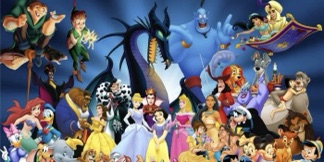
 Here is a photo for reference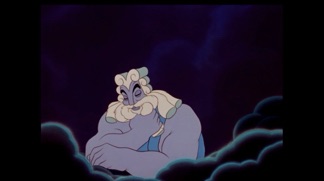
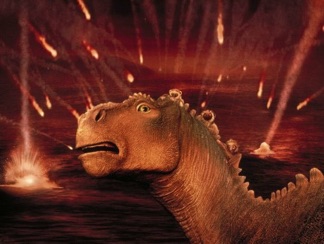

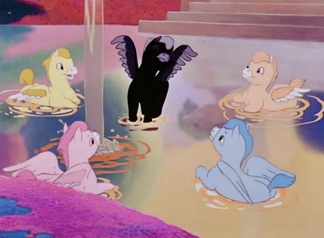


 A section of my Disney chart which shows the Atlantan Connection
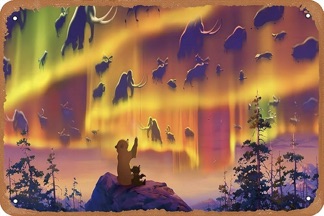 Just like we saw in the segment Pines of Rome with the humpback whales from Fantasia 2000, here we have the events of the ice age as presented in Disney’s brother Bear 1 and 2. This takes place sometime around 9,500 BC, give or take!
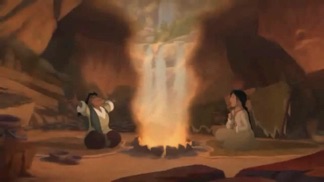 Note: another instance of magic in this timeline is with Innoko in brother bear 2 when she showed Nita a flashback vision through her magic campfire. One of the earlier recorded instances of curses as well to be honest!
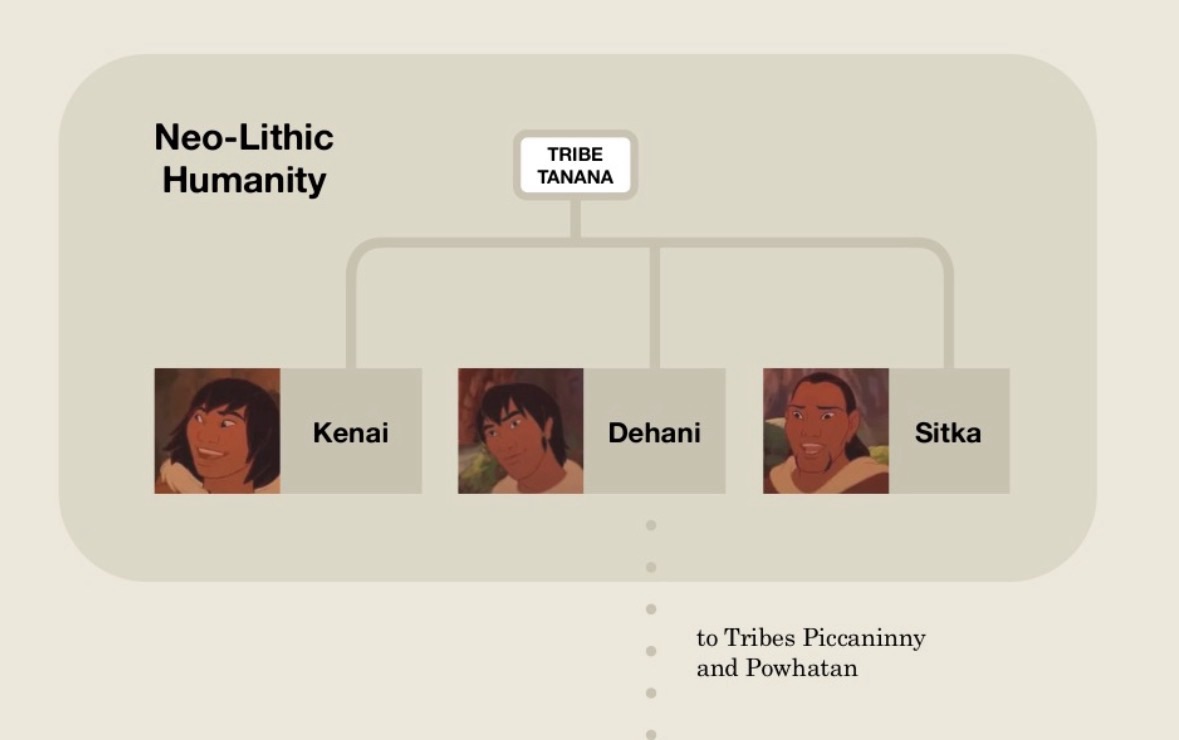 For reasons I will explain later, I show on my Disney chart how the Indians from Neverland and Pocahontas would also be descendants from this expansion.
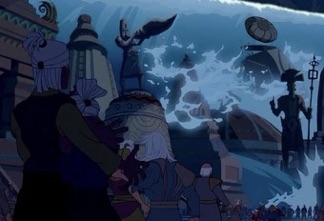 By the year 7,000 BC, Atlantis sinks due to a cataclysmic event known as the Great Flood, which was initiated by an attempt to harness the power of the Heart of Atlantis as a weapon of war. This accidental discharge caused a massive tidal wave that threatened to destroy the entire island, forcing the Atlanteans to evacuate. Although the city ultimately sank, its inhabitants, with the exception of the king’s brother, were successfully evacuated to underground shelters just in time to escape the rising waters.
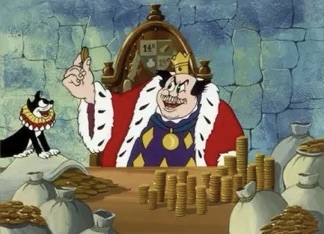
 In Aladdin 3 we actually see something similar to this with Turtle island. This specific turtle is where King Midas built his city after the great flood.
 Here on my chart you can see the relationship between Gaia and King midas
 Another Cool connection between Disney Atlantis and “A strange world” is that a book appears in the film with the Atlantan symbols. This is further proof that “A strange world” is infact apart of the D23 universe. Just like we in Atlantis 2 with that city I mentioned earlier, the surviving humans studied the ancient language as they repopulated the earth.
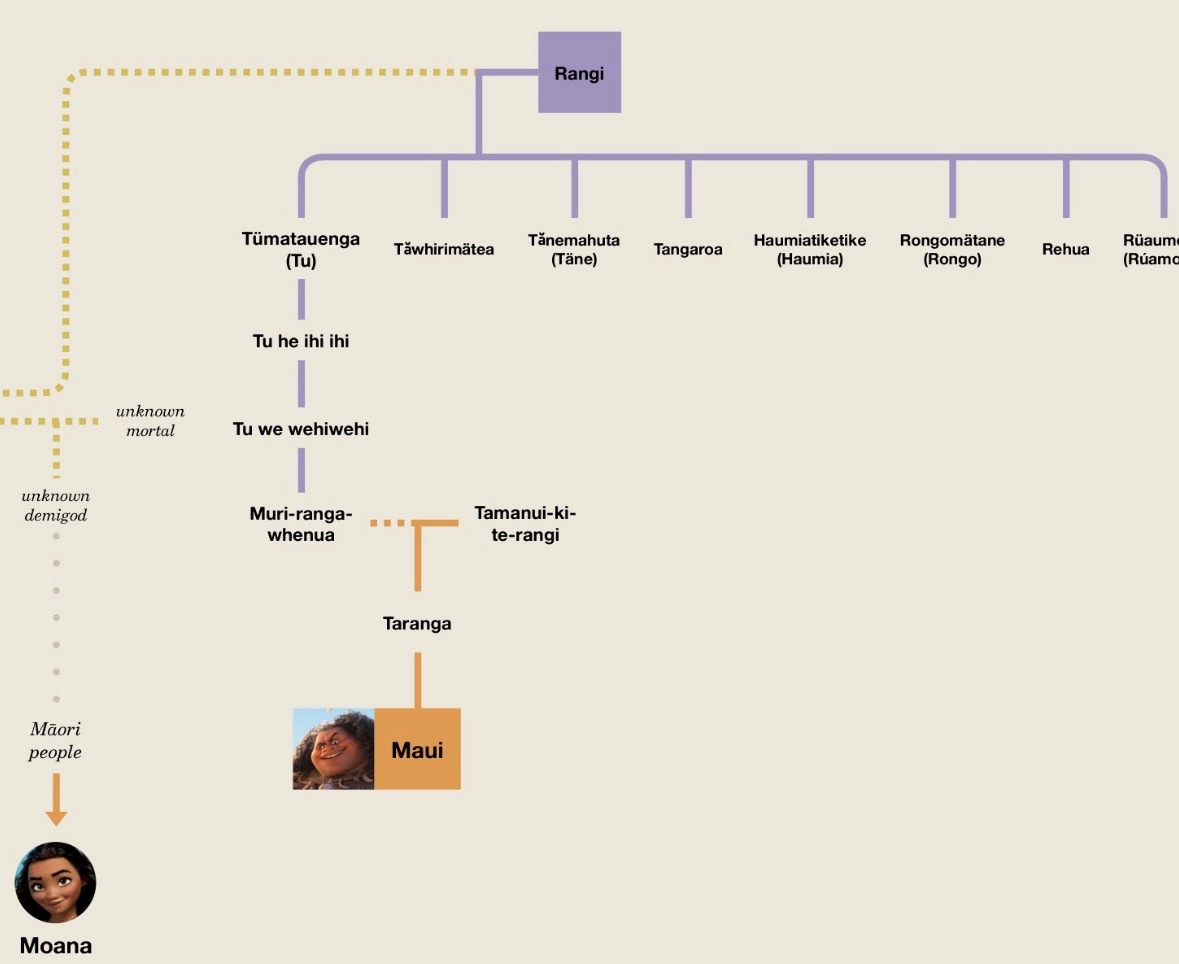 The family tree of Maui as shown on my Disney chart
 The next series of events in the D23 timeline is the Lion king. By the way here’s the list of each film:
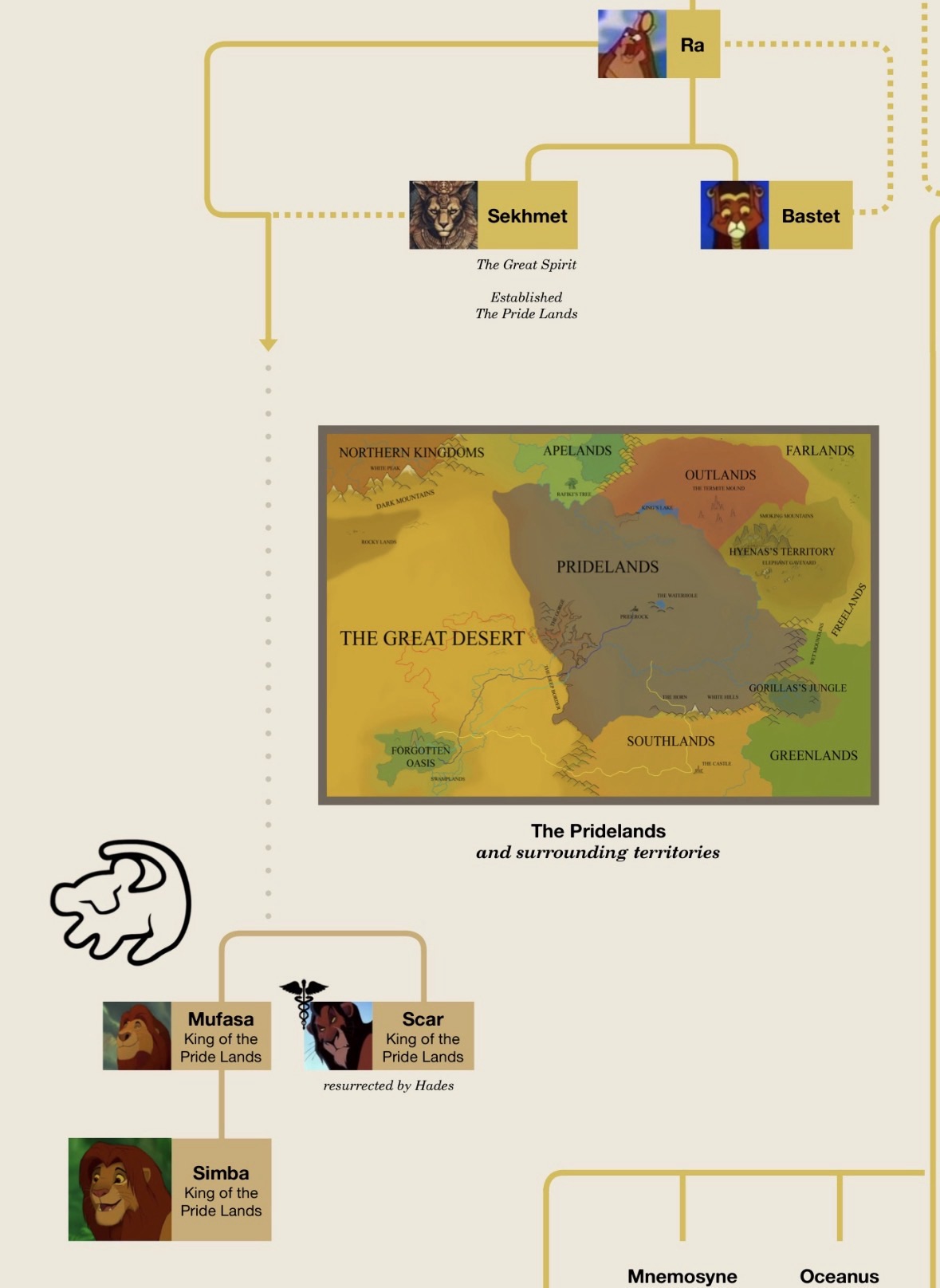 Here on my family tee chart, you can see that I have the family of Mufasa as being the creations of the “Great Spirit” as being represented by the Egyptian God Sekhmet.
 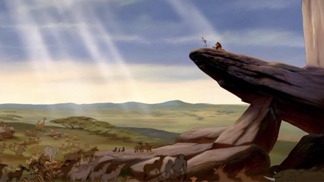 In the lion king lore, this ray of sunshine represents God to the lions of the pridelands. What’s interesting is that the Aurora also does it’s magic once again in the lion king.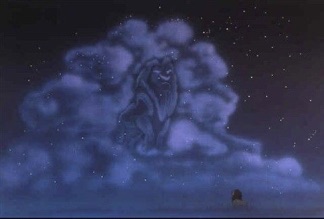
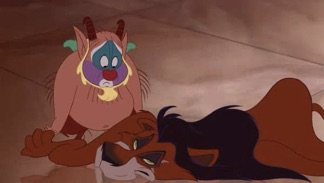 In this next part of the timeline we have Disney’s Hercules, (this also includes Hercules: The Animated Series).
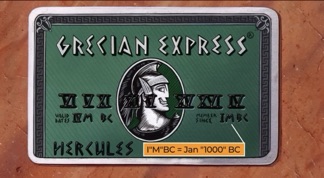 So apparently according to this credit card from Disney’s Hercules we can therefore determine that the events of Hercules in the year 1,000 BC. (Along with the lion king)!
 The Family Tree of Hercules
 In the year 800 BC, Dark entities known as Druuns spread all across the earth with the power to turn any creature into solid Stone. Though you might not be able to kill a God, but you sure can trap them inside solid rock.
 The Family of King Arthur as shown in my chart.
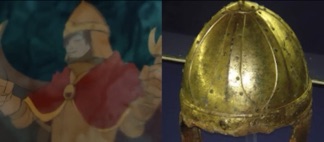 This leads us to the next Disney film, The sword and the Stone! This story is set in 500 AD in Medieval England.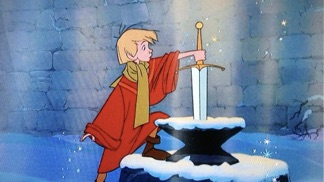

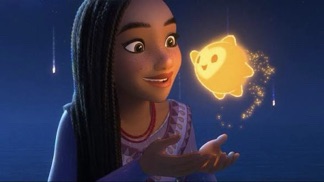 By 1200 AD, off of the southern coast of Spain we have Disney’s “Wish”. I find this film very intriguing because hope were introduced to even more magical beings such as Fairy Godmothers, Star magic and even magic mirrors. Infact, wish is a direct prequel to Snow White and the Seven Dwarfs.
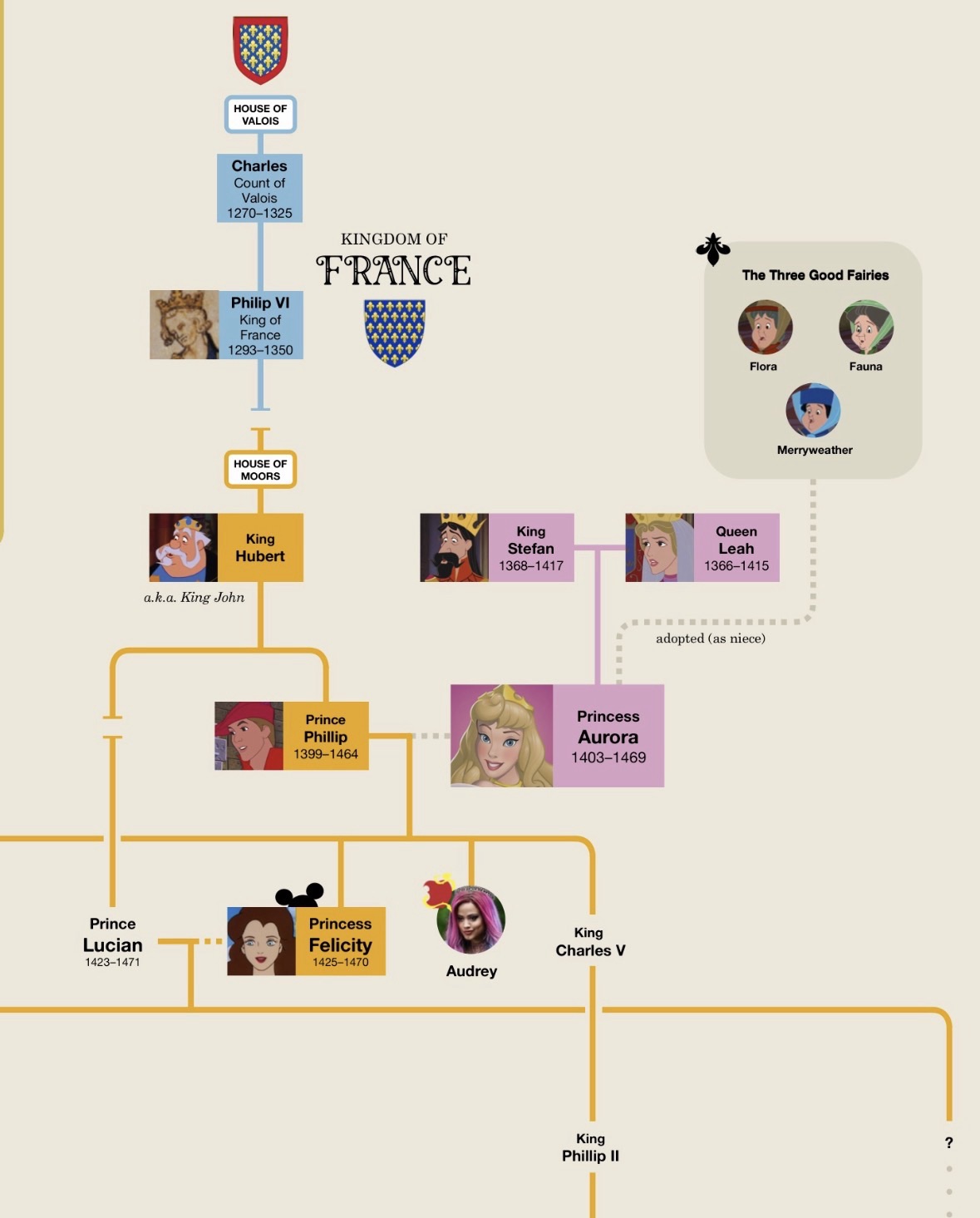 The Family of Aurora on my chart.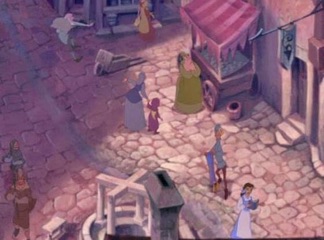
 We also know this takes place in the late 1400’s because we see a brief shot of the great wall of china and the imperial palace, which want completed until 1420 AD. In Mulan 2, we see a calendar dated to the year of the fire ox, which only occurs once every 60 years. This would place Mulan in the year 1457.
 The first thing that must be made certain is that the characters are definitely Muslim. The sultan even says “Praise Allah” so the faith of Islam has been established. Jasmine also almost loses a hand for stealing. While looking up when such practices might have started, I found that this punishment is listed in the Quran, which was written between 609 and 632 AD. So we can assume that the movie takes place after 632 when the Islamic faith was fully formed.
 Also. Apparently marvel’s infinity gauntlet is a thing in this universe for some random reason?!
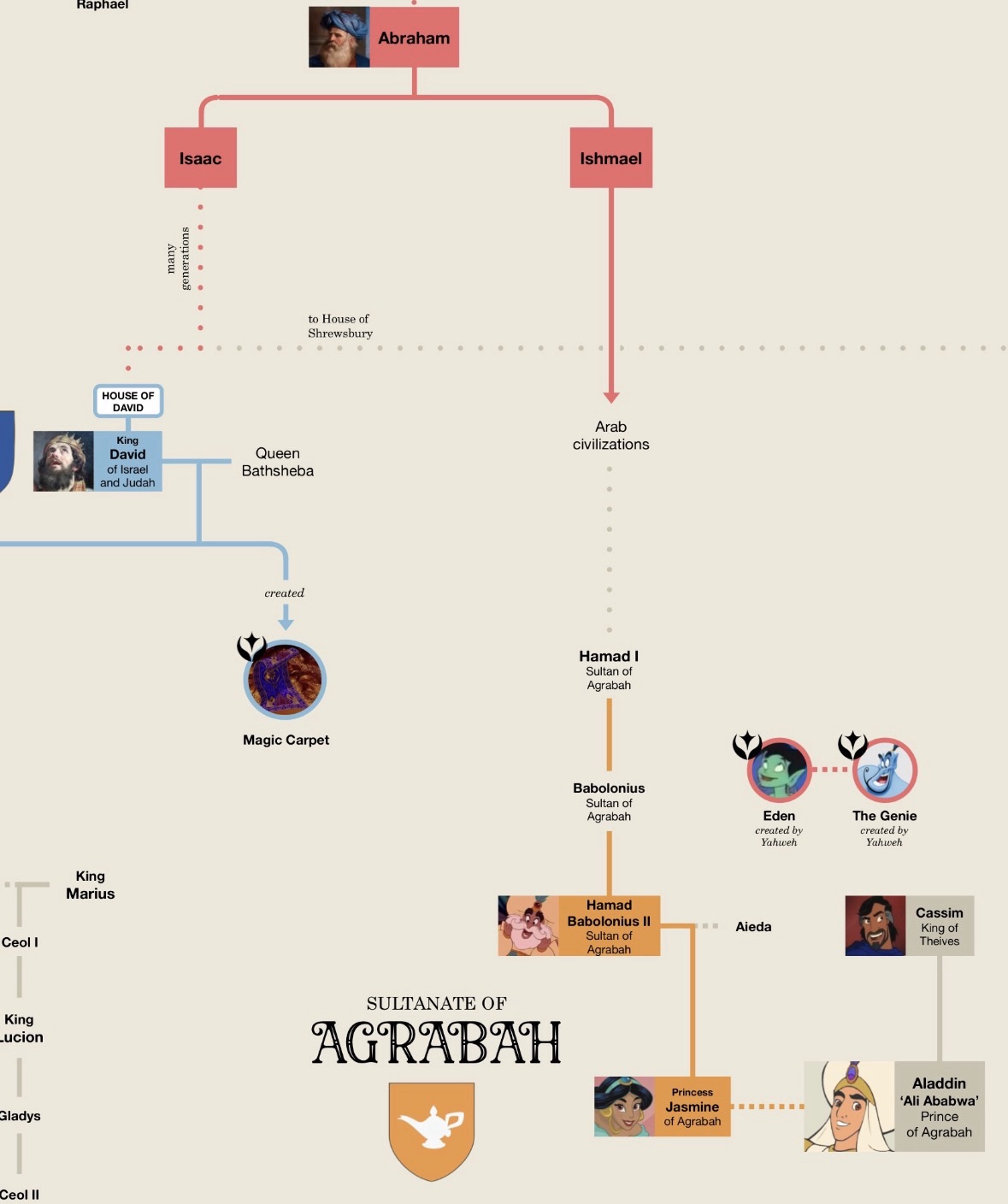 The family of Aladdin on my chart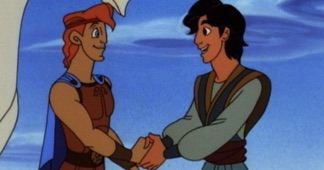
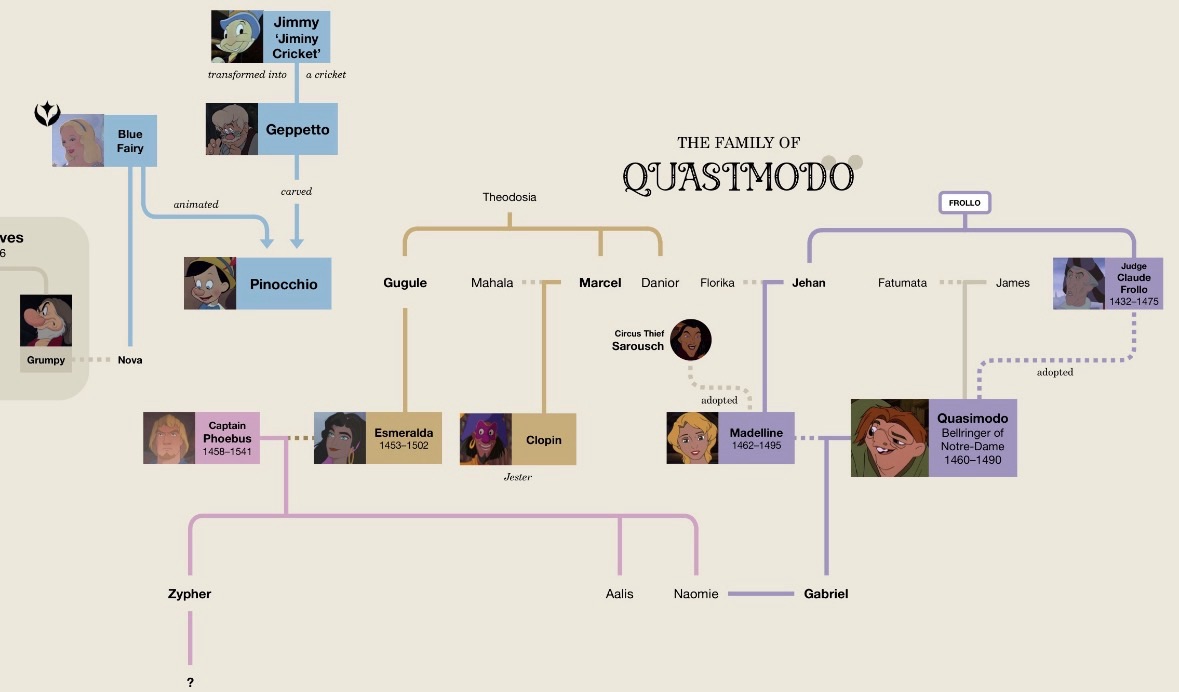 The family of Quasimodo as seen on my chart.
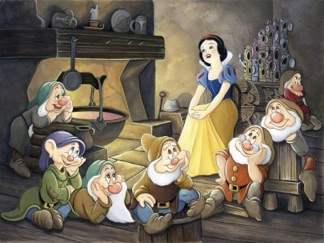 So here we are! We’ve finally reached Disney’s very first film ever released, Snow White and the seven dwarfs.
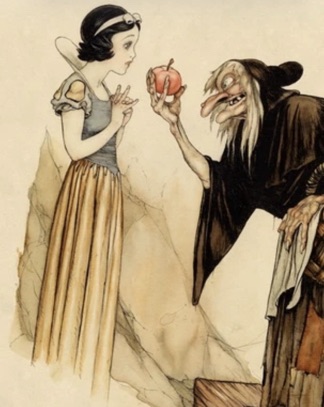 In a comic book titled “Fairest of All: A Tale of the Wicked Queen” we learn that The Evil Queen survived her brutal death.
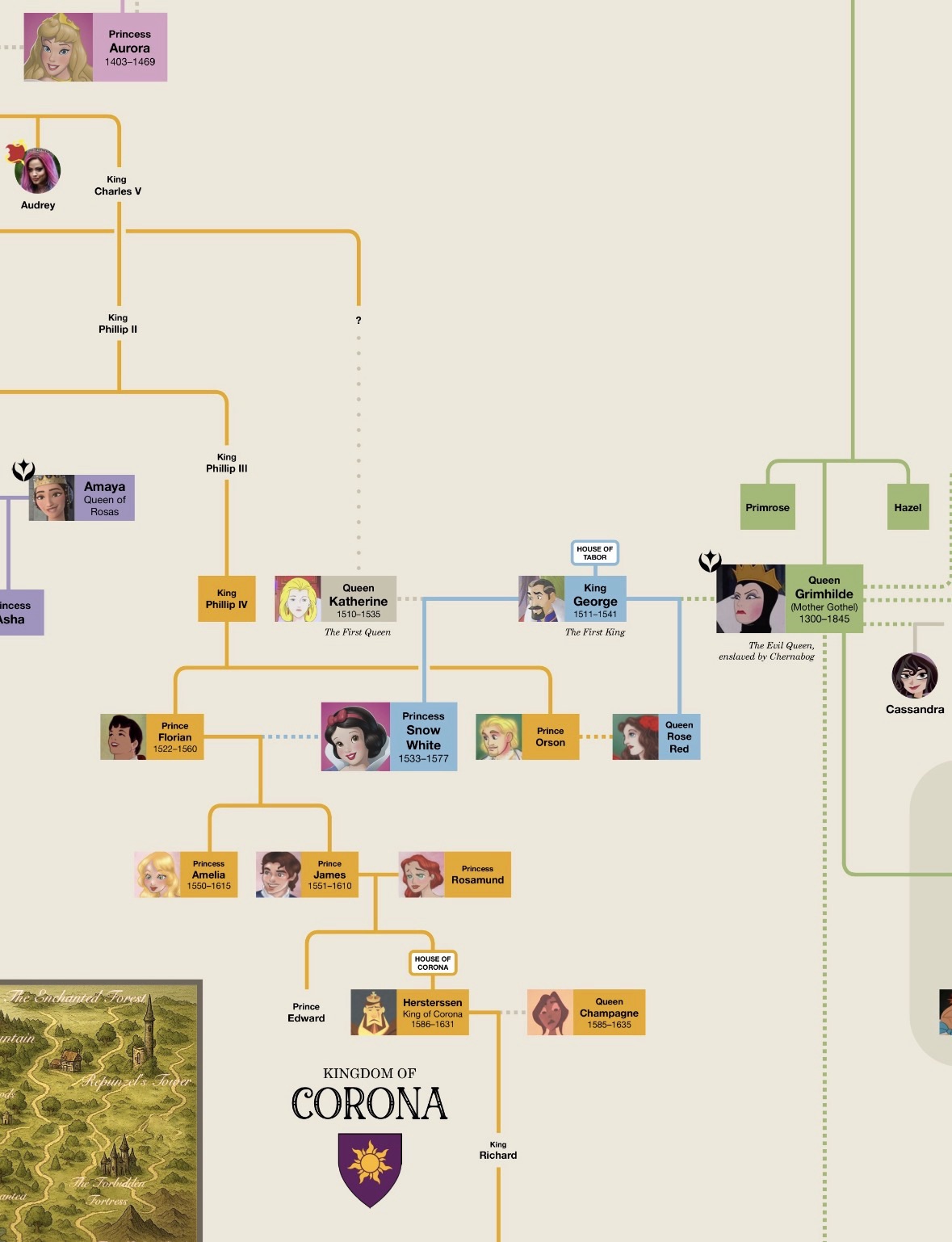 The family of Snow White on my Tree
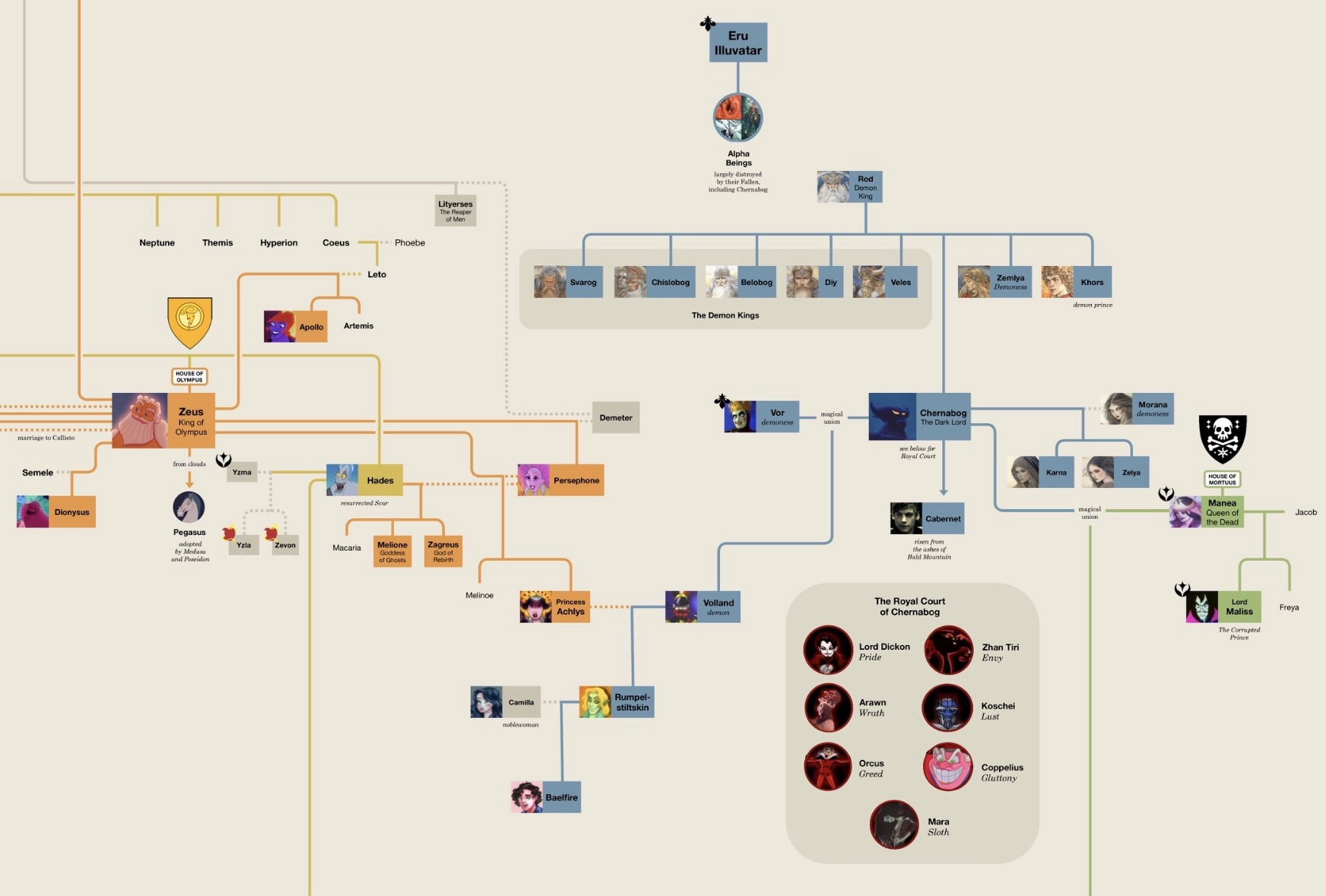 The Family of Chernabog as seen in my chart
 As seen on my chart
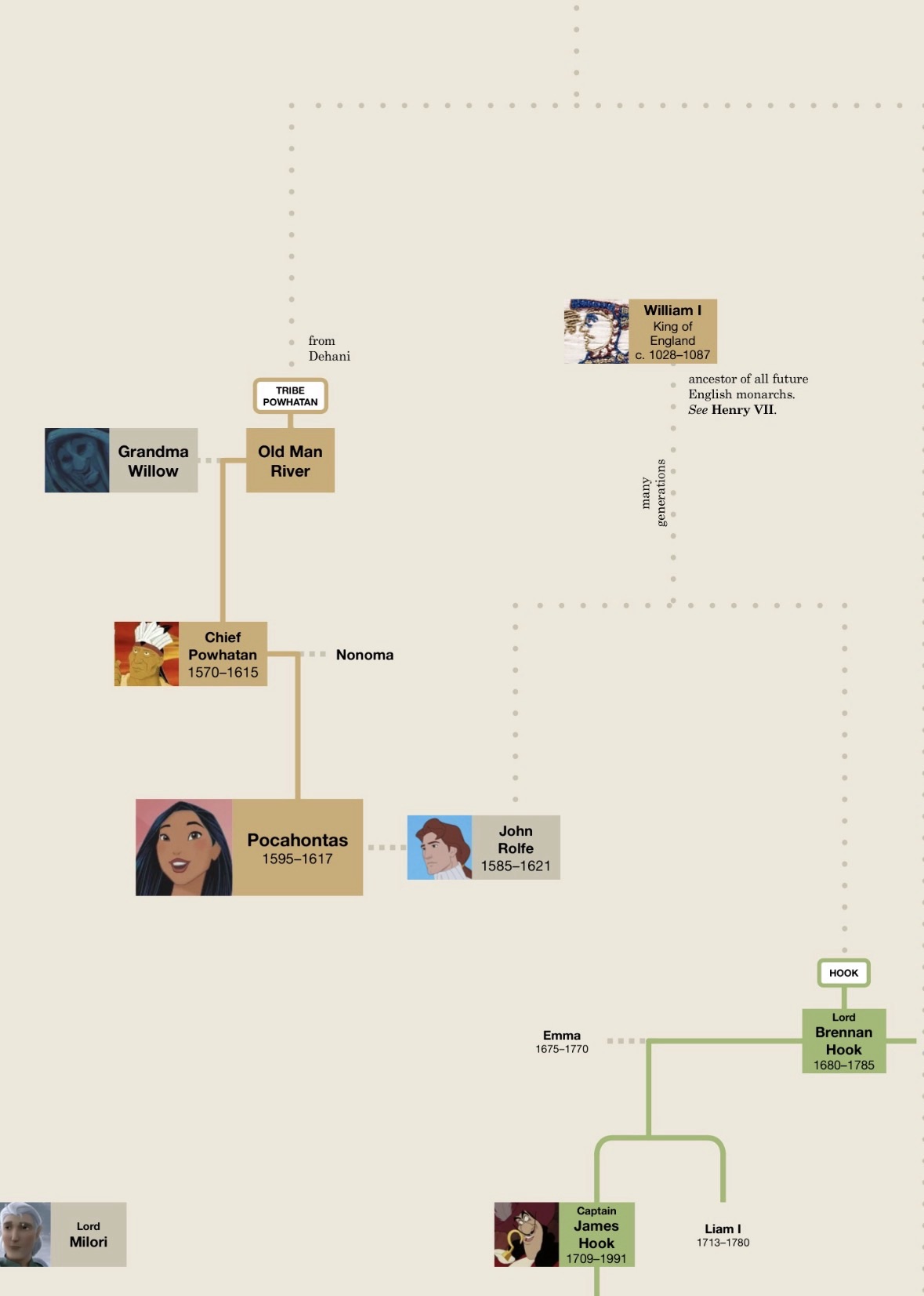 The family of Pocahontas as seen on my chart
 The family of Captain Hook as seen on my chart.
 Family of Jack Sparrow as seen on my chart
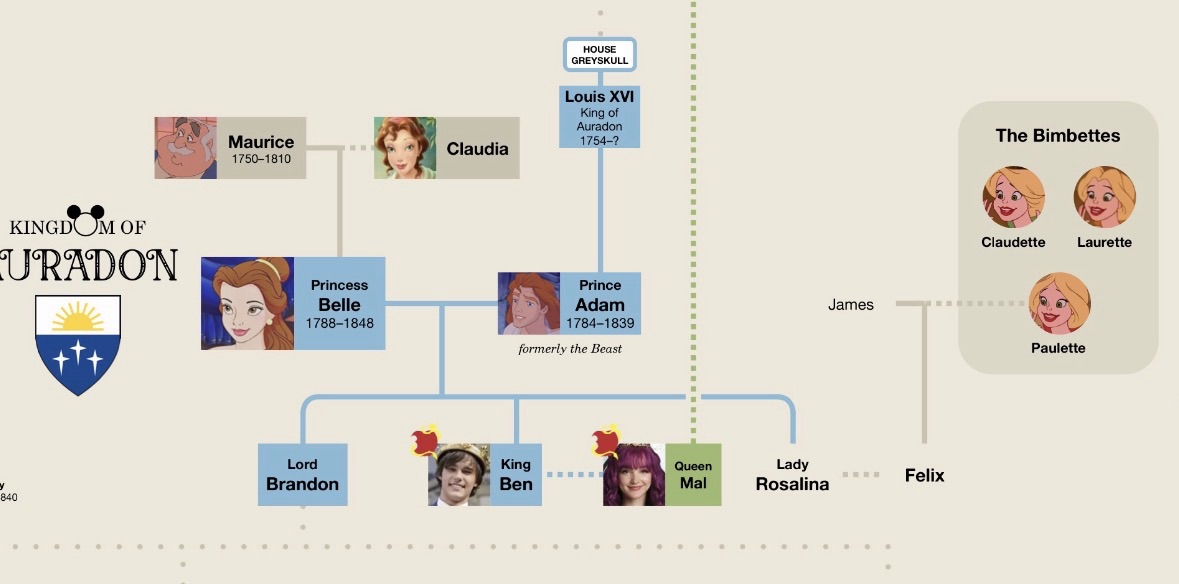 The family of Belle as seen on my chart
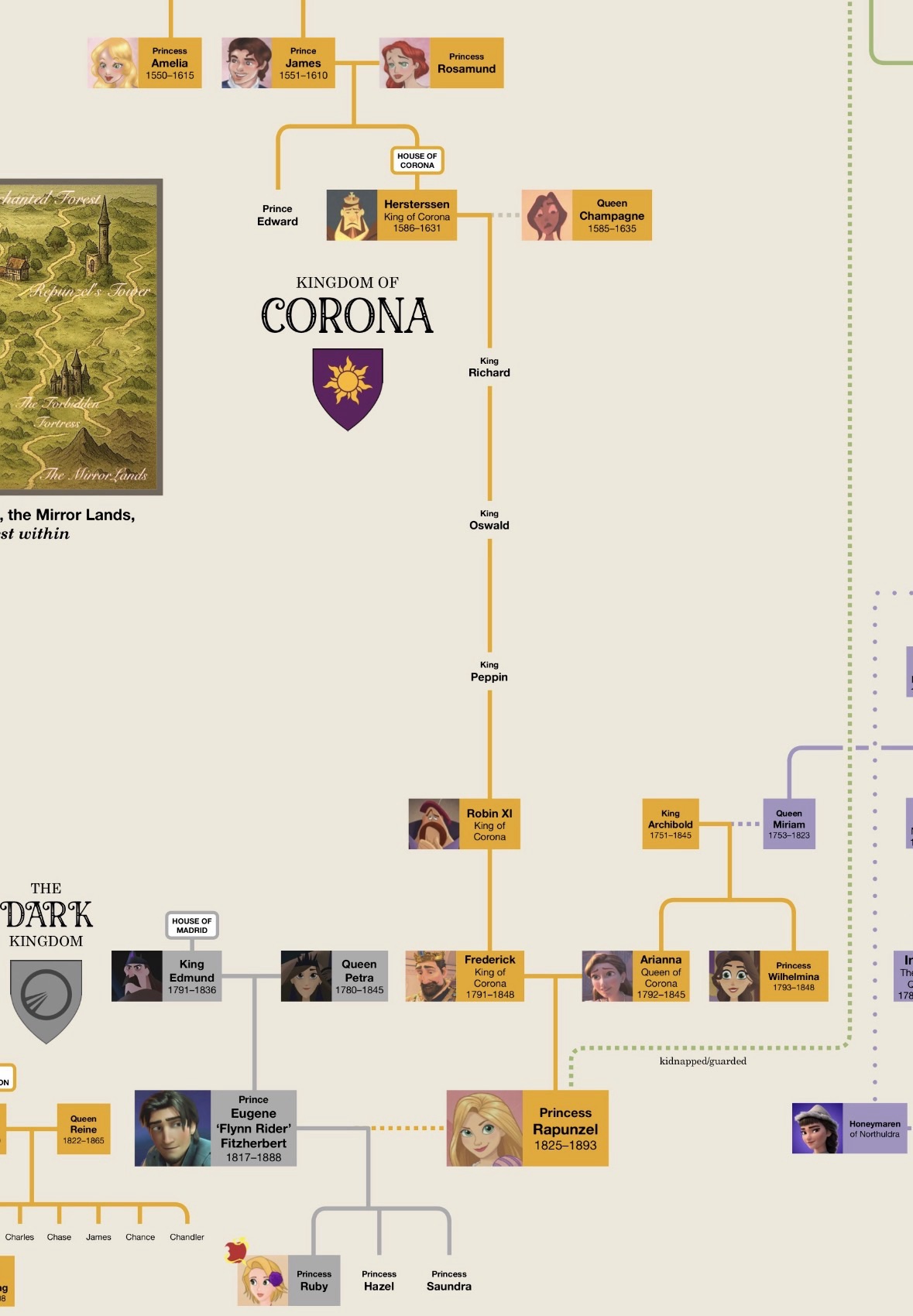 Family of Rapunzel as seen in my chart
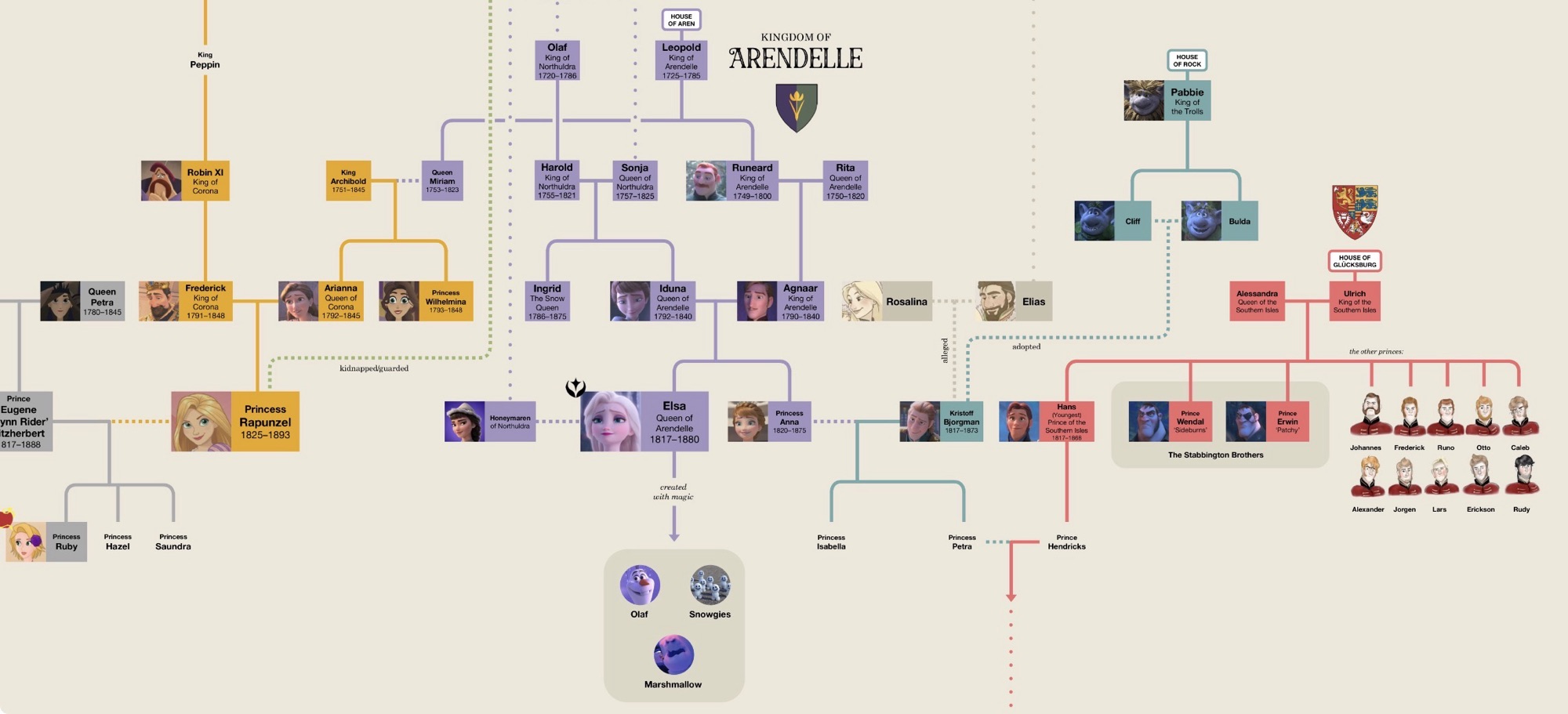 The family of Queen Elsa as seen on my chart.
 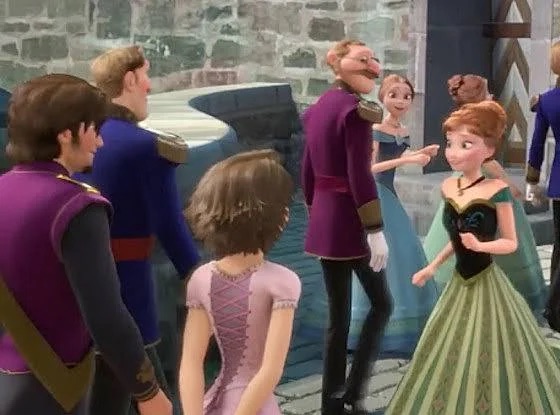 Further evidence of their connection is seen here as Rapunzel and Flynn Rider attend Elsa’s coronation party.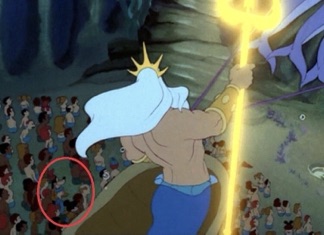
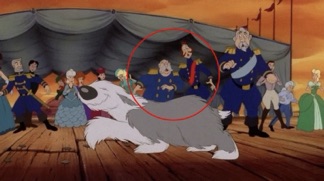

 The Family of Ariel as seen on my chart.
 Cinderella as seen on my chart.
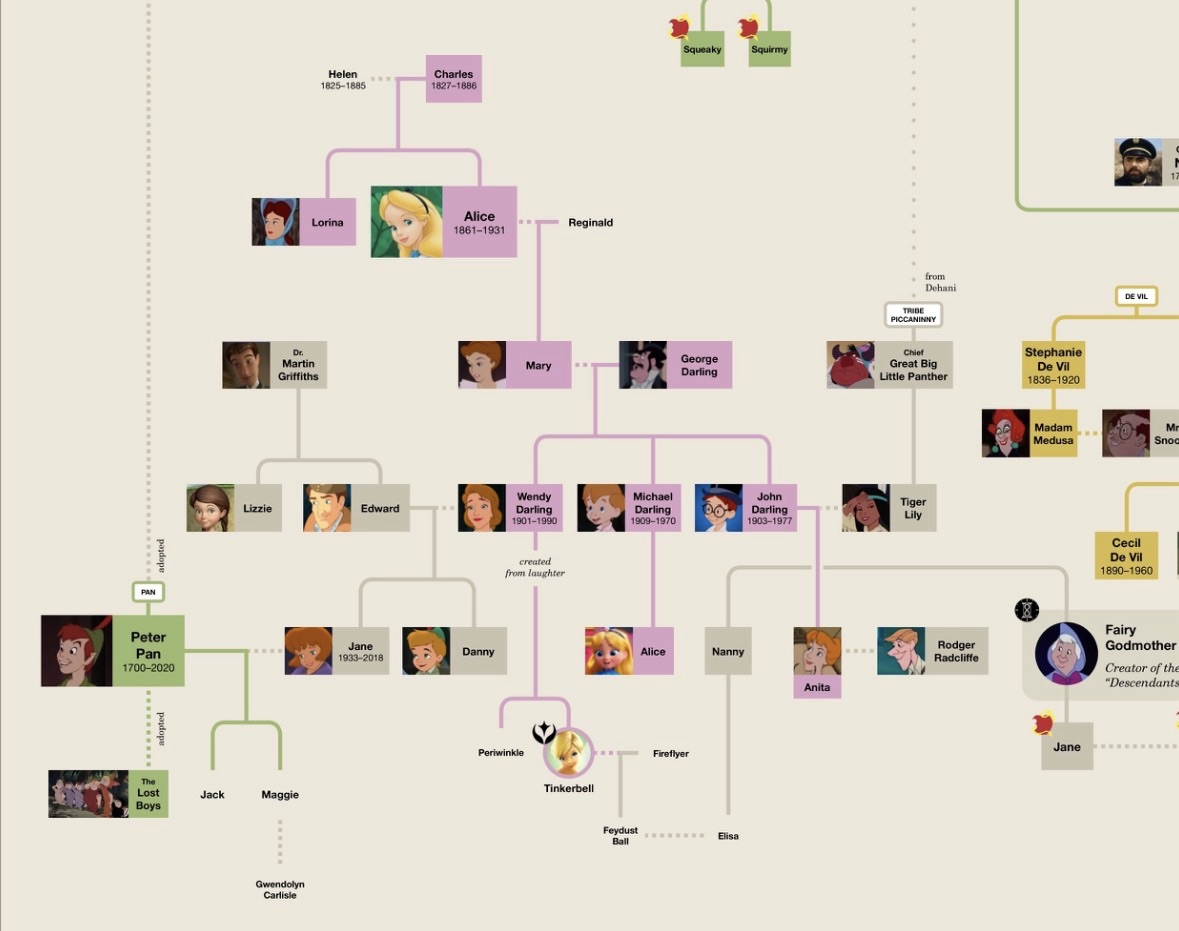 The family of Peter Pan as seen on my chart

 The family of Tarzan as seen in my chart.
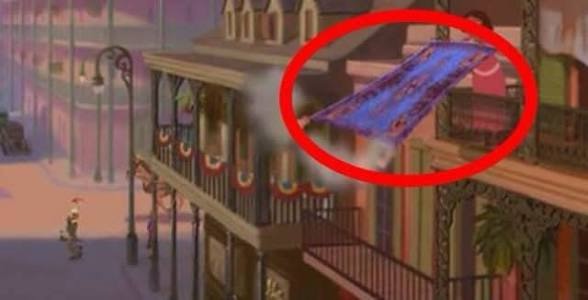

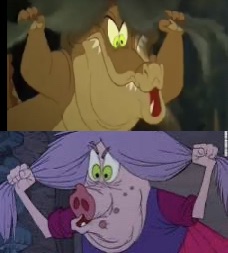
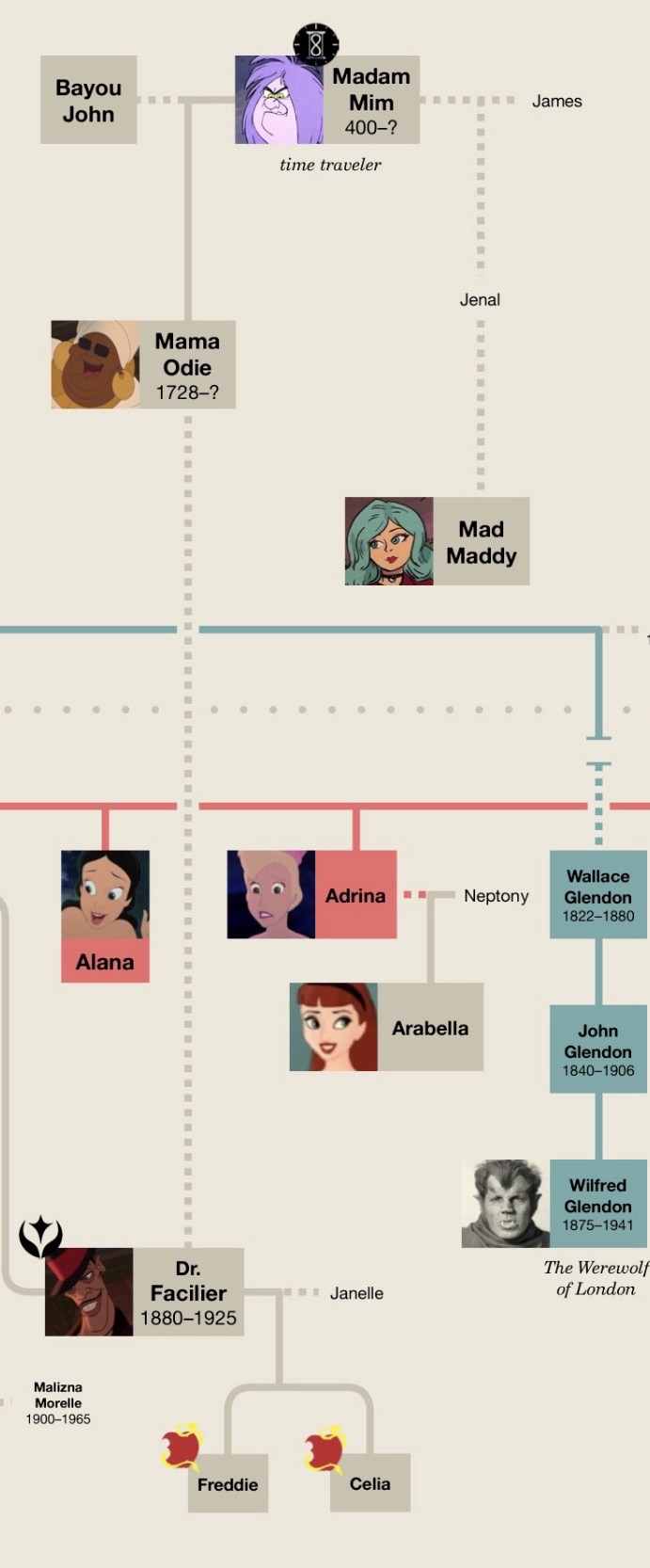
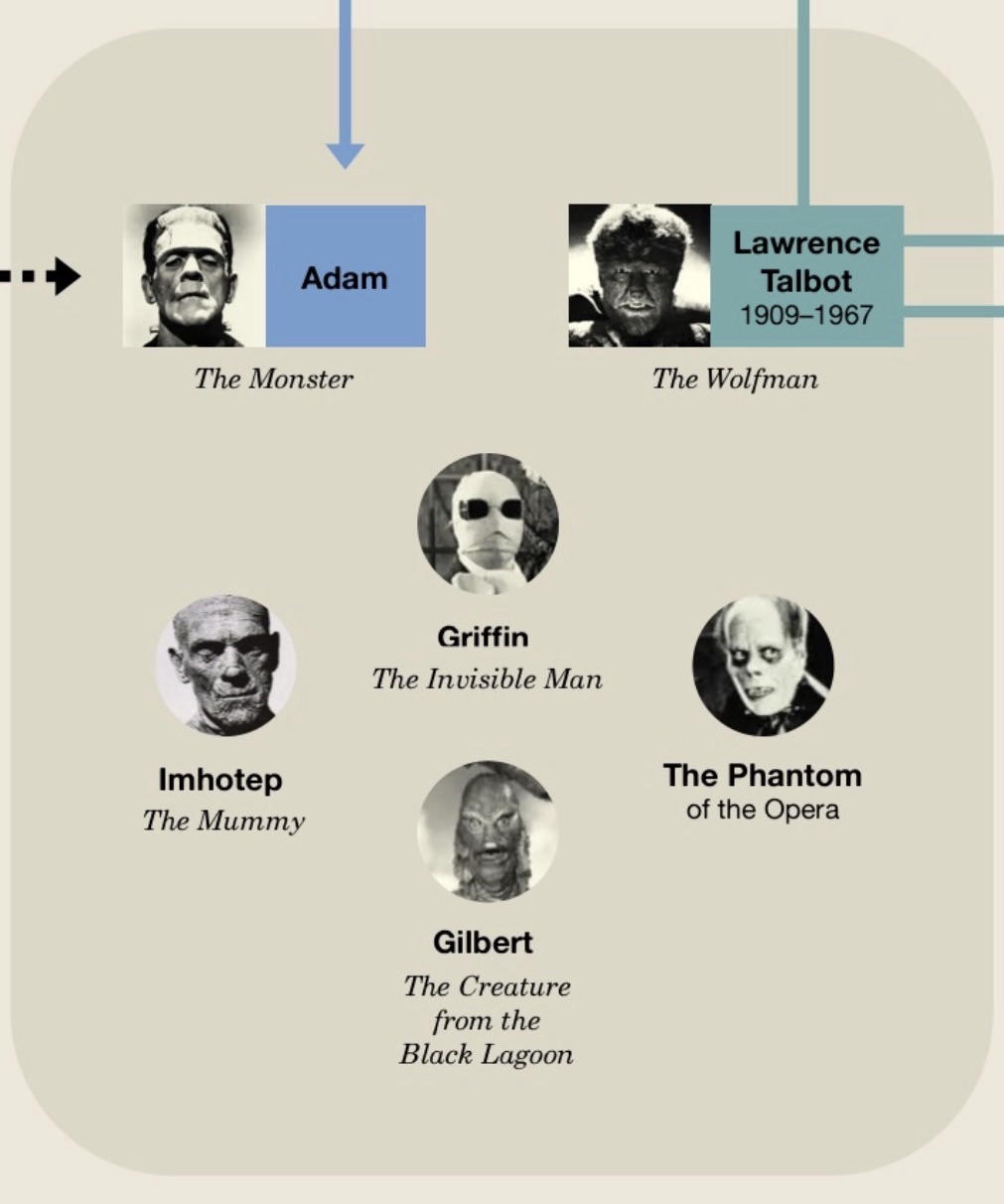 First here’s my monster mash box that shows the classic movie monsters.
 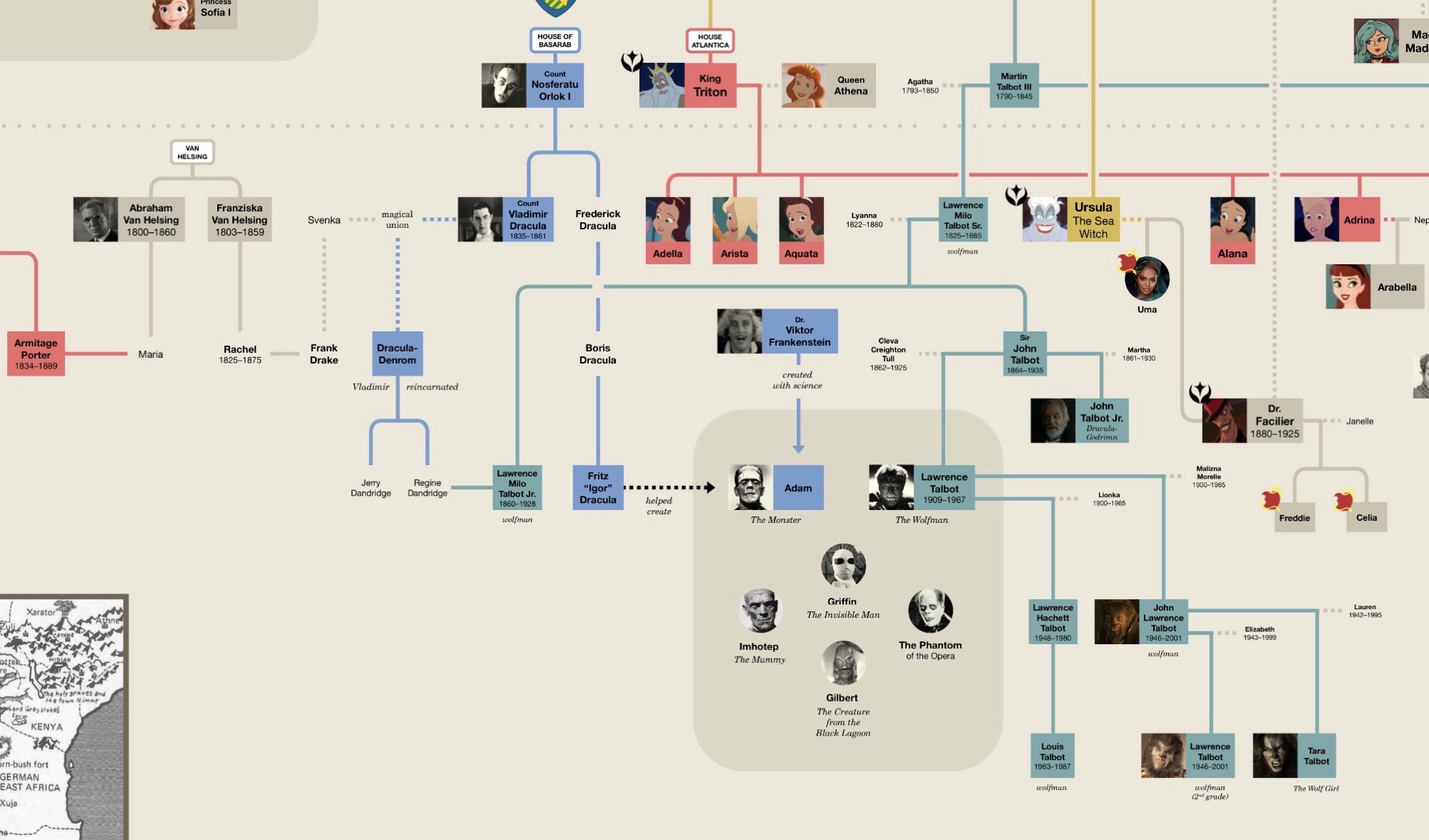 And here’s the relationship between the Wolfman, Frankenstein and Dracula as seen on my chart.
 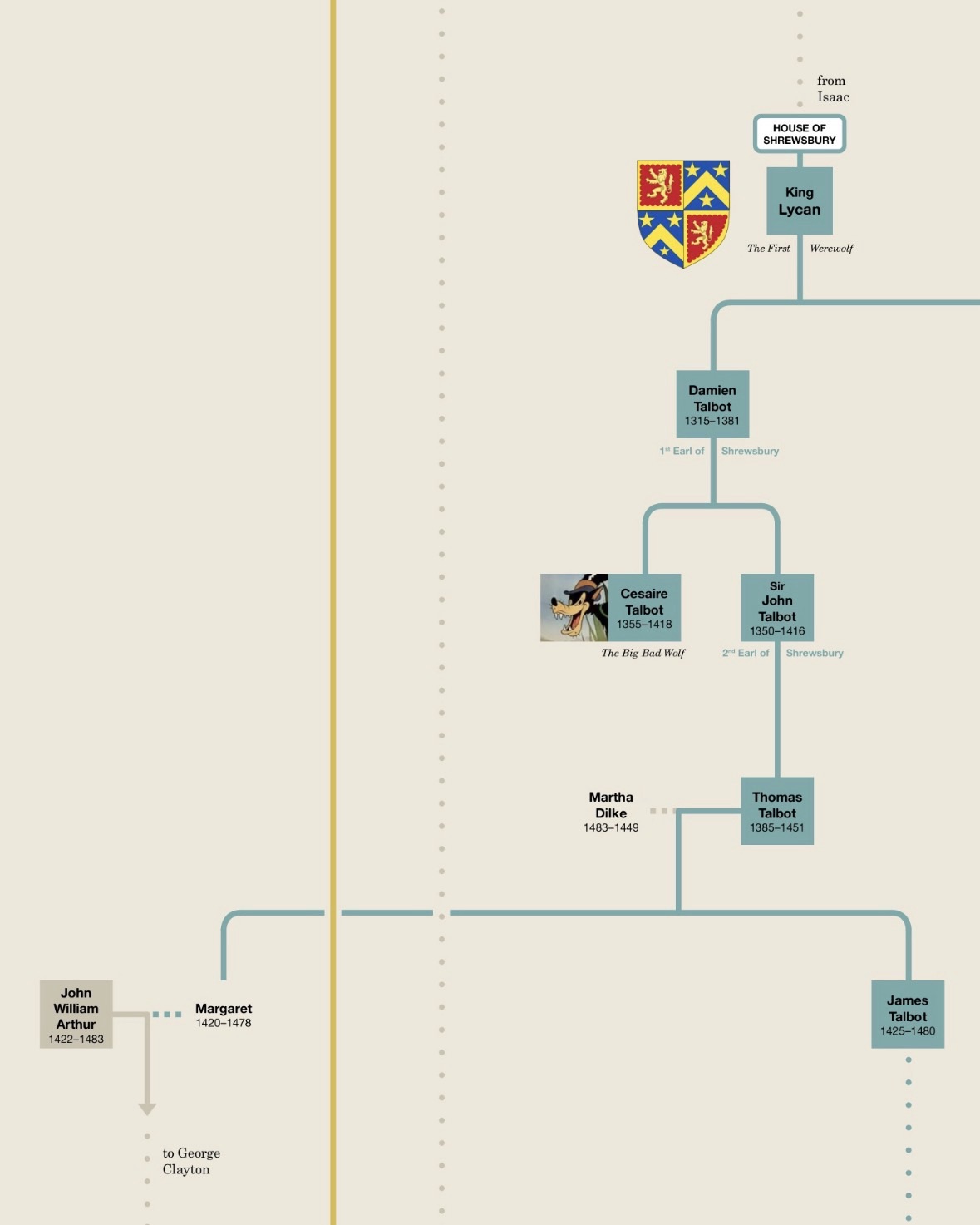 Another cool connection is that the Wolfman is a cousin to Tarzan. You can also see that they are both descendants of the big bad wolf from an early Disney film featuring the Big Bad Wolf, Little Red Riding Hood and The Three Little Pigs.









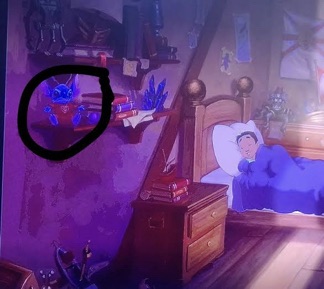

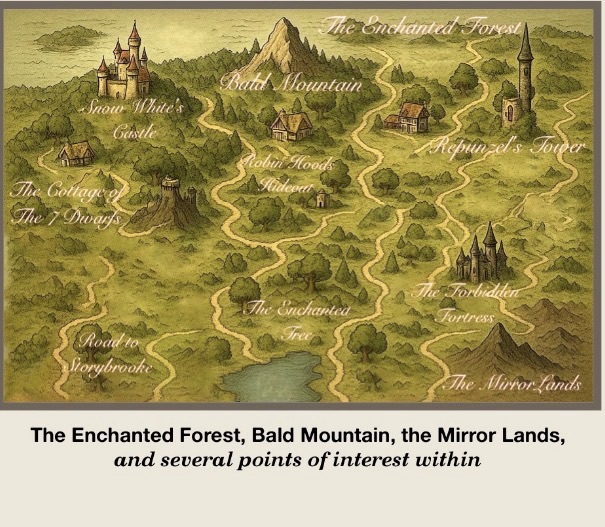 The Enchanted Forest as seen on my chart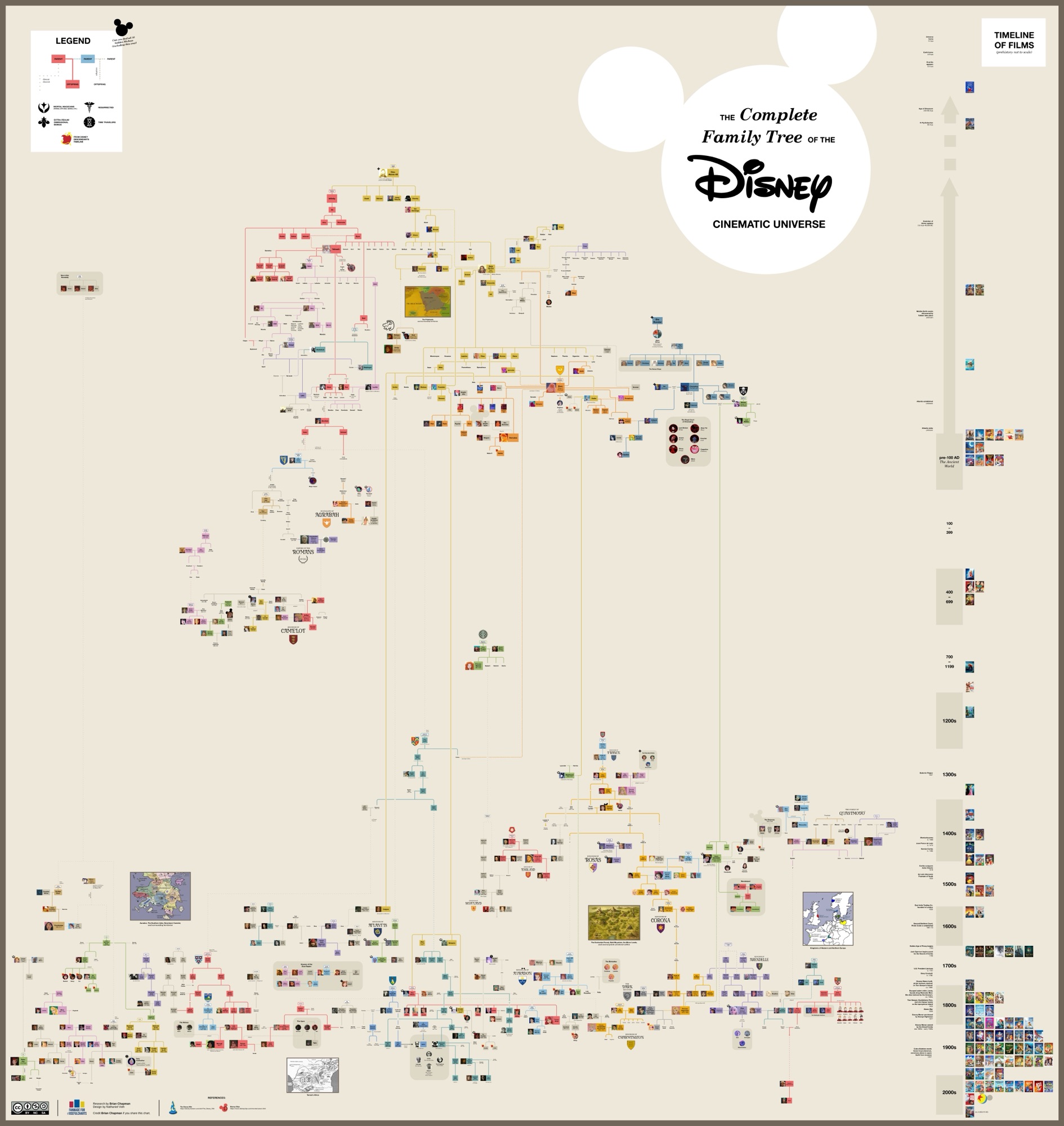



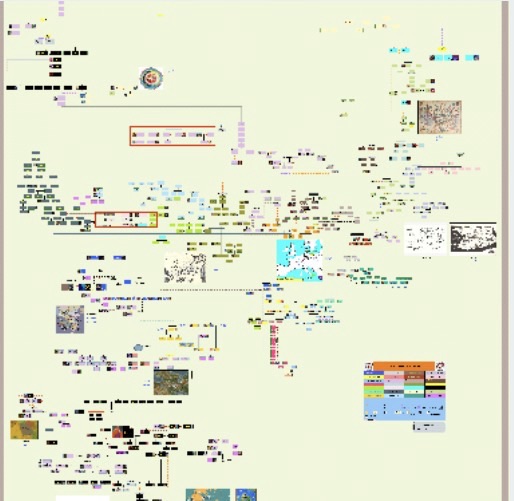


 Brian's_Biblical_Research_Guide